

From South Asia to Southeast: Pakistan’s Battle-Proven JF-17 and Shahpar Drones Eye Landmark Deal with Indonesia
A recent development that not only features the growing presence of a regional military power like Pakistan on the global defense map but also exemplifies the strengthening partnership between two...

A recent development that not only features the growing presence of a regional military power like Pakistan on the global defense map but also exemplifies the strengthening partnership between two Muslim-majority states, poised to redefine the Asian security paradigm, is the highly progressive talk between Islamabad and Jakarta over a historic agreement involving more than 40 JF-17 Thunder jets as well as Shahpar drones. This historic agreement, marked by a recent visit between Indonesian Defence Minister Sjafrie Sjamsoeddin and Pakistani Air Chief Marshal Zaheer Ahmad Baber Siddiqui, not only marks a bilateral deal but a strategic partnership between two Muslim-majority countries, aiming to redefine the Asian security paradigm.
Defense & Military Context
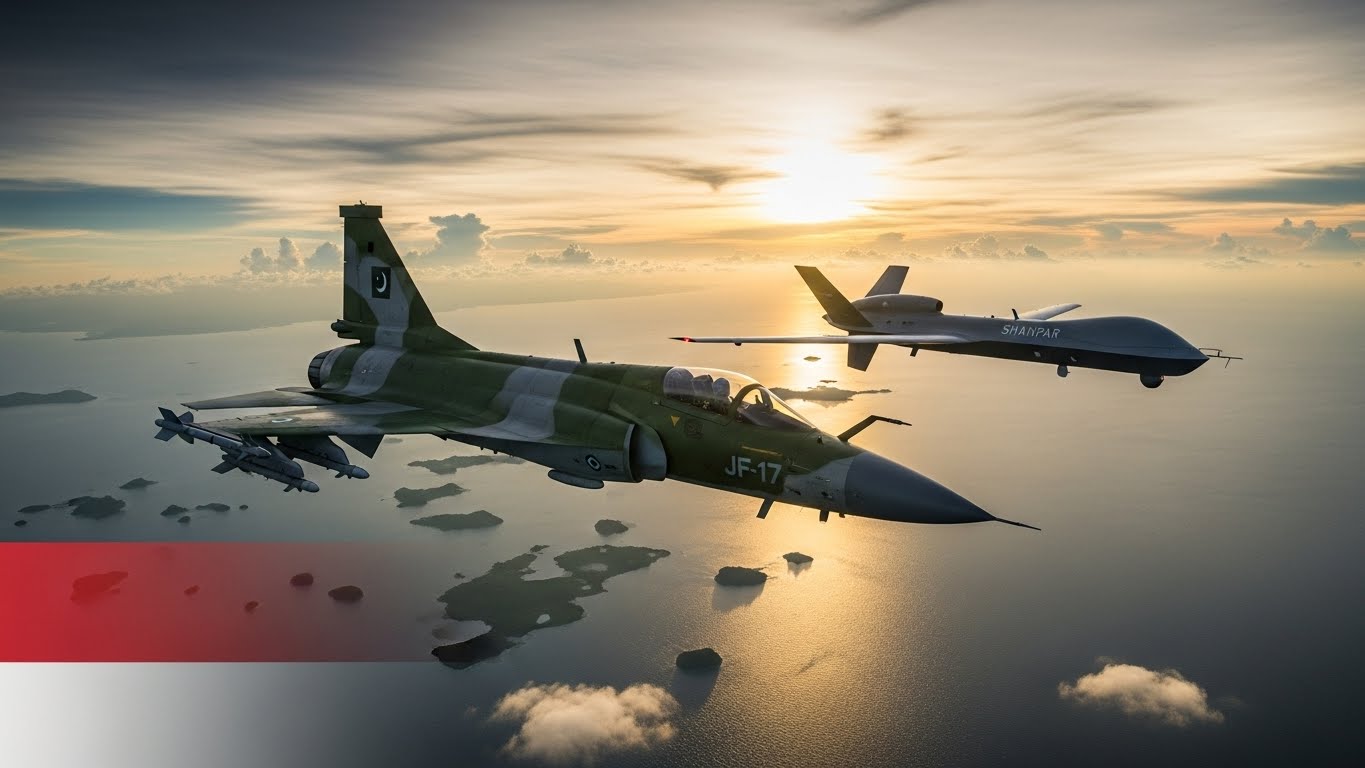
At the heart of these talks is the JF-17 Thunder, a versatile multi-role combat aircraft co-developed by Pakistan Aeronautical Complex and China’s Chengdu Aircraft Corporation. This lightweight supersonic fighter boasts some impressive capabilities: a top speed of Mach 1.6, a service ceiling of 55,500 feet, and a thrust-to-weight ratio of 1.07, thus enabling it to excel in interception, ground attack, anti-ship operations, and aerial reconnaissance. The JF-17 is fitted with state-of-the-art avionics, an AESA radar on its Block 3 variant, and an ability to deploy air-to-air missiles such as the PL-15E, air-to-surface ordnance, and guided bombs, hence representing an affordable 4.5-generation platform. With an estimated price tag of $25-50 million per unit-half the price of any comparable Western jet-it has fought its way into the service, becoming the mainstay alongside the F-16s of the Pakistan Air Force.
Supplementing the jets are the Shahpar drones of Pakistan, particularly the Shahpar-II MALE UCAV, designed for surveillance and precision strikes. Built for spying and precision-striking missions, it has a 20–30-hour endurance for Intelligence, Surveillance, & Reconnaissance missions, or 14-16 hours when armed. Its Service Ceiling stands at a maximum of 30,000 feet, line-of-sight data link of 250 km, extensible up to 2,500 km beyond line-of-sight, & a(payload) carrying capability of 125kg internal & 570 kg on six points for the Shahpar-II, enabling the use of guided missiles such as Burq for ground strikes. The acquisition by Indonesia reflects a requirement for replacement for their aging aircraft, such as their F-5 Tigers & Su-27/30 Flankers, for improved aerial superiority & maritime monitoring capabilities within their insecure region, while for Pakistan, the purchase of these aircraft marks their progressive development on the global front, having exported already to Myanmar, Nigeria, & Azerbaijan, proving their prowess for the Pakistani JF-17, already tested on actual combat missions.
Strategic Implications
This upcoming agreement has immense geopolitical implications, which labels Pakistan as an important country beyond the boundaries of South Asia and helps to fortify the defensive systems of Indonesia by means of the increasing tensions being witnessed in the South China Sea. Purchase of the JF-17 aircraft and the Shahpar drones by Indonesia will allow them to possess the ability to protect their expansive sea territory, which is necessary to stabilize the ASEAN organization. This JF-17 project is further enriched by the involvement of Chinese support and technology.
For Pakistan, this alliance marks the expansion of Islamabad’s strategic influence into the ASEAN region and is a testament to the country’s long-term strategic engagements in joint trainings, joint military exercises, and intelligence-sharing activities. This strategic move is in line with other regional developments, including Pakistan’s strategic alliances and mutual defense treaties with Saudi Arabia and Turkey. However, the emergence of new global alignment shifts has been accompanied by the signing of this Pakistan-MALP regional strategic alliance.
Industrial Angle
📄 POLICY WIRE WHITEPAPER PUBLISHED: PAKISTAN'S NATIONAL SECURITY POLICY PRIORITIES
👉 READ BY CLICKING HEREOn the economical front, it will be a windfall for the already thriving defense sector of Pakistan, whose exports have already reached record-breaking levels, valued at close to $10 billion in 2025 alone. The PAC & companies such as Global Industrial & Defence Solutions (GIDS) anticipate reaping massive profits through the sales of more than 40 JF-17 aircraft & Shahpar drones, which could potentially extend to multiple years, including technological licensing & maintenance services. This is expected to provide massive employment opportunities to thousands of people related to the aerospace & engineering sectors.
In the face of economic difficulties, such exports are important foreign exchange earners, lessening the need for financial bailouts from the IMF. The recent agreement with Libya for $4.6 billion in exports and with Sudan for $1.5 billion, among others, goes to show that Pakistan’s cost-effective, ‘battle-tested’ equipment is increasingly taking over the world market, from Africa to the Middle East. It provides modernization on favorable terms for Indonesia and boosts the credentials of Pakistan.
Indonesia’s Ministry of Defense has reported that the meeting is in the context of the ‘strategic dialogue’ and that there has been no final decision yet. This was stated by Indonesia’s Brigadier General Rico Ricardo Sirait, citing the enhancement of institutional links and mutual benefits. This was similarly reported by the Pakistani Military, which has pointed out the discussions in relation to regional security and the expansion of bilateral defense-related cooperation. On the development, sources have reported it to be at an advanced stage but with quotes from unnamed people.
Conclusion
In case these negotiations materialize in signed agreements, the defense cooperation between Pakistan and Indonesia will permit the latter to enhance its strength in terms of its military capabilities and help consolidate the latter’s position in Asia as the most favored defense export supplier in the continent. This partnership is set to change the complexion of this region of the world because of its ability to guarantee prosperity in the field of innovation. In the new world order that is expected to become multipolar, this move will help prove the wisdom of Pakistani policy makers and intelligence.
Author