


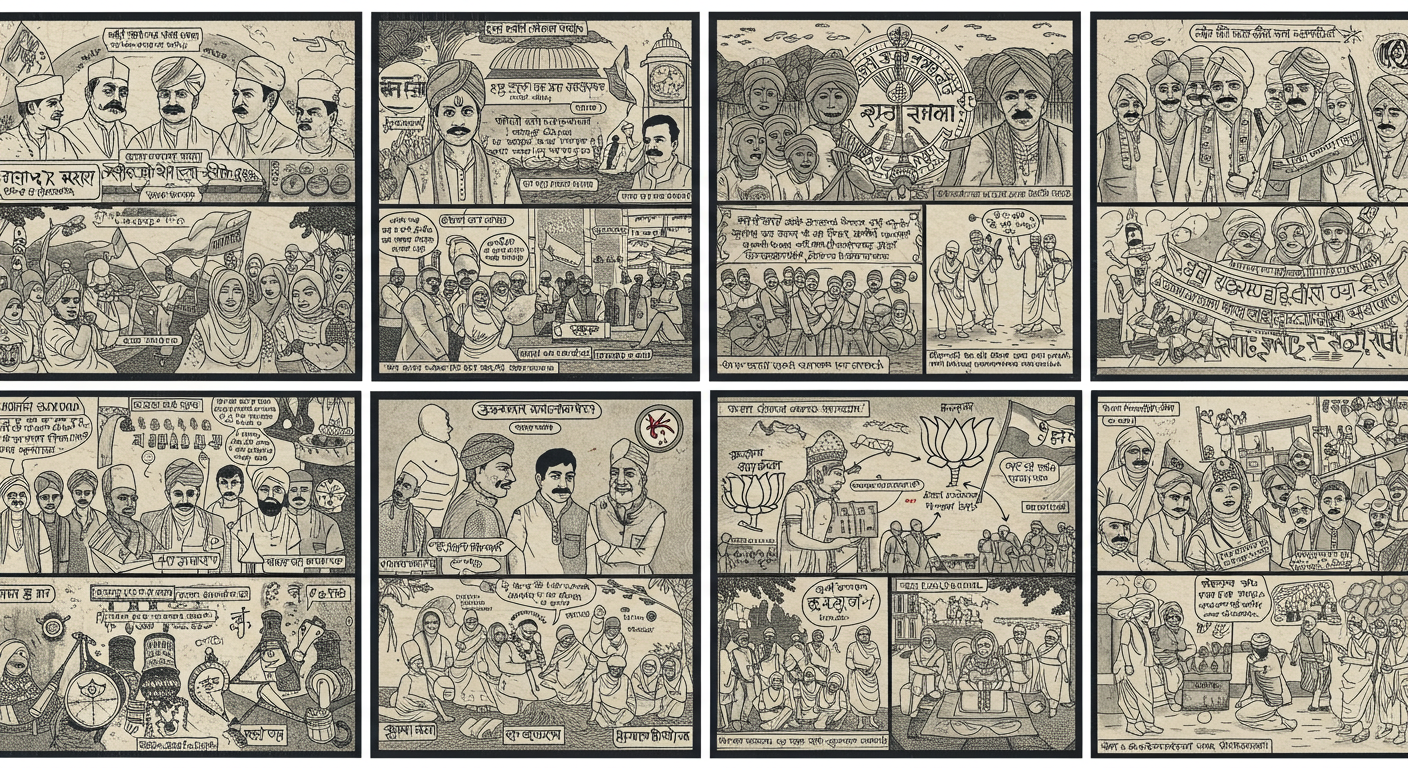
From Soft to Hard: The Evolution of Neo-Hindutva under Modi’s India
Neo-Hindutva is not merely a repackaging of Hindu nationalism. It is a calculated, evolving project of cultural dominance, institutional capture, and global narrative warfare. What began as a subtle,...

Neo-Hindutva is not merely a repackaging of Hindu nationalism. It is a calculated, evolving project of cultural dominance, institutional capture, and global narrative warfare. What began as a subtle, seemingly inclusive articulation of Hindu identity under Narendra Modi’s first term has now transformed into an assertive, often violent, civilizational reordering of India’s political and social fabric. This ideological mutation, from ‘soft’ to ‘hard’ Hindutva, marks not only a dangerous shift in India’s internal dynamics but also raises profound questions about the future of democracy, secularism, and pluralism in the world’s largest democracy.
Christopher Jaffrelot and Arjun Appadurai have long warned about the ideological elasticity of Hindutva, its ability to masquerade as developmental nationalism while embedding deep majoritarian instincts. But it is Thomas Blom Hansen’s concept of “the saffron horizon” and Benedict Anderson’s dual typology of Neo-Hindutva that provide the most surgical insight into how the Modi regime has operationalized this duality. Anderson (2018) argues that Neo-Hindutva exists in two categories: “soft,” which maintains a façade of secular or inclusive governance, and “hard,” which openly allies with Hindu nationalist politics and the Sangh Parivar’s ideological foundations. Modi’s India has not just embodied this shift. It has accelerated it with brutal efficiency.
In his first term (2014–2019), Modi projected a vision of India that balanced technocratic modernity with cultural rootedness. The discourse of “Sabka Saath, Sabka Vikas” (Together with all, development for all) was emblematic of this soft Hindutva, a political code that allowed for cultural majoritarianism without explicitly invoking it. The cow protection rhetoric was couched in “animal rights.” The promotion of Sanskrit and yoga was framed as “heritage preservation.” The saffronisation of school curricula was dismissed as “curriculum correction.” Soft Hindutva operated beneath the surface, encoding Hindu supremacy in policies that appeared secular at first glance.
However, the 2019 electoral landslide changed everything. With parliamentary dominance secured, Modi’s administration swiftly discarded its soft mask. In came the Citizenship Amendment Act (CAA), which for the first time in independent India’s history, linked citizenship to religion. The National Register of Citizens (NRC) was trialed in Assam, disproportionately targeting Muslims. The abrogation of Article 370, without Kashmiri consent or consultation, revealed an openly Hindu majoritarian assertion over a Muslim-majority region. The Ayodhya verdict, while judicial in form, was celebratory in tone. BJP leaders invoked divine providence rather than constitutional restraint.
This transition to hard Neo-Hindutva is not just legislative. It is deeply psychological and symbolic. The state has become the custodian of Hindu civilizational pride, and dissent is increasingly equated with betrayal. From the bulldozer politics of Uttar Pradesh to the banning of halal meat and hijabs in Karnataka, the performance of Hindutva is now street-level, televised, and algorithmically weaponized.
Neo-Hindutva’s hard version thrives not only through state power but through cultural engineering. Bollywood is being rewired to erase Muslim contributions and glorify Hindu kings. University campuses, once bastions of critical thinking, are being purged of dissent through a combination of surveillance, funding cuts, and orchestrated harassment. The National Education Policy 2020, although clothed in reformist language, subtly inserts Vedic references and Sanskrit primacy while ignoring the histories of India’s marginalized.
Importantly, this hardening of Hindutva is not confined within Indian borders. Neo-Hindutva has global ambitions. In the diaspora, particularly in the United States, Canada, and the UK—Hindu organizations aligned with the RSS propagate a sanitized, diasporic version of Hindutva that presents it as a civil rights movement for “oppressed Hindus.” This is Anderson’s soft version again, strategically detached from the violence and discrimination unfolding in India, but enabling it all the same.
What makes Neo-Hindutva especially dangerous is its ability to alternate between these soft and hard modalities. It is both a movement and a masquerade. It speaks the language of “civilizational revival” while practicing the politics of exclusion. It wears the clothes of democracy while hollowing out its foundations.
The implications are chilling. India is no longer a secular republic in aspiration. It is a Hindu Rashtra in motion. Muslims are citizens in name but suspects in practice. Christians are accused of “conversion conspiracies,” Sikhs are disloyal “Khalistanis,” and Dalits are co-opted only when they serve saffron agendas. Dissenting Hindus, journalists, activists, students: are branded “urban Naxals” or “anti-nationals.” The secular constitutional identity of India has been replaced with a civilizational narrative that demands obedience to a singular culture, religion, and worldview.
This shift from soft to hard Hindutva is not an aberration. It is the design. It is the logical endpoint of a long-gestating ideological project that was born in the writings of Savarkar, organized by Golwalkar, mainstreamed by Advani, and perfected by Modi. It is not accidental. It is algorithmic, symbolic, performative, and deeply embedded in the state’s machinery.
For the international community, silence is complicity. The West’s strategic embrace of India as a counterweight to China has blinded many to the erosion of rights within the country. Multinational corporations celebrate India’s market size while ignoring the shrinking civic space. Academics in the West who once studied authoritarianism abroad must now reckon with its unfolding within the heart of the world’s so-called largest democracy.
Neo-Hindutva has become India’s new normal. Unless this ideology is dismantled, through global pressure, domestic resistance, and intellectual deconstruction, the republic envisioned by Ambedkar and Nehru will continue to be eclipsed by a theocracy built not on unity, but on exclusion.
This is not just India’s internal crisis. It is a cautionary tale for the world. Democracy, when paired with majoritarian ideology, can destroy itself from within, quietly at first and then all at once.
Author