


From Derision to Dominion: Arsenal’s Ascent Redraws Premier League Power Map
POLICY WIRE — London, England — It wasn’t long ago that the internet was awash with images of a fan—a particular fan—drinking from a bottle conspicuously labeled ‘Arsenal Tears.’...

POLICY WIRE — London, England — It wasn’t long ago that the internet was awash with images of a fan—a particular fan—drinking from a bottle conspicuously labeled ‘Arsenal Tears.’ Erling Haaland, Manchester City’s prodigious striker, had even cast a withering assessment via Snapchat, deeming the North London club ‘boring.’ Yet, in the labyrinthine world of elite football, narratives shift with the bewildering speed of a politician’s policy stance. And sometimes, (just sometimes) ridicule precedes a rather dramatic resurgence.
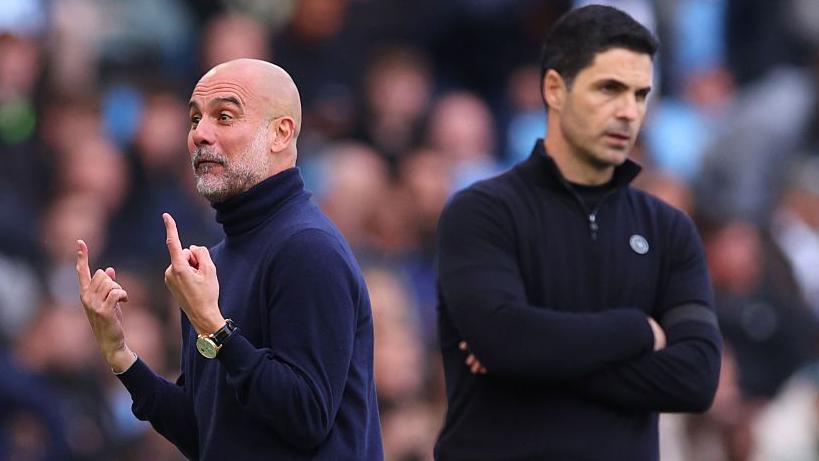
So it was that Arsenal, weathering a fortnight of sneering disdain that saw them briefly dethroned from the summit of English football for the first time in 209 days, reasserted a precarious, yet consequential, dominance. Their emphatic 3-0 dispatch of Fulham hasn’t merely added three points to their tally; it has profoundly recalibrated the Premier League’s most captivating title joust. They now stand six points clear of Pep Guardiola’s Manchester City, though City holds two games in hand—a mathematical caveat that belies the psychological heft of the current standings.
Still, the Gunners, managed by the often-intense Mikel Arteta, have only three league fixtures awaiting them. Manchester City, by contrast, faces a more congested and, arguably, more formidable gauntlet of five encounters. The margins are, to borrow a phrase from the tacticians, infinitesimal. Defeats to Bournemouth and Manchester City, interspersed with a City triumph at Burnley, had indeed knocked Arsenal off their perch. But consecutive victories against Newcastle United and Fulham, flanking a Champions League semi-final draw, have seen a collective breath held across North London finally exhale.
At its core, this isn’t just about points; it’s about momentum, about belief, and crucially, about what statisticians like Opta now project. According to their rigorous models, Arsenal now commands a 79.7% probability of lifting the English championship—a trophy that hasn’t graced their cabinet since 2004. That’s a considerable surge from the mid-table odds many would’ve given them even a season ago. Their manager, Arteta, known for his almost professorial approach to tactics and team psychology, mused recently on the shift. “We’ve learned to embrace the pressure, not buckle under it. It’s the culmination of months of relentless work, and the boys truly believe in what we’re building,” he opined, a rare flicker of emotion discernible behind his usual stoicism.
Goal difference, that often overlooked arbiter of destiny, could yet prove decisive. Arteta’s side, previously criticized for a perceived cautiousness—they’ve notched ten one-goal victories this season—unleashed a more assertive offensive against Fulham. In stretching their goal difference advantage over City to four, it wasn’t merely a tactical shift; it was a declarative statement. The 1-0 aesthetic, it seems, has been supplanted by an all-out assault.
Manchester City’s commander, Pep Guardiola, renowned for his meticulous planning and a distinct aversion to even marginal errors, reflected on the campaign’s taxing nature. “Every match in this league is a final; we know this. There isn’t a single easy opponent, and the demands are simply extraordinary,” he stated, his voice betraying a hint of weariness that only the grind of a title race can elicit. He knows City’s journey includes formidable tests: a visit to Everton, an away trip to seventh-placed Brentford, a home tie against Crystal Palace, a potentially tricky clash at sixth-placed Bournemouth (who boast a 15-game unbeaten run), and a season finale against Champions League hopefuls Aston Villa.
📄 POLICY WIRE WHITEPAPER PUBLISHED: PAKISTAN'S NATIONAL SECURITY POLICY PRIORITIES
👉 READ BY CLICKING HEREArsenal, meanwhile, after their Champions League return leg against Atletico, navigates a path that appears, on paper, less fraught: struggling West Ham, relegated Burnley, and a final visit to Crystal Palace. This disparity in the remaining schedule is, a significant factor in Opta’s calculations.
What This Means
Beyond the turf, the implications of a Premier League title, particularly one wrested from the clutches of a dominant Manchester City, are profound and multi-faceted. Economically, a championship for Arsenal would be a colossal boon. It’s not just the prize money—a relatively modest sum in the grand scheme—but the exponential surge in global brand value. Sponsorship deals would renegotiate skyward, merchandise sales would spike, and the club’s attractiveness to elite talent in subsequent transfer windows would become irresistible. This isn’t merely about bragging rights; it’s about cementing a position in football’s financial elite, securing revenue streams that underpin long-term competitiveness.
Consider the expansive reach of the Premier League: its contests are avidly consumed by billions worldwide. In nations like Pakistan, where cricket has long been the undisputed sovereign of sporting passions, football’s allure—particularly that of the Premier League—has swelled remarkably. Young, digitally native populations are increasingly tuning into these high-stakes dramas. An Arsenal triumph would resonate deeply across the Muslim world, where Arsenal already boasts a substantial following, translating into enhanced soft power for the club and, by extension, for the league itself. It’s a cultural commodity that transcends borders, a narrative that unites disparate demographics. So, for a club like Arsenal, the potential to inspire a new generation of fans—from Lahore to London—represents a potent, intangible asset, strengthening its global footprint and enhancing its commercial viability for decades to come. As South Asian nations grapple with their own unique political and social currents, the escapism and unified passion of global football offer a unique connection.
Politically, while football remains ostensibly apolitical, a shift in power dynamics within England’s top flight does reflect, however subtly, on the broader cultural landscape. A new champion injects fresh energy into the sporting narrative, fostering a sense of dynamism and unpredictability that’s vital for any major entertainment export. It avoids the perception of a stagnant duopoly, maintaining global interest and ensuring that the Premier League continues to be viewed as the pinnacle of competitive club football, a vital cog in the UK’s cultural and economic soft power machinery.