


Four Provinces and 241 Million People
Pakistan governs 241 million people through four provinces, a structure barely touched since 1970. Lawmakers are now weighing a 28th constitutional amendment that would make smaller units out of...

Pakistan governs 241 million people through four provinces, a structure barely touched since 1970. Lawmakers are now weighing a 28th constitutional amendment that would make smaller units out of Punjab, Sindh, Khyber Pakhtunkhwa and Balochistan, reviving a debate that has circled Islamabad for decades without a vote. The arithmetic behind the push is straightforward. Punjab alone holds nearly 128 million people, more than Japan, while a single provincial government in Lahore is expected to run everything from tax collection to school inspections for a population larger than every country in Europe except Russia.
The scale mismatch is not evenly distributed. Balochistan covers 44 percent of Pakistan’s landmass but holds just six percent of its population, a density of 43 people per square kilometer against Punjab’s 622, according to Pakistan Bureau of Statistics figures. A resident of Rajanpur or Rojhan in southern Punjab faces a six-hour drive to Lahore to file a government form. Multan, Bahawalpur and Dera Ghazi Khan divisions supply much of the country’s cotton, wheat and mangoes, yet lag on education and health indicators, a gap that has driven the South Punjab movement.
Pakistan’s four-province model also looks thin against other large federations. India, with 1.4 billion people, splits administration across 28 states and eight union territories. Nigeria, with roughly 220 million people, has 36 states. Germany runs 84 million people through 16 states. Pakistan asks four provincial governments to do a job that comparable federations spread across dozens of subnational units, which is part of why a single chief minister’s office in Lahore or Quetta ends up managing school curricula, land records and policing for tens of millions of people at once.
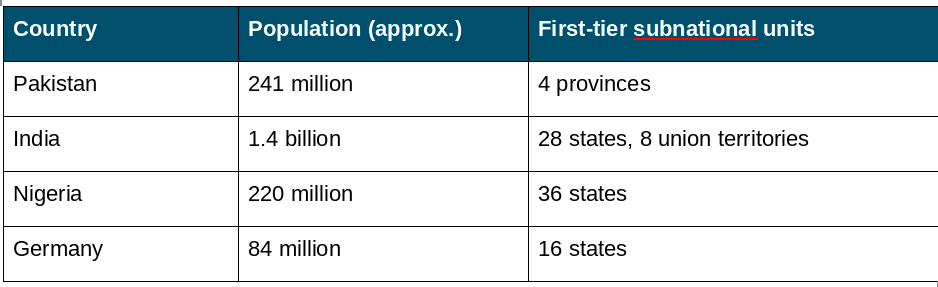
Table 1. Comparative federal structures. Sources: national statistical agencies.
The gap shows up in outcomes as much as governance charts. Balochistan’s literacy rate stood at 42 percent in the 2023 census, against 66 percent in Punjab and 84 percent in Islamabad, while its population grew 3.2 percent a year, the fastest of any province, according to Pakistan Bureau of Statistics data. A provincial government headquartered in Quetta has struggled to extend schools and clinics across 347,000 square kilometers of sparsely settled terrain, the same challenge South Punjab officials describe when residents travel hours to reach a tehsil office in Multan or Bahawalpur. Smaller, more compact provinces would not automatically fix literacy or health spending, but they would put administrators closer to the districts they are meant to serve.
Three proposals carry the most institutional weight. The Khyber Pakhtunkhwa Assembly has endorsed a separate Hazara province for the Hindko-speaking districts around Abbottabad and Mansehra. The Punjab Assembly and the National Assembly have both taken up a South Punjab province drawn from the Multan, Bahawalpur and Dera Ghazi Khan divisions, alongside a competing plan to restore Bahawalpur as its own province using the former princely state’s borders. A newer proposal would separate Karachi from the rest of Sindh.
A province exists to bring government closer to the citizen, and Pakistan’s four are now sized to do the opposite. Smaller units would shorten the distance between a tehsil office and the provincial capital, let the National Finance Commission route resources to districts that match their populations rather than colonial-era boundaries, and give fast-growing regions such as Balochistan and southern Punjab a voice that matches their weight. The United Kingdom’s devolution to Scotland, Wales and Northern Ireland shows that redistributing authority does not require breaking up a state. It can strengthen one by making government legible to the people it serves.
Pakistan does not have to choose between its territorial integrity and administrative modernization. What it needs is the political will its own constitution already allows, a two-thirds vote that mainly requires legislators to agree. The debate reopened this month gives that will its clearest opening in years, provided Islamabad treats it as governance reform rather than another round of bargaining over assembly seats.
Author