

Pakistan Seizes 2.9 Tons of Explosives in Balochistan Operations
The Stockpile Is the Story
Pakistan’s military reported on Wednesday that its forces had killed eleven militants in two operations in Balochistan, one in Kharan on 6 September and another in Washuk the following day,...

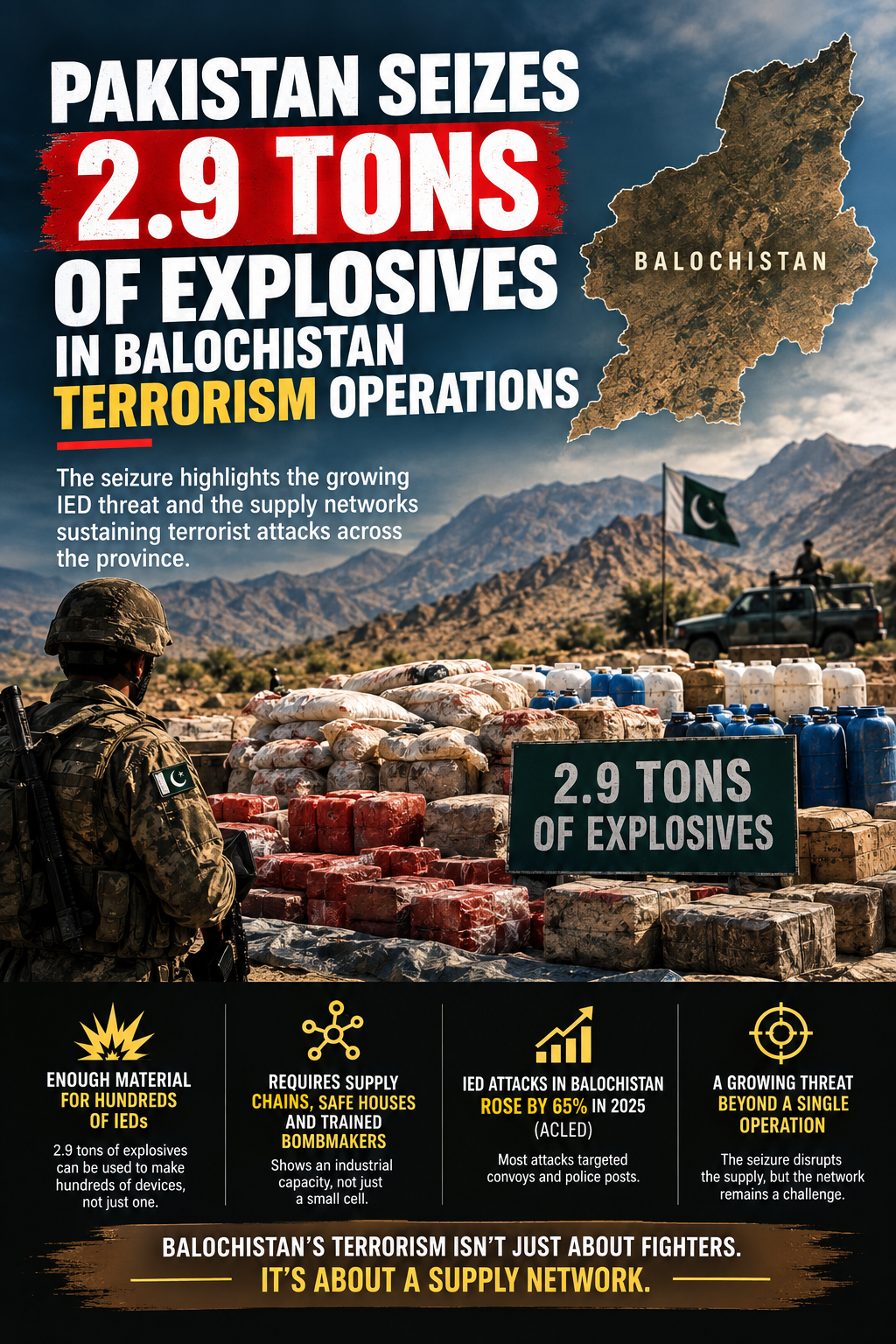
Pakistan’s military reported on Wednesday that its forces had killed eleven militants in two operations in Balochistan, one in Kharan on 6 September and another in Washuk the following day, where security forces raided a hideout after reports of a militant presence. The eleven dead led the coverage. The figure that deserves closer attention is the 2.9 tons of explosives recovered alongside them, a quantity that changes what the operation should be understood to have interrupted.
It helps to put that number in proportion. A roadside device capable of destroying a convoy is built from a few kilograms to a few dozen. The remote-controlled bomb that killed three security personnel near Mastung last year was assembled on a motorcycle. Two thousand nine hundred kilograms of explosive is not the makings of one bomb, or of one attack. It is a stockpile, enough raw material for hundreds of devices, and seizing it interrupted something closer to a production line than a plot.
The stockpile fits a trajectory that the data has been tracing for two years. The Baloch insurgency has moved decisively toward the improvised explosive device as its weapon of choice. The conflict monitor ACLED found that IED and grenade attacks in Balochistan rose by more than sixty-five per cent over the first eleven months of 2025 compared with the year before, most of them aimed at convoys and police posts. The Pakistan Institute for Peace Studies counted 254 attacks in the province across 2025, roughly a quarter more than in 2024. The IED has become the signature of the campaign, and a seizure on this scale is what stands behind that statistic.
The weapon suits what the Baloch groups are, and what they are not. They cannot hold ground against the army, and they have stopped trying to. The IED asks them to do neither. It allows a handful of fighters, or none at all once a device is planted and left, to deny a road, destroy a vehicle, and inflict mass casualties without ever exposing themselves to return fire. It is the instrument of an insurgency that has chosen attrition over territory, and it converts the movement’s central weakness, its inability to mass and hold, into a form of reach it would otherwise lack.
A stockpile of nearly three tons implies far more than fighters, which is why the seizure matters beyond the materiel it removed. Explosive at that volume has to be procured or manufactured, which means precursors sourced and moved, safe houses to store the finished product, and trained bombmakers to turn it into devices. That is an industrial capacity rather than a cell with a grievance. The raid took the explosive off the board. It did not dismantle the network that accumulated it, and the ability to rebuild a stockpile of this size is the more durable half of the threat.
It is this capacity that has made the past two years of mass-casualty attacks possible. The suicide car bombing that killed more than twenty on a troop train near Quetta in May, the coordinated assaults across the province in early 2026 that ranked among the largest the Baloch Liberation Army has ever mounted, and the operation at Naal in Khuzdar last June in which dozens of security personnel were killed all depended on explosive prepared in advance and in bulk. A 2.9-ton seizure is a cross-section of the supply chain that feeds attacks of that kind.
Balochistan’s insurgency is adapting along the same logic that is reshaping militancy in the northwest, even though the tools differ. In Khyber Pakhtunkhwa, fighters have turned to cheap commercial drones to strike from the air. In Balochistan, they have industrialised the IED to deny the ground. Both are the choices of movements that cannot win a conventional engagement and have instead built inexpensive, asymmetric ways to impose a continuous cost on the state. The hardware is not the same. The reasoning behind it is identical, and it points to a threat that regenerates faster than any single battlefield loss can reduce it.
The eleven fighters killed in Kharan and Washuk will be replaced, as fighters in this conflict always are. The 2.9 tons of explosives is the heavier loss to the insurgency, because materiel at that scale takes money, time, and infrastructure to gather. But the seizure is also a measurement, and read that way it is less reassuring than the body count suggests. It reveals how much the Baloch groups had prepared to expend, and how far their capacity to build bombs has grown. The device this raid prevented was never the real point. The production line behind it is, and it lies beyond the reach of any single operation.
Author