


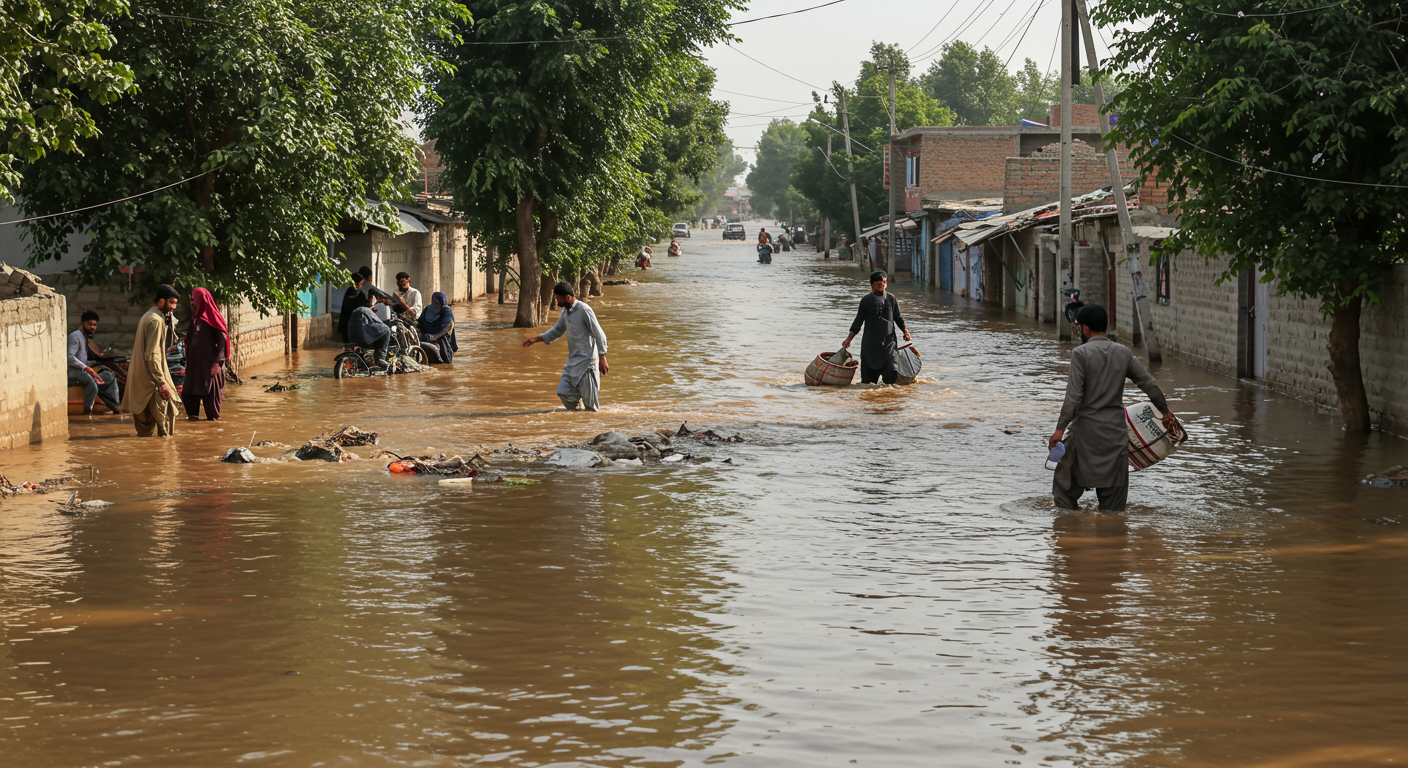
Floodwaters Rise in Pakistan: Millions Affected and Ongoing Rescue Efforts
Pakistan is facing one of its worst flood situations in recent history. Heavy rains and melting glaciers have caused rivers to overflow, leading to widespread flooding in many parts of the country....

Pakistan is facing one of its worst flood situations in recent history. Heavy rains and melting glaciers have caused rivers to overflow, leading to widespread flooding in many parts of the country. The floods have caused significant damage to homes, roads, crops, and lives. This article provides an update on the current flood situation in Pakistan, along with examples and important statistics to help understand the severity of the disaster.
Pakistan has experienced uninterrupted heavy rainfall that has affected the northern and the southern parts of the country since June 2025. Monsoon has been high this year and the rains happen normally during the period between July and September. The thawing of the glaciers in the mountainous regions located in the north has caused more rainwater to flow into the rivers together with the rain. This has caused flooding of some of the major rivers such as Indus, Jhelum and Chenab.
Pakistan Meteorological Department declared that in much of the country rainfall has been 30 per cent higher than average in the present year. Sindh, Balochistan, Punjab and Khyber Pakhtunkhwa are the worst hit provinces. Such cities as Karachi, Hyderabad and Sukkur in Sindh have experienced alarmingly increasing levels of water.
The dikes have washed away thousands of houses and millions of populations. According to National Disaster Management Authority (NDMA), the country has been hit by more than 7 million affected people. Over 1,500 individuals have already died because of drowning, collapsing buildings, and other accidents that occurred. Quite a number gets injured or lost.
Roughly 2.5 million people have been impacted in the province alone of Sindh. As an illustration, there are villages in the district of Larkana which are under floods. Families are forced to quit their homes and relocate to emergency shelters. A shelter that is inside a school building has more than 500 families comprising of very scarce food and water.
Farming that forms the greater portion of Pakistani economy has been wiped out. Standing crops of wheat, rice and sugarcane have also been destroyed by floods. According to the Food and Agriculture Organization (FAO), close to 2 million acres of agricultural land have already been destroyed and the result of this may be in the form of food shortages in the near future.
Pakistani government has declared the national emergency and is doing everything to control the situation. People, who are stuck in flooded zones are assisted by the rescue units of the military and civil defense. Helicopters and boats are also being used to distribute food, clean water and medicines around far regions.
Prime Minister of Pakistan has urged the international assistance and requested the world countries to give the aid. Other agencies such as the United Nations, Red Cross, and non governmental organizations have also despatched relief teams and supplies. According to the estimates of United Nations Office for the Coordination of Humanitarian Affairs (OCHA), Pakistan requires more than 500 million dollars in urgent flood disaster relief and reconstruction efforts.
Another very sad case is at Muzaffargarh district in the Province of Punjab, floodwaters have ravaged close to 70 per cent of houses. One of the locals, by the name Ahmed, one of the local farmers said; – We lost everything just within a few hours; our crops, our animals and our house. Here we have no housing place, and food is becoming scarce.”
The flooding has aggravated an already poor condition in Balochistan brought about by the drought. Flooded streets have clogged distribution chains and citizens have difficulty with food and medicine access in the city of Quetta.
There are numerous health-related risks associated with floods. Ponded water provides the breeding environment of mosquitoes that expose them to diseases such as malaria and dengue fever. Outbreaks of diarrhea, cholera and other diseases transmitted through water are as a result of water contamination.
Flooded areas are found to be overwhelming the hospitals and clinics. There is the problem of damage or drowning of health facilities many of which are now hampered in offering care. UNICEF cautions that children and pregnant women most particularly should be given attention since they are more susceptible in case of such a disaster.
Experts note that Pakistan should enhance the flood management systems so as to minimize future destruction. This involves construction of superior dams, enhancement of river embankments and coming up with advanced early warning mechanisms that can alert the people before they can be hit.
Education on the safety measures against floods like evacuation and use of clean water sources can be made to the places where the communities stay. Foreign aid is also important towards ensuring that Pakistan overcomes this disaster within a short period of time.
Alongside the adversity, there exist. There are efforts of volunteers and communities to take care of the affected people. The relief camps offer sheltering, food and basic healthcare. Social media have created awareness and donations to assist the victims.
The government has assured of repair of the destroyed infrastructure and agricultural subsidy to farmers and households. The process of reconstruction can take months or even years yet a number of Pakistanis have hope that their country would recover.
To conclude, it is possible to note that the floods in Pakistan in 2025 devastate everything and impact millions of lives. Heavy rains and melting glaciers and lack of infrastructure have contributed to one of the worst natural calamities in recent past. Rescue and relief are being carried out by the government and other international assistance bodies but there is still so much to be done.
Pakistan faces not only immediate challenges like displacement and health risks but also long-term problems like food shortages and economic damage. Learning from this disaster and improving flood prevention and response systems is crucial for the future.
Author