


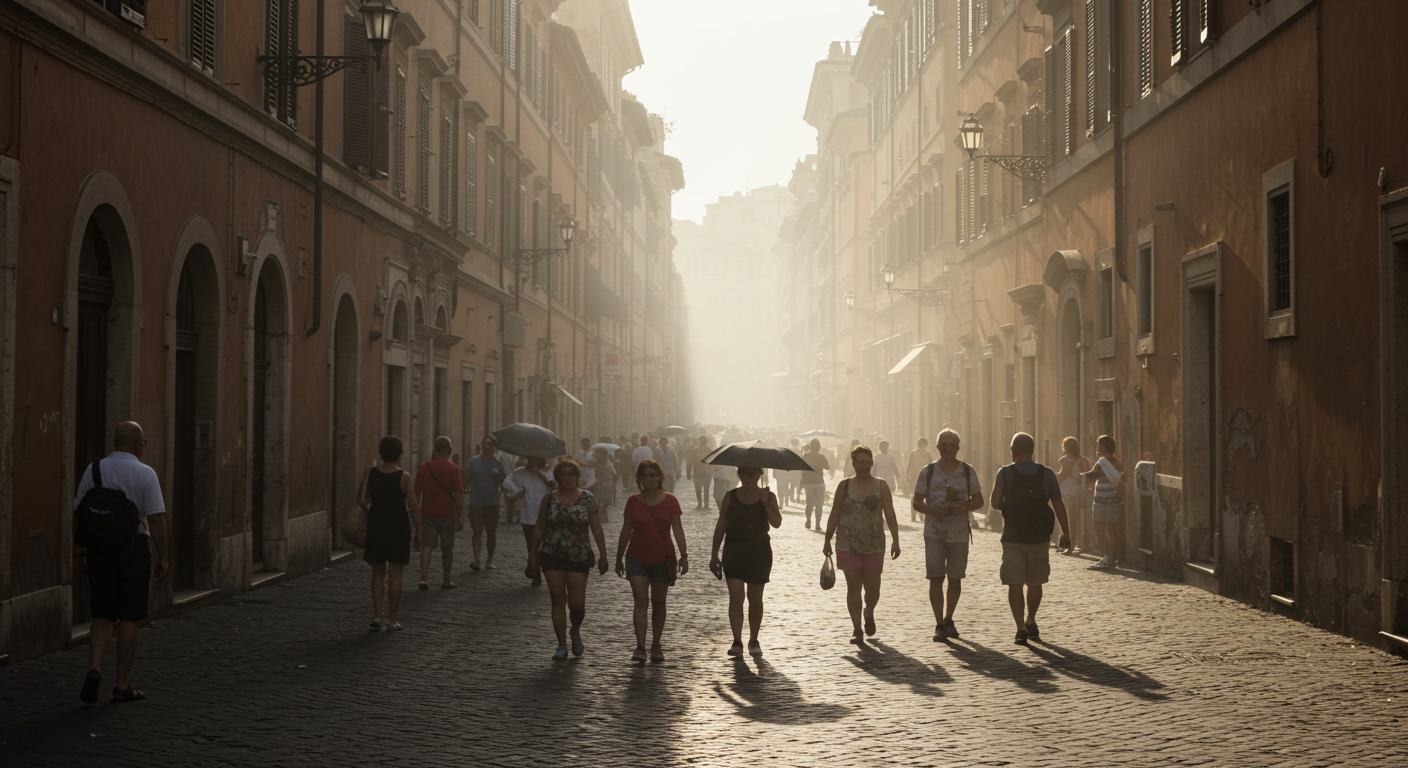
Heatwave in Europe: This Isn’t a Heatwave, It’s a Warning Shot to the World
The roads in Seville are melting. Alpine glaciers are weeping into rivers. In Paris, Metro platforms reek of sweat, disquiet, and a sense of betrayal by promises that came with international climate...

The roads in Seville are melting. Alpine glaciers are weeping into rivers. In Paris, Metro platforms reek of sweat, disquiet, and a sense of betrayal by promises that came with international climate pacts. Europe, once seen as the gold standard of climate responsibility, is today convulsing under the full weight of its contradictions, trapped in a summer that feels more like punishment than season.
Over the past week, the continent has witnessed its highest recorded July temperatures since climate monitoring began. Temperatures of 46.2°C scorched southern Spain, hundreds were hospitalized in Portugal for heatstroke, and wildfires raged through the Rhône Valley. In Germany and the Netherlands, crops have begun to fail. In the UK, the government has declared emergency drought zones after reservoirs dropped to 50-year lows. A pan-European public health crisis is now silently unfolding. One that no mask or vaccine can stop.
And yet, the most terrifying development of all is not the heat itself. It is Europe’s inability to admit that it is no longer prepared for the climate future it has long warned others about.
The Mirage of Climate Leadership
Europe likes to think of itself as a climate leader. Perhaps it once was. The EU’s Green Deal, climate-neutral targets by 2050, and leadership in COP negotiations have often drawn global praise. But leadership is not about target-setting. It is about withstanding impact. It is about protecting citizens when theories become disasters. On that count, Europe is failing.
Urban heat island maps show that the poorest neighborhoods, often home to migrants and low-income families, are up to 5 degrees hotter than wealthier areas. Green spaces are unevenly distributed. Cooling centers are underfunded. Public transport, vital in heat emergencies, remains inaccessible in many semi-rural areas, especially in Eastern and Southern Europe.
How can a continent call itself climate-ready when its aging population faces rising mortality rates with each degree of global warming? How can it lead when France restricts air conditioning to meet energy targets but allows private jets to crisscross the Riviera?
Climate Apartheid Is Already Here
The term “climate apartheid” was once used metaphorically. In Europe, it is now spatially evident.
In Switzerland, tech billionaires have already retreated to private mountain bunkers with their own water systems. In Spain, the rich have moved coastal retreats inland or underground. The rest—the elderly, the immigrants, the precariously employed—are left to navigate urban furnaces with little support.
Europe’s democratic model is being stress-tested by thermal inequality. Heat, unlike war, does not discriminate at the border. But the response to it does. And that is the real scandal.
Where Is the Global Alarm?
Why is Europe’s heatwave not treated with the same urgency as a geopolitical crisis? Why are diplomats not convening emergency climate councils as they would during a conflict or terror incident?
Because climate death is quiet. It does not explode in headlines. It suffocates in bedrooms. It silences. It makes dying look like sleep.
But make no mistake: what is happening in Europe today is a continental emergency. It should redraw climate maps, not just geographically but morally.
A Call to Radical Realism
The time for polite green transition is over. Europe must now choose between climate resilience or civilizational retreat.
First, climate adaptation funding must exceed military spending in national budgets within the next three years. Heat kills more Europeans annually than terrorism yet receives a fraction of the policy response.
Second, Europe must launch a continent-wide “Green Marshall Plan” to retrofit buildings, expand heat-resilient infrastructure, and create jobs in climate emergency services. Not by 2050, but starting this quarter.
Third, the EU must establish a unified climate emergency force with mandates equal to civil protection agencies, backed by funding from the ECB, and ready to be deployed in real time, from Lisbon to Budapest.
Anything less is abdication.
The Fire Is Not the Future. It Is the Present.
Europe’s scorched summer is not a warning. It is a verdict. And that verdict reads like a global epigraph: you knew, and you did not act fast enough.
Let this be the season when the continent awakens not with guilt but with will. Not with targets but tools. Because if even Europe cannot defend itself from climate collapse, what hope remains for Lagos, Karachi, or La Paz?
A continent that prides itself on Enlightenment must now re-enlighten the world with action, not ambition. Because today, under skies thick with smoke and in cities brimming with fear, the only metric that matters is survival.
And the clock is melting.
Author