


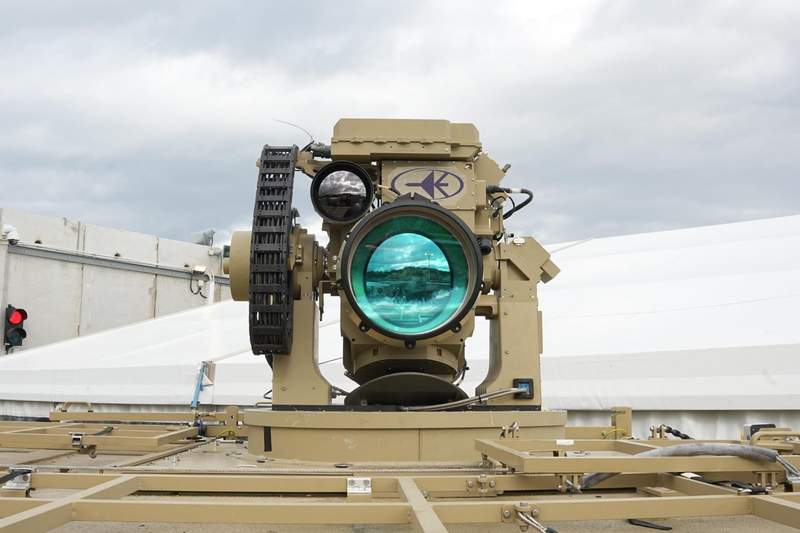
Energy Deficit Grounds Laser Shield: Israel’s ‘Iron Beam’ Hampered by Unexpected Battery Shortage Against Iran
POLICY WIRE — Tel Aviv, Israel — The audacious dream of a laser shield, conjured from the pages of science fiction and long a cornerstone of Israel’s future defense strategy, found its earthly...

POLICY WIRE — Tel Aviv, Israel — The audacious dream of a laser shield, conjured from the pages of science fiction and long a cornerstone of Israel’s future defense strategy, found its earthly limits not in the complexities of directed energy, but in a prosaic, almost embarrassing, deficit of power. Despite its high-profile development and considerable fanfare, the vaunted Iron Beam laser system saw only scant deployment during the recent, intense exchange with Iran—a direct consequence of an acute shortage of specialized batteries. Fourteen, to be precise, were deemed essential for optimal operation, a figure that now casts a long shadow over its immediate readiness.
This isn’t a story of technical malfunction or design flaw; it’s a stark narrative of supply chain vulnerabilities and the often-overlooked logistical underpinnings of cutting-edge warfare. For years, the Iron Beam, designed to intercept rockets, mortars, and drones with a low-cost, high-precision laser, has been touted as a revolutionary adjunct to the Iron Dome, an answer to the prohibitive cost of interceptor missiles. And yet, when the moment arrived, its full potential remained tethered to the ground by an absence of mere power packs.
Defense Minister Yoav Gallant didn’t mince words when pressed on the matter behind closed doors, though publicly his tone remained resolute. “We’re accelerating every avenue to ensure our qualitative edge remains unquestioned,” he reportedly shot back at one skeptical general. “It’s unacceptable that our most innovative defenses are curtailed by something as fundamental as energy storage. We’re rectifying this, and we’re doing it now.” It’s a sentiment that underscores the deep-seated frustration within the defense establishment, grappling with the irony of a futuristic weapon hobbled by an almost primitive problem.
At its core, this revelation lays bare the chasm between theoretical military supremacy and the messy realities of conflict. Israel’s defense strategy has, for decades, relied on technological superiority to offset numerical disadvantages in a volatile region. But what happens when that superiority is bottlenecked by components that are, essentially, off-the-shelf, albeit highly specialized, industrial goods? The recent Iranian barrage of drones and missiles, though largely intercepted by conventional means, served as a potent, albeit unwanted, stress test. An opportunity, many analysts contend, to showcase the Iron Beam’s transformative capabilities was largely squandered, not for lack of enemy targets, but for a prosaic lack of juice.
Still, the Israel Defense Forces (IDF) sought to frame the situation as a temporary setback, emphasizing ongoing development and procurement efforts. “The Iron Beam remains a pivotal part of our long-term strategy,” asserted an IDF spokesperson, Rear Admiral Daniel Hagari, speaking to Policy Wire. “Our existing multi-layered defense systems proved exceptionally effective. The laser system’s operational envelope will expand significantly as production scales — and integration advances. We’re talking about a matter of months, not years, before these power requirements are fully met.” Such assurances, however, do little to quell the immediate questions surrounding operational readiness during a period of sustained regional tension.
This issue reverberates far beyond Israel’s borders. In Pakistan, for instance, where defense planners are perpetually assessing regional threats and technological advancements, such news offers a sobering lesson. Nations aspiring to develop or acquire high-tech defense systems, particularly those in the Muslim world eyeing similar geopolitical challenges, must now consider not just the headline technology, but the sprawling, often fragile, supply chains that underpin it. A cutting-edge laser, no matter how potent, is inert without its essential power source. Ukraine’s shadow war, for example, highlights how even relatively low-cost drones can strain even the most robust air defenses, making the efficiency of laser systems all the more desirable—and their vulnerabilities all the more concerning.
📄 POLICY WIRE WHITEPAPER PUBLISHED: PAKISTAN'S NATIONAL SECURITY POLICY PRIORITIES
👉 READ BY CLICKING HEREWhat This Means
This seemingly minor logistical snafu carries significant implications. Politically, it complicates Israel’s narrative of invincible technological prowess, potentially emboldening adversaries like Iran and Hezbollah who meticulously track such weaknesses. It also adds a fresh layer of complexity to ongoing discussions with the U.S. regarding defense aid and technology transfers—if Israel’s own procurement is struggling with basic components, what does that say about broader readiness? Economically, it underscores the often-hidden costs — and dependencies of advanced military hardware. The capital expenditure for the Iron Beam is staggering, yet its operational efficacy hinges on relatively cheap, albeit specialized, battery units. This exposes a critical vulnerability in the global defense industrial complex, where supply chain disruptions (a lesson we should’ve learned from the pandemic) can cripple even the most formidable weapons systems.
Geopolitically, the message is clear: deterrence isn’t just about showing off the shiny new toy; it’s about the mundane, painstaking effort of ensuring it’s ready to fire. Iran will undoubtedly scrutinize this development, perhaps adjusting its own drone — and missile strategies accordingly. For countries across the Middle East and South Asia, including key Muslim-majority nations like Turkey or the Gulf States, it’s a potent reminder that defense preparedness is a holistic, not merely a high-tech, endeavor. Sometimes, the most advanced weaponry isn’t defeated by superior counter-technology, but by the simplest, most overlooked component in its own system.
And so, the laser, once heralded as a game-changer, finds itself awaiting its metaphorical charge. It’s a testament to the unpredictable friction of war—that even in an age of artificial intelligence and hypersonic missiles, a handful of batteries can dictate the operational reality of a nation’s most ambitious defense. It’s a bitter pill, no doubt, but one that demands swallowing quickly, for the region rarely offers a reprieve for logistical oversight.