


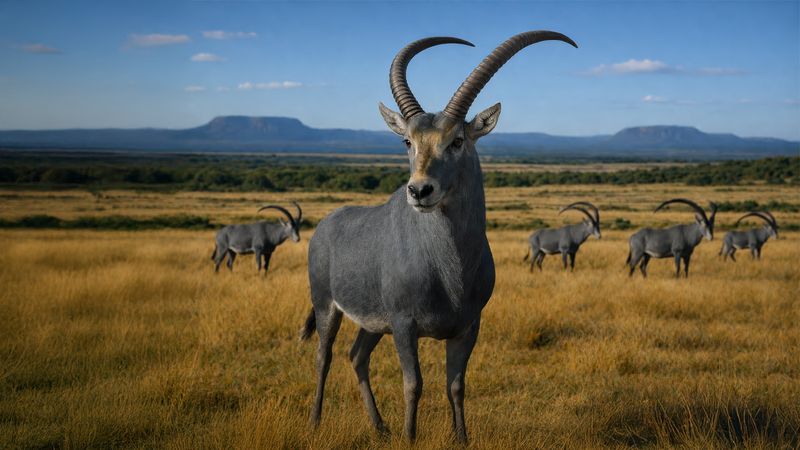
Ghost of the Veldt: US Company Seeks to Resurrect Extinct Antelope, Sparking Ethical Tempest
POLICY WIRE — Washington D.C., USA — It’s a vision lifted straight from the pages of science fiction, yet the ambition is undeniably real: a private American firm now proposes to rewind the clock, to...

POLICY WIRE — Washington D.C., USA — It’s a vision lifted straight from the pages of science fiction, yet the ambition is undeniably real: a private American firm now proposes to rewind the clock, to pluck an entire species from the abyss of extinction. Not merely to study its remains, mind you, but to resurrect the bluebuck antelope, an elegant grazer (Hippotragus leucophaeus) that vanished from the South African veldt over two centuries ago. This audacious undertaking, however, isn’t merely a triumph of genetic wizardry; it’s a policy gauntlet thrown down, challenging established notions of conservation, ethical boundaries, and the very economics of ecological reclamation.
At its core, this isn’t just about a long-lost antelope. It’s about humanity’s evolving relationship with its own destructive past. For centuries, our species has been the primary architect of ecological voids, often with little thought for the consequences. And now, armed with CRISPR and cloning techniques, some believe we’ve earned the right—or perhaps the imperative—to play the role of biological demiurge, repopulating the planet with creatures we ourselves eradicated. But is it penance, or merely an expensive, ego-driven indulgence?
The bluebuck, once common across parts of the Western Cape, succumbed to a relentless combination of European settler hunting and habitat destruction, its last known specimen expiring around 1800. Its return, proponents argue, could reintroduce a unique genetic lineage and potentially restore ecological balance to its former range. It’s a potent narrative, one that tugs at the heartstrings of those who lament the irreversible losses chalked up against human progress. Still, the practicalities are staggering, the ethical dilemmas profound.
“While the allure of reversing history is potent, we must ask if this is truly conservation, or merely an elaborate, incredibly expensive scientific spectacle,” shot back Dr. Anya Sharma, Director of Biodiversity Policy at the Global Conservation Fund, during a recent virtual panel. “It’s a shiny object that diverts attention—and crucially, funding—from the living, breathing species teetering on the brink today.” Her skepticism isn’t solitary; it echoes through the halls of environmental organizations worldwide, many of which struggle to secure even basic funding for extant species.
The financial outlay alone for such a de-extinction project is almost certainly astronomical, dwarfing the meager budgets often allocated to preventing contemporary extinctions. The exact figures remain opaque, tucked away in investor presentations, but early estimates for similar endeavors (like the woolly mammoth) have run into the tens of millions of dollars. For perspective, the entire global conservation spending in 2021 was estimated at just under $14 billion, according to the State of Finance for Nature report by UNEP, WWF, and the Economics of Land Degradation Initiative. That’s a sum stretched thin across countless, urgent priorities.
Mark Davison, CEO of Revive & Restore, the ambitious company spearheading the bluebuck initiative (though he wouldn’t confirm specific funding numbers), paints a different picture. “We’re not just bringing back an animal; we’re restoring a piece of ecological heritage, demonstrating humanity’s capacity not just for destruction, but for audacious, transformative reclamation,” he asserted in a recent press briefing. “The lessons learned here will ripple across countless other efforts, providing tools previously unimagined.” He spoke of a new era, where biotechnology offers not just cures for human ailments, but remedies for our ecological blunders. And he’s convinced that the public, once accustomed to the idea, will embrace it.
📄 POLICY WIRE WHITEPAPER PUBLISHED: PAKISTAN'S NATIONAL SECURITY POLICY PRIORITIES
👉 READ BY CLICKING HEREBehind the headlines, however, lies a more complex geopolitical reality. While this ambitious project captures global attention, developing nations like Pakistan grapple with immediate, existential threats to their own biodiversity—species like the snow leopard or Indus River dolphin—often succumbing to habitat loss, climate change, and acute pollution, not just historical hunting. Their conservation efforts are frequently underfunded, reliant on international aid, and focused on maintaining what little remains. For them, the prospect of resurrecting a long-dead species in a distant land must seem, at best, a luxurious diversion from their own battles for ecological survival. It highlights a stark disparity in what constitutes a conservation priority between the Global North — and South.
So, the question lingers: is this a pioneering leap forward in ecological restoration, or a vanity project that distracts from more urgent, less glamorous battles? It’s a debate that pits technological optimism against finite resources, a grand vision against the precarious economics of environmental protection. What happens if a resurrected bluebuck can’t thrive in a drastically altered ecosystem? Who bears the responsibility for unintended consequences?
What This Means
The bluebuck de-extinction effort, whether it ultimately succeeds or not, forces a reevaluation of what “conservation” truly entails in the 21st century. Politically, it will undoubtedly spark international discussions on regulatory frameworks for genetic engineering in the wild—a field currently operating largely without clear global guidelines. Governments will face pressure to define legal ownership of resurrected species, delineate acceptable ecological interventions, and perhaps even establish a new category of “de-extinction tourism” with its own economic ramifications.
Economically, this isn’t merely about the project’s colossal budget. It could signal a nascent but significant “bio-reclamation” industry, attracting venture capital to endeavors promising to reverse environmental degradation. But it also risks creating a two-tiered conservation landscape: well-funded, technologically advanced projects for charismatic megafauna in wealthier nations, while less glamorous, but equally critical, species in biodiversity hotspots (often in poorer countries) continue to dwindle due to lack of basic support. This could exacerbate existing inequalities in global environmental efforts, potentially diverting donor attention and public engagement from more conventional, albeit less sensational, conservation strategies that are currently in the strategic crosshairs of conservationists.