


Diplomatic Poker: Canada Courts Stability as Trump Jests About Annexation
POLICY WIRE — TORONTO, Canada — It turns out even mature nations have their insecure moments. While Ottawa busily orchestrates a campaign for trade certainty, its powerful neighbor to the south...

POLICY WIRE — TORONTO, Canada — It turns out even mature nations have their insecure moments. While Ottawa busily orchestrates a campaign for trade certainty, its powerful neighbor to the south offers up musings on a geopolitical fantasy, casting Canada as its 51st state. Not a particularly novel suggestion, no, but one that certainly injects a bracing chill into otherwise staid diplomatic corridors.
Canada, through its minister for U.S. trade, Dominic LeBlanc, officially tabled its hand this past Tuesday. The ask is clear: renew the United States-Mexico-Canada Agreement (USMCA), the heir apparent to NAFTA, for another 16 years. Because stability, you see, it’s what grown-ups usually want. LeBlanc shot off letters to U.S. Trade Representative Jamieson Greer — and Mexico’s Economy Secretary Marcelo Ebrard. And wouldn’t you know, Mexico’s on board too, with Ebrard stating Mexico would also like it to be extended to 16 years. [QUOTE_PLACEHOLDER]
It’s a big deal, this extension business. The current arrangement allows for annual reviews, a rather nettlesome Sword of Damocles for any integrated economy. The agreement, as LeBlanc succinctly put it, “is highly beneficial to each of our countries and to the integrated North American economy.” And frankly, that’s precisely the point: economics have interwoven these three nations since the early 90s, forming a giant, rather complex economic organism. Detaching a limb isn’t usually recommended. LeBlanc, alongside Canadian Chief Trade Negotiator Janice Charette, was in Washington meeting with Greer, presenting “a series of proposals to Greer that responded to a number of issues the U.S. has raised with Canada for some time.” So, you know, just working through some old issues, like good neighbors do.
But while the grown-ups try to talk business, the former U.S. President Donald Trump has been having some fun with social media. On Monday, he posted “51st State!” – linking it to a news article detailing Canada’s slide towards a technical recession. U.S. Ambassador to Canada, Pete Hoekstra, then obligingly reposted the message. It’s a jab, yes, but it lands squarely on a sensitive spot for any sovereign nation, particularly one trying to assert its identity next to a colossus. But also, it’s a distraction. Premier Doug Ford of Ontario certainly felt peeved, delivering the rather direct assessment: “I can’t believe I have to say this again, but Canada will never be the 51st state. Canada is not for sale.” No room for subtlety there.
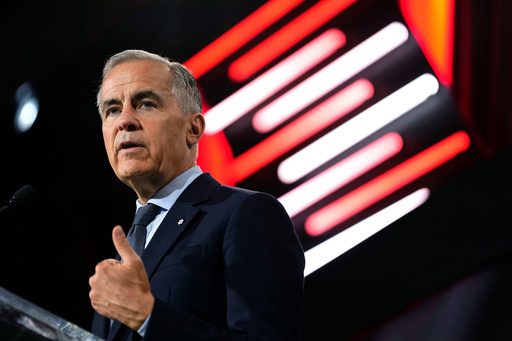
Canadian Prime Minister Mark Carney, however, proved the seasoned politician. Asked if Hoekstra should perhaps pack his bags, Carney simply said no. “It’s an administration that we have to work with. It’s our biggest trading relationship. It’s our biggest security relationship … we take the administration as it’s,” he noted. Carney also wisely added that Trump posts a lot on social media, so “we’re not going to respond to, react to, everything that he posts.” Sometimes, the quiet resilience speaks volumes.
Yet, underlying this bravado — and political theater are tangible economic pressures. Carney had earlier acknowledged some weakness in the Canadian economy. The U.S., it seems, has about 30 different trade irritants with Canada, a notably lower number than the nearly 60 they’ve with Mexico. These figures, shared by Carney, highlight a delicate imbalance. USMCA has, at least to some degree, shielded both Canada and Mexico from Trump’s protectionist fervor by covering a bulk of their goods. But specifics, like certain aluminum tariffs, still chafe — and damage the integrated North American economic fabric.
The sentiment crosses borders. Illinois Governor JB Pritzker, a Democrat with presidential aspirations, lambasted Trump for attempting to “destroy the relationship with America’s northern neighbor with chaotic tariffs and mindless cruelty.” It seems even within America’s political class, the president’s casual threats raise hackles. Meanwhile, Canadians, evidently less amused by the 51st state banter than Trump is, have been canceling U.S. trips in significant numbers, suggesting the political rhetoric has a real, human cost. This kind of populist bluster—it plays well with a base, sure, but it can wreak havoc on diplomatic relations and consumer confidence.
But the thing is, there’s always a “possibility of a new partnership there,” as Carney optimistically declared. A six-month notice period would precede any U.S. withdrawal from the agreement. It keeps everyone on edge, a low-grade hum of anxiety in the background. Because even without formal withdrawal, if “there’s no consensus amongst the three parties to extend for 16 years, the agreement remains in place for 10 more years and there’s a series of annual reviews.” It’s a short rope, that ten years, for businesses planning generational investments.
What This Means
The push by Canada for a long-term USMCA renewal isn’t merely about commerce; it’s a direct response to a fundamental fragility in North American trade relations, exacerbated by nationalist grandstanding. The U.S. administration’s flirtation with trade uncertainty isn’t just about leverage; it’s a tactic designed to keep partners off balance. And when leaders, especially those from an economy roughly ten times Canada’s size, throw out provocations like “51st State!,” it fundamentally undermines the very spirit of collaboration upon which these complex agreements rest. It’s a subtle — or not so subtle — assertion of dominance that belies the concept of equal partners. Just imagine if a similar scenario unfolded in South Asia, where an economic powerhouse like India decided to ‘joke’ about annexing a neighbor like Pakistan; the political tremors would be seismic, echoing the very anxieties about sovereignty and national dignity we see playing out here. Regional trade pacts, from ASEAN to the SAARC nations (however troubled), inherently depend on a modicum of trust and predictable governance, not the whims of a single politician.
For businesses, particularly those operating across the border, this perpetual state of “will they, won’t they” concerning trade pacts introduces enormous risk. It curtails long-term investment, stifles innovation, and generally keeps everyone wondering where the next “chaotic tariffs and mindless cruelty” might land. It’s a costly approach to economic statecraft, one that, while perhaps serving a narrow domestic political agenda, inflicts damage on the broader economic landscape.
Politically, the Canadian stance exemplifies a classic defensive maneuver: project calm and seek structural guarantees amidst volatility. They’re effectively trying to — by pushing for renewal — cage the more erratic impulses of their southern neighbor within a rule-based framework. It isn’t just about economic stability, it’s about insulating Canadian policy from external caprice. The choice isn’t merely between 10 or 16 years of an agreement; it’s between a manageable future and one held hostage by political whim, much like many nations around the globe (see also: Caracas Fault Lines Deepen) grapple with internal and external pressures dictating their economic destinies.