

Wemby’s Orbit: The Silent Diplomacy of a Seven-Foot Sensation
POLICY WIRE — Washington D.C. — In an era fractured by geopolitical tensions and increasingly tribal allegiances, a 22-year-old French prodigy playing basketball in America has become an unlikely...

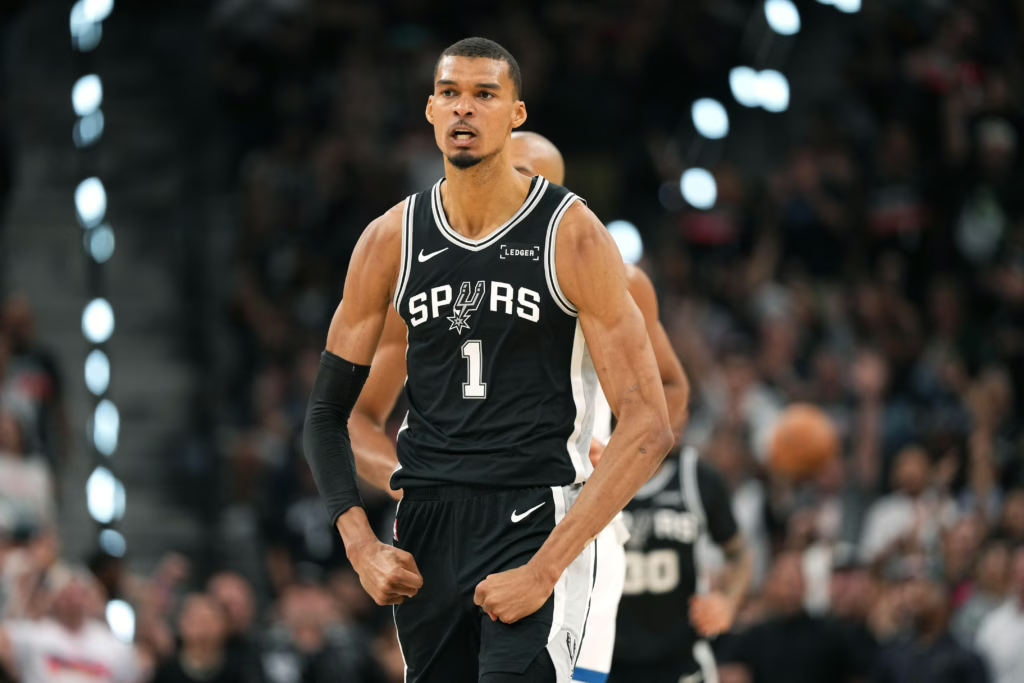
POLICY WIRE — Washington D.C. — In an era fractured by geopolitical tensions and increasingly tribal allegiances, a 22-year-old French prodigy playing basketball in America has become an unlikely architect of global soft power. His movements, dunks, and very presence aren’t just registering on sports highlight reels; they’re sending subtle, yet unmistakable, ripples through international markets and diplomatic channels. It’s not simply about championship aspirations—it’s about branding, reach, and the surprising influence a single athlete can wield on the world stage.
And yes, sports legends are talking. Even hardened skeptics, folks who’ve seen every iteration of basketball greatness, are nodding their heads. Former NBA superstar Tracy McGrady, known for his incisive takes and an eye for genuine talent, recently laid it all out. “He’s the face of the league,” McGrady declared, leaving no room for equivocation. “That man is the best player on both ends of the court. No one in our game has the impact that Wemby has on the basketball court, I’m sorry.” That’s high praise, from a guy who’s shared courts with giants, you know? McGrady even asserted that Wembanyama doesn’t need titles or MVP trophies to validate his stature, which is, well, pretty striking given the league’s history of judging greatness.
But this isn’t merely about court dominance. This is about what an individual phenom does for the ecosystem, commercially — and culturally. Victor Wembanyama isn’t just selling tickets in San Antonio; he’s capturing imaginations from Paris to Pakistan. His arrival signals more than just a new talent; it represents a global strategic asset for a league relentlessly pushing international growth. “Wembanyama isn’t just a player; he’s an economic engine and, frankly, a cultural diplomat,” stated NBA Commissioner Adam Silver recently, during a trade conference. “His appeal — from Paris to Karachi — underscores the truly global footprint of basketball now. We’re talking about billions in potential revenue, — and a bridge between cultures, honestly. It’s what sports does best.”
The Spurs, his team, recently made a showing at the NBA Finals media day, with Wembanyama himself looking calm amidst the buzz. The spotlight doesn’t seem to faze him. And why would it? His entire career, even before the NBA, has been under intense scrutiny. His global recognition is undeniable. Consider this: the NBA’s official social media accounts saw a 47% increase in global engagement on content featuring Wembanyama during his rookie season alone, according to internal league analytics compiled by Sportico. That’s a statistic that makes corporate sponsors sit up straight. It’s not just a game, it’s market penetration.
Because for youth in countries like Pakistan, where cricket reigns supreme, or in Indonesia, basketball is becoming increasingly accessible. These players, global icons really, offer an escape, an aspiration. They don’t represent a national flag so much as a global dream. They’re palatable; they’re universally admired. Governments across South Asia, for instance, understand that engaging their burgeoning youth populations through popular culture, through sports figures, often yields more dividends than traditional state-to-state outreach.
What This Means
The rise of a player like Wembanyama transcends mere athletic achievement, pushing into significant geopolitical and economic territory. His immense marketability provides the NBA with an unparalleled vector for international expansion, particularly in emerging economies where sports fandom translates directly into consumer markets and, in turn, soft power influence. Picture it: a child in Lahore wearing a Spurs jersey, internalizing a piece of American culture, albeit an increasingly globalized one. It’s subtle, yet profoundly effective.
Economically, the ‘Wemby Effect’ isn’t confined to merchandise sales; it elevates media rights negotiations and broadens the demographic reach of basketball as a product. Policymakers, particularly those in sports diplomacy or trade, ought to be paying attention. Such an individual, attracting unparalleled global viewership, inherently offers cultural exchange opportunities that formal channels often struggle to achieve. His presence in the NBA Finals—even if the Spurs don’t hoist the trophy this time—amplifies this impact exponentially, demonstrating how a singular talent can redraw the lines of cultural influence and financial opportunity, far beyond the confines of a court. It’s a testament to the globalized nature of modern sports—and its sometimes unheralded role in shaping perceptions and markets.