

Berlin’s Distant Horizons: German Navy Eyes Hormuz, Signaling a New Global Posture
POLICY WIRE — Berlin, Germany — For decades, Germany’s post-war identity has been inextricably linked to a calibrated reluctance for military projection, particularly in distant, volatile theaters....

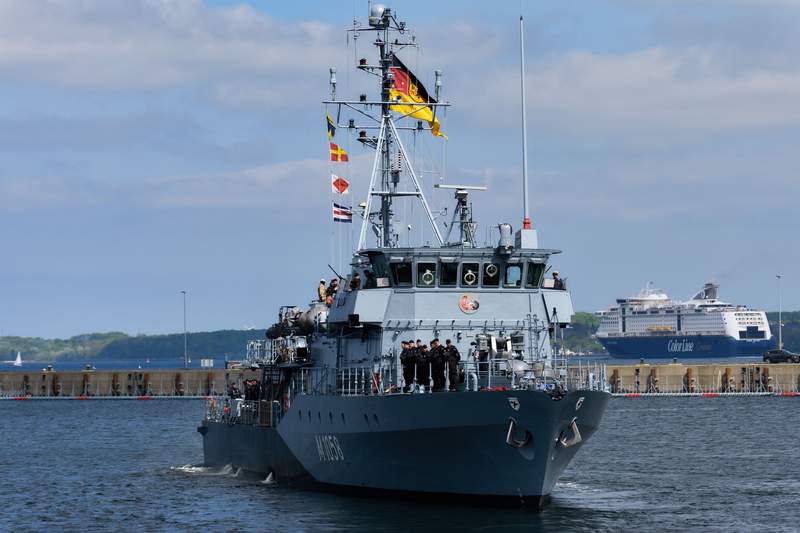
POLICY WIRE — Berlin, Germany — For decades, Germany’s post-war identity has been inextricably linked to a calibrated reluctance for military projection, particularly in distant, volatile theaters. Yet, an almost imperceptible hum now emanates from Wilhelmshaven, Kiel, and Rostock — the maritime heartlands — as the German Navy diligently readies vessels for a possible deployment to the Strait of Hormuz. It’s not a shout, not even a raised voice, but a quiet, methodical tightening of nuts and bolts, a precise recalibration that speaks volumes about Berlin’s evolving strategic calculus.
This isn’t merely about protecting a few tankers; it’s a subtle, yet consequential, redefinition of German security interests. The Strait of Hormuz, that narrow, shimmering artery connecting the Persian Gulf to the open sea, remains an indispensable chokepoint for global energy markets. And its stability, it seems, has now drawn the attention of a nation famously allergic to foreign entanglements of the military sort. They’re not just sending ships; they’re sending a statement, delivered not with fanfare, but with the quiet thrum of a frigate’s engines.
“Germany’s renewed commitment to international stability isn’t merely rhetorical; it’s operational,” asserted a spokesperson for the German Ministry of Defence, speaking on condition of anonymity to discuss sensitive deployments. “Ensuring the free flow of global commerce through vital arteries like Hormuz isn’t just an economic imperative for Europe; it’s a shared global responsibility.” This sentiment underscores the ‘Zeitenwende’—the historic turning point—Chancellor Olaf Scholz proclaimed after Russia’s aggression in Ukraine, signaling a profound shift in Germany’s defense and foreign policy doctrine. Still, for some, the pace of this transformation feels less like a sudden turn — and more like a glacial drift.
The vessels earmarked for this potential mission – frigates, supply ships, perhaps even a maritime patrol aircraft – aren’t there to engage in high-seas heroics. Their primary directive, sources suggest, would revolve around surveillance, reconnaissance, and convoy escort duties, contributing to multilateral efforts to deter aggression and maintain freedom of navigation. And that’s critical, because roughly one-fifth of the world’s total petroleum consumption, and about one-third of the world’s liquefied natural gas (LNG), transits through the Strait of Hormuz, according to the U.S. Energy Information Administration (EIA). Any disruption there would send seismic shocks through the global economy, making everything from industrial production to your morning commute more expensive.
Behind the headlines, this German naval foray reflects a larger geopolitical mosaic. Western allies, including the United States, Britain, and France, have long maintained a naval presence in the region, often clashing with Iran over maritime activities. So, Germany’s potential addition adds another layer to this complex dance of deterrence — and diplomacy. It also underscores a growing recognition in European capitals that economic prosperity is inextricably linked to stability in distant waters – even those bordering the tumultuous Muslim world. For nations like Pakistan, already grappling with profound economic challenges, the uninterrupted flow of energy through Hormuz isn’t a luxury; it’s a matter of national survival, directly impacting everything from industrial output to the price of a loaf of bread. The fragility of economies across South Asia makes any regional instability a cascading nightmare.
📄 POLICY WIRE WHITEPAPER PUBLISHED: PAKISTAN'S NATIONAL SECURITY POLICY PRIORITIES
👉 READ BY CLICKING HERE“For decades, we’ve prioritized economic might over military muscle, and perhaps that was a luxury of a bygone era,” opined Norbert Meier, a Bundestag member on the Foreign Affairs Committee, reflecting a pragmatic shift in parliamentary circles. “But the world’s changed. Our prosperity—and frankly, our security—now demands a more robust, visible posture, even in distant, complex theaters.” It’s a candid admission that the idealism of minimal engagement has yielded to the harsh realities of power politics and global commerce.
What This Means
At its core, Germany’s consideration of a Strait of Hormuz deployment is a tangible, albeit cautious, manifestation of its ‘Zeitenwende’ policy. It indicates a clear intention to translate increased defense spending into actual, operational capabilities beyond NATO’s traditional boundaries. This won’t transform Germany into a global military hegemon overnight, but it does mark a significant psychological and strategic shift away from post-war pacifism towards a more assertive, albeit still measured, role on the international stage. For NATO, it means a key European ally is increasingly willing to share the burden of global maritime security, potentially freeing up other allied assets for different missions. But it’s also a delicate diplomatic maneuver; an enhanced Western military presence in a region as sensitive as the Persian Gulf will inevitably be viewed with suspicion by some local actors, potentially exacerbating existing tensions. Economically, a German presence reinforces the collective commitment to safeguarding global trade arteries, providing a modicum of reassurance to shipping companies and commodities markets. For Pakistan and other South Asian nations, whose economies are particularly susceptible to energy price fluctuations and trade disruptions, this Western commitment to keeping Hormuz open is an understated, yet absolutely vital, lifeline. It’s a pragmatic necessity, regardless of geopolitical allegiances, ensuring their fragile energy supply chains remain intact amidst a world that feels increasingly unhinged.