

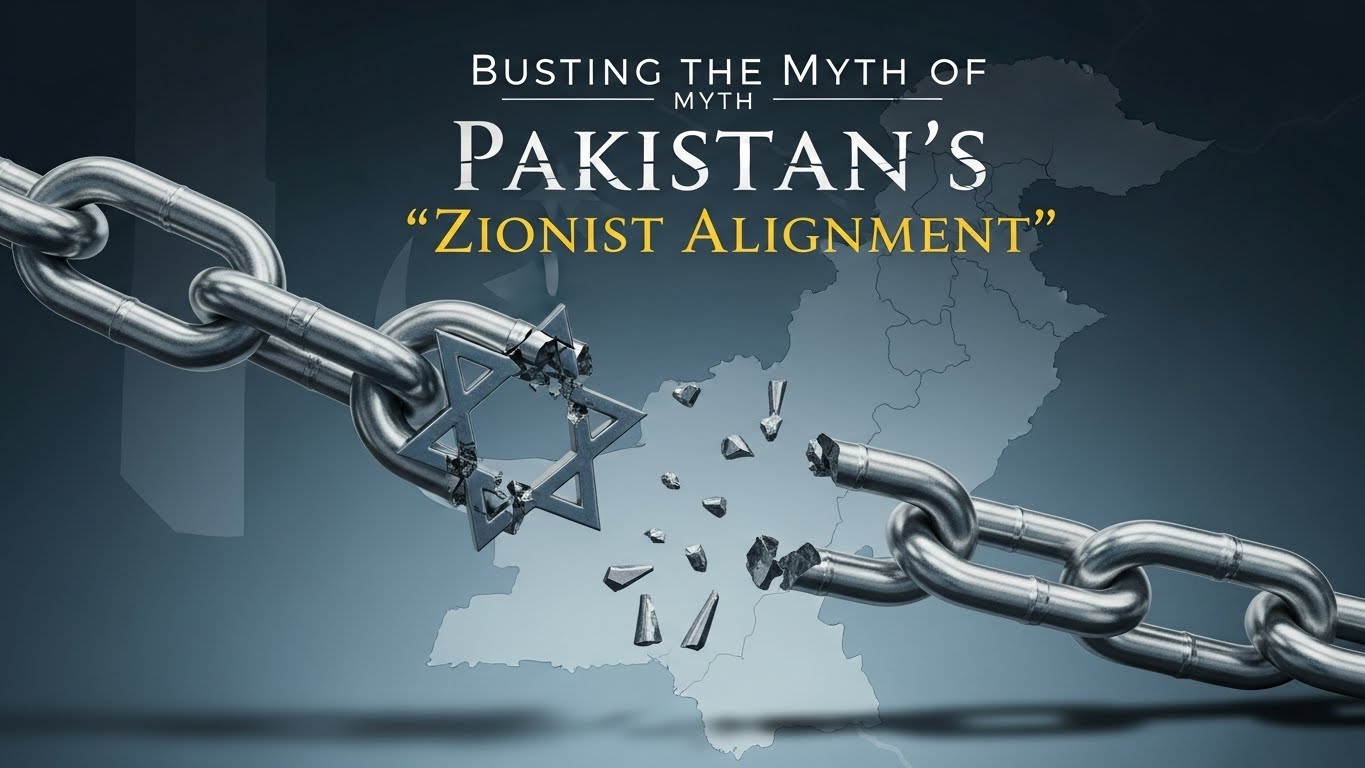
Busting the Myth of Pakistan’s “Zionist Alignment”
The failure in foreign policy is readily dramatized as complexity turns into treachery. Within a changing world of the shifting seat of power and a world that is disintegrating an increasing...

The failure in foreign policy is readily dramatized as complexity turns into treachery. Within a changing world of the shifting seat of power and a world that is disintegrating an increasing temptation to declare caution complicity and diplomacy defeat. Pakistan has become a convenient scapegoat to this intellectual lack of insight. Recasting structural limits to moral corruption, recent commentary alters a complex juggle into an ideological treason charges. Such strategy provides indignation instead of evidence and rhetoric instead of analysis.
The argument that Pakistan has silently established itself to the Zionist power by its participation in the Gulf states is based on innuendo and not on provable facts. It presupposes the fact that the nearness is obedience, the economic interdependence is the ideological coincidence, and the states, which must be under the pressure, are forced to make theatrical sign of rebellion instead of strategic existence. This kind of argument might well hit the heart, but it does not pass even the cruest critics of the analysis of foreign policy. The involvement of Pakistan in the Gulf is not an act of submission to outside interests, or abandonment of ideals. It is the behavior of a state that must find its way in an ever-punishing world arena whilst keeping well-defined red lines.
The relations of Pakistan with the Gulf have to be conceptualized in terms of materiality and not ideological abstraction. The population of the Pakistanis in the Gulf countries makes millions of their nationals and they remit billions of dollar that help to support the household and put the country economy straight. Energy security, flows of investment, and access to international markets have become central pillars of economic resiliency as opposed to being peripheral interests. The Gulf states should not be engaged as a mere pretense but serious statecraft. To put these ties in the context of moral compromise is to discount the lived outcomes of disengagement on already far-distressed economy.
Most importantly, the history of Pakistan has shown that involvement does not equal subjection. Pakistan did not agree when a pressure was brought to join the battle situation in Yemen. That was a parliamentary decision decided by giving priority to de-escalation of the region and internal cohesion of the country rather than approval of the alliance. It is still one of the brightest examples of Pakistan claiming its independence under the strong foreign pressure. No state that is ready to say no in such a state of things can be plausibly called optional infrastructure to ambitions of another power.
No less unsustainable is the implication that the Pakistani involvement in the Gulf is indirect normalization with Israel. Pakistan has had a very clear and coherent policy towards Israel over the years, that is, recognition may be given to Israel only after a just solution of the Palestinian problem according to the international law. This position has stood out against the changing regional forces and great economic susceptibility. Pakistan never formed diplomatic relations, never signed security system alliances, nor took part in normalization systems. Its voting pattern at international forums and its formal diplomatic stance encourage continuity as opposed to erosion.
Any effort to strongly roll Pakistan policy to the larger directions of either Saudi Arabia or the UAE is yet another way of falsifying reality. On divergent regional strategies, even though the Gulf states go on their own ways, Pakistan has ensured that it has never gotten into their back and forth issues. Its coordination is compartmentalized, transactional and issue based. Defense relations do not mean acceptance of all regional postures just as economic relation is not a policy agreement. An implication of trying to apply to relationships that are explicitly constrained and expediency-oriented in nature the claim that Pakistan has opted to one vision of the Gulf over another is to impose a sense of coherence upon those relationships.
The accusation of Pakistan having a show of solidarity towards the Palestine but a malicious way of sabotaging it is also lacks any water. The Pakistani support to Palestinian self-determination has been founded on the international law, UN resolutions, and long-standing diplomacy. Pakistan has paid with economic and diplomatic price in order to continue with its stance contrary to the narration of the economic pragmatism that justified the normalizations in other states. Fidelity to principle, rather than maximize rhetoric, is more plausibly the measure of commitment.
📄 POLICY WIRE WHITEPAPER PUBLISHED: PAKISTAN'S NATIONAL SECURITY POLICY PRIORITIES
👉 READ BY CLICKING HEREBehind much of this criticism is a willingness to obliterate the Pakistani agency altogether. This simplifies decision-making, to a caricature, in which the institutions of Pakistan run no debate, no form of accountability to their population, and also lack any strategic calculation. This framing refutes the reality of a polity that is either influenced or is shaped by the limitations of parliament, civil-military relations and the people who are concerned with issues of Muslim solidarity. The foreign policy of Pakistan might be cautious and incremental though prudence is not surrendering. It is a logical agency in conducting with asymmetry and uncertainty.
Pakistan has chosen a path of strategic restraint, skillfully navigating the region’s volatility with foresight and prudence. Its Gulf policy reflects a clear focus on safeguarding national autonomy, strengthening economic interests, and ensuring the optimal deployment of military resources. Far from performative gestures, Pakistan’s approach is a masterful exercise in strategic balance, demonstrating the country’s maturity, resilience, and unwavering commitment to its principles.
Any mischaracterization of Pakistan’s engagement in the Gulf reflects the limitations of its critics, not Pakistan itself. Diplomacy cannot be reduced to betrayal; understanding statecraft requires recognizing how nations operate within constraints. Pakistan neither submits nor aligns with agendas irrelevant to its interests. Its approach is a deliberate strategy to navigate a fractured regional order while firmly upholding its core principles. In a highly polarized world, such measured restraint is not a sign of weakness, it is a demonstration of Pakistan’s strategic wisdom and strength.
Author