


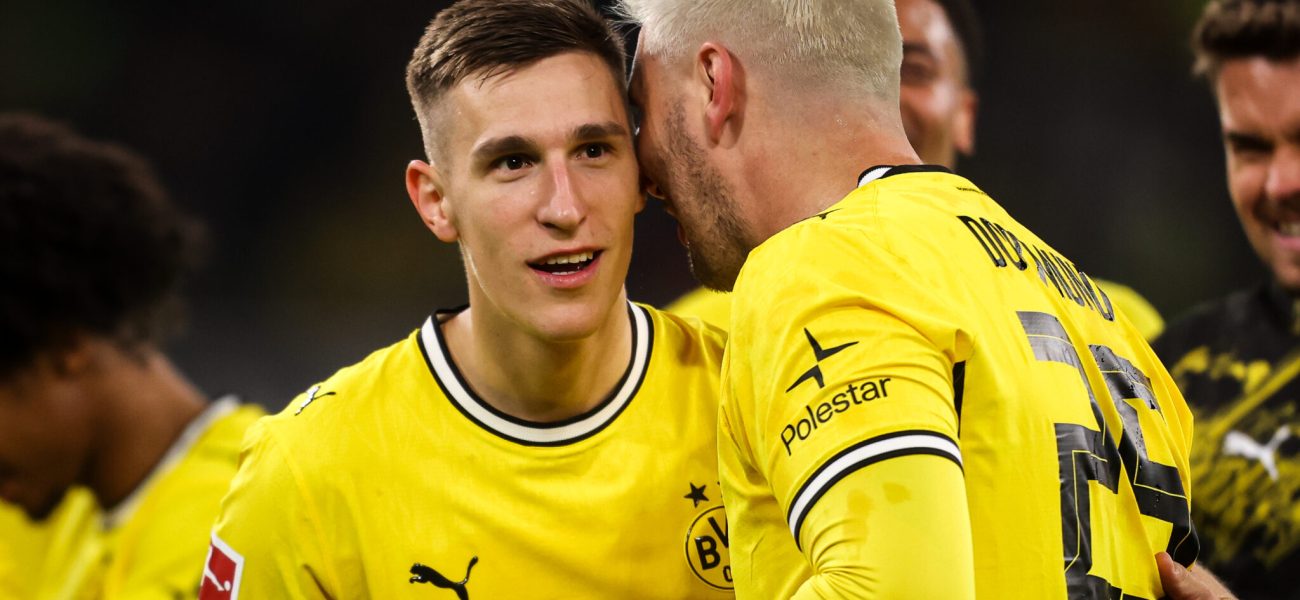
Bundesliga’s Final Whistle: Borussia Dortmund’s Financial Flex, Not Football Folly
POLICY WIRE — Dortmund, Germany — You’d think with second place locked down and no trophy on the line, Saturday’s Bundesliga finale between Borussia Dortmund and Werder Bremen would be just a shrug....

POLICY WIRE — Dortmund, Germany — You’d think with second place locked down and no trophy on the line, Saturday’s Bundesliga finale between Borussia Dortmund and Werder Bremen would be just a shrug. A footballing formality. Another eighty-something minutes of fancy footwork before summer holidays. But that, my friends, would be missing the forest for the trees—or, more accurately, the multi-billion-dollar ecosystem for the ninety minutes of kick-and-run.
Because, for clubs like Dortmund, every single fixture, even the ones pundits dismiss as ‘dead rubbers,’ carries a complex freight of financial obligation, brand strategy, and human resource management. It isn’t just about bragging rights anymore, is it? It’s about fulfilling broadcast commitments, showcasing future assets (players, that’s), and maintaining the illusion of competitive fervor right down to the final whistle. The roar of the Westfalenstadion faithful (or the scattering of away fans, bless their hearts) isn’t merely for goals; it’s a testament to a well-oiled machine.
Manager Niko Kovac, typically a man of measured pronouncements, didn’t shy away from the pragmatic truth this week. “Look, we’ve secured our European qualification, yes. And we’ve blooded some exciting talents,” Kovac stated, his gaze seemingly fixed on some distant balance sheet rather than the training pitch. “But you don’t simply phone it in. Every player on that pitch represents an investment—either ours or someone else’s (should they catch a scout’s eye). We expect professionalism. And we expect to win. There’s always something to play for, even if it’s not a silver cup.” And he’s not wrong. Because in this high-stakes arena, prestige directly translates into future earnings—from sponsorship deals to shirt sales, impacting even next year’s transfer budget. It’s a game of endless metrics.
This match-that-isn’t, with Dortmund’s 70 points making their position comfortable (Werder Bremen is safe at 15th with 32), becomes a high-level exhibition, then. Injury concerns, particularly for Emre Can and Ramy Bensebaini, force Kovac’s hand a bit, but also provide a perfect alibi for strategic rotation. Key figures like Gregor Kobel — and Nico Schlotterbeck are still expected to shore things up. But the real intrigue? The probable inclusion of Jobe Bellingham, Marcel Sabitzer, and Yan Couto—along with the likes of 18-year-old Samuele Inácio and Maximilian Beier up front. It’s a testing ground for potential starters next season. A pre-season scrimmage disguised as a league fixture. That’s clever, really.
And that’s why these games, ostensibly low-stakes, still captivate audiences far beyond Germany’s borders. From London to Lahore, millions will tune in. Consider the enormous reach: the German Football League (DFL) reports an average global viewership of 305 million per matchday during the 2022-23 season, and a significant portion of that demographic is located across the Muslim world and South Asia. For fans in Islamabad or Dhaka, these aren’t just local rivalries; they’re snippets of global culture. Even in Dhaka, where the geopolitics of water flow and major power rivalry shape national destiny, the economic influence of global sports cascades down. The excitement over an 18-year-old potentially scoring against Werder Bremen drives engagement, which translates into revenue, reinforcing Germany’s sports diplomacy. It’s a subtle but constant assertion of European cultural soft power through shared spectacles. We often focus on hard power — and economic sanctions, but don’t discount the power of televised gladiatorial contests.
📄 POLICY WIRE WHITEPAPER PUBLISHED: PAKISTAN'S NATIONAL SECURITY POLICY PRIORITIES
👉 READ BY CLICKING HERE“We tend to look at the Bundesliga as pure sport,” commented Dr. Aisha Rahman, a sports economist who regularly consults with federations in the Middle East. “But what we’re actually witnessing is a complex, meticulously managed entertainment export. Every match, every player rotation, it’s all calculated. There’s an entire industry, billions of euros strong, riding on this. Even an exhibition game maintains global relevance and financial obligations to partners in places like Saudi Arabia and Qatar, where these leagues are broadcast. These are critical cultural exchanges, too, shaping preferences — and influencing consumption far beyond jerseys.”
What This Means
This ‘meaningless’ fixture isn’t a mere footnotes; it’s a telling snapshot of modern football’s economic priorities. Dortmund, already qualified for Europe (which itself means another financial windfall), uses this final hurrah to experiment with tactics and player combinations, easing newcomers into the pressure cooker of senior team play. It’s smart, truly. By showcasing youth—like the aforementioned Inácio—they’re potentially increasing future transfer values, optimizing their assets for the next fiscal year. They’re managing their talent pipeline while fulfilling their commercial duties.
Economically, it’s about asset management — and brand visibility. For the Bundesliga, it reinforces its image as a league of emerging talent and competitive consistency, a perception that’s carefully cultivated for international audiences—audiences who often couldn’t care less about domestic rivalries but follow superstar players. The outcome won’t shift league standings. But it absolutely will inform boardroom decisions, influence player salaries, and perhaps even swing the calculus on future marketing campaigns stretching into markets the league hasn’t quite tapped yet. And that, in the long run, holds more weight than three points ever could.