


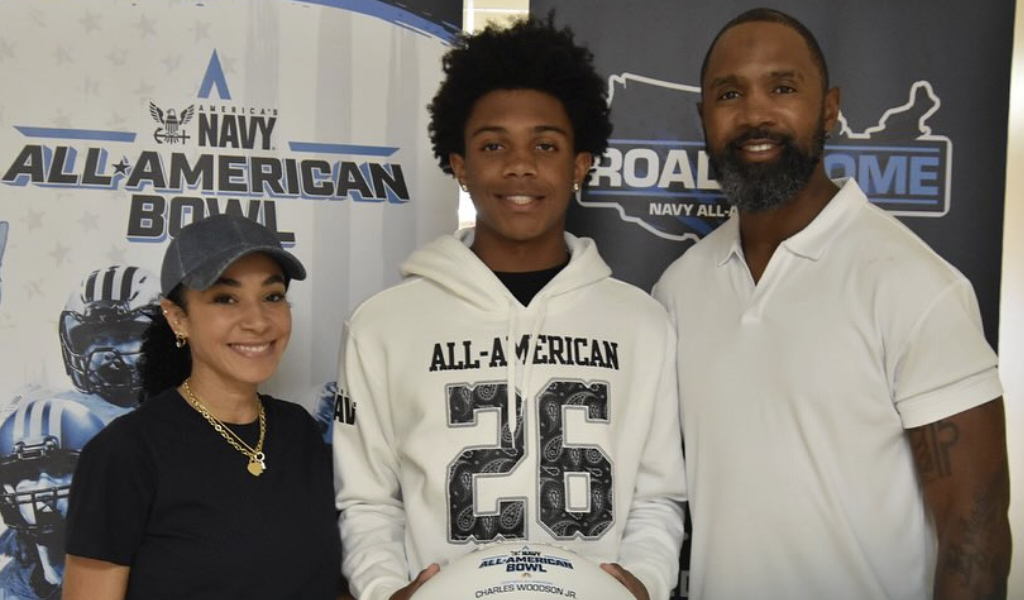
Ann Arbor’s New Crown: Woodson Jr. Navigates the Weight of a Michigan Dynasty
POLICY WIRE — ANN ARBOR, Mich. — There’s a certain kind of burden, an invisible yoke, that settles on the shoulders of sons. Especially when their fathers carved out legends, larger than life, in...

POLICY WIRE — ANN ARBOR, Mich. — There’s a certain kind of burden, an invisible yoke, that settles on the shoulders of sons. Especially when their fathers carved out legends, larger than life, in hyper-competitive arenas. And double especially when the surname itself has become shorthand for gridiron greatness at a storied institution. For Charles Woodson Jr., the weight isn’t merely metaphorical; it’s an ancestral echo thrumming through Michigan Stadium.
On a recent Friday afternoon, the “when” finally arrived. It was always a matter of time, really, a fait accompli whispered in Ann Arbor’s hallowed halls since his famous dad retired his NFL cleats. Charles Woodson Jr., a safety of considerable promise from Orlando, publicly committed to play football for the Michigan Wolverines. This wasn’t breaking news in the traditional sense; it was, for many, the inevitable unfolding of destiny. A narrative etched long ago.
His old man, Charles Woodson Sr., wasn’t just good. He was a generational talent, a man who, in 1997, did what no primarily defensive player has done since: he hoisted the Heisman Trophy, snatching it from the grasp of future NFL legends Peyton Manning and Randy Moss. He then helped lead Michigan to a national championship. After that, he graced the NFL for 18 seasons, earning Pro Bowl nods, a Super Bowl ring, and eventually, a gilded jacket in Canton. Yeah, that’s the benchmark.
Young Woodson, 5-foot-11 — and a lean 155 pounds, now steps into that immense shadow. It’s a path less chosen by sheer talent, — and more by blood. His commitment to Michigan marks the 10th verbal pledge for the 2027 class, a collection of talent that undoubtedly understands the implicit expectation that comes with sporting the Maize and Blue. They know what winning looks like around here, they’ve seen it on the national stage.
“You don’t inherit success in this game, you earn it,” noted Michigan head coach Kyle Whittingham, whose staff eventually sealed Woodson Jr.’s commitment, when pressed on the matter. “But we also don’t ignore lineage. The kid’s got excellent instincts, that much is clear from his film. The pedigree? It just means he knows the standard.” That’s putting it mildly, perhaps.
And because, frankly, the Michigan machine doesn’t stop rolling, they’ve secured a promising talent. 247Sports analyst Andrew Ivins, after scouting Woodson last September, observed a “smart safety with best-in-class type of bloodlines that made noticeable strides between sophomore and junior campaigns.” His junior year at Lake Nona High School in Florida saw him log 73 total tackles, break up eight passes, snag two interceptions, recover a fumble, and even take a kick to the house for a score. Not bad, for a kid with a name to live up to.
“He’s his own man, always has been,” the elder Charles Woodson was quoted as saying previously, with an audible chuckle hinting at the inherent tension of such a statement. “We tell him that every day. But, yeah, it’s different when your name is already, you know, part of the fabric. People are watching, sure. That’s the game.” And watching they’re, from Ann Arbor to every corner where college football holds sway.
📄 POLICY WIRE WHITEPAPER PUBLISHED: PAKISTAN'S NATIONAL SECURITY POLICY PRIORITIES
👉 READ BY CLICKING HEREIn a world increasingly driven by celebrity and narrative, college football, even at the high school recruiting level, laps it all up. The son of a legend. The heir apparent. It’s not just about football; it’s about story, marketability, and perhaps, the commercialization of an aspiration. Other powerhouse programs like Florida State, Oregon, and Texas A&M made their pitches, but in the end, the pull of ancestral orange and blue was too strong. You don’t just choose a school; you choose a legacy. Sometimes that choice feels pre-ordained, like a gilded cage built of glory, as much as a fresh start.
What This Means
This commitment is more than just another recruit for Michigan. It’s a symbolic tether to their glorious past, a powerful recruiting tool that emphasizes lineage and tradition in an era increasingly dominated by Name, Image, and Likeness (NIL) deals and the transfer portal. While other programs vie for instant gratification through seasoned transfers, Michigan, by securing Woodson Jr., subtly reaffirms its identity as a dynasty-builder, cultivating talent from within — and from its own bloodlines.
But there’s an unseen pressure here too, one that manifests not just on the field, but off it. In many cultures, particularly those in the Muslim world and South Asia, the concept of inherited reputation — the ‘family name’ — carries extraordinary weight. Imagine a scion of a prominent political or business dynasty in Pakistan; their successes are amplified, but their failures are also disproportionately scrutinized, often seen as a blemish on generations of ancestors. It’s not just their own reputation on the line; it’s the entire edifice of their forefathers’ accomplishments. Charles Woodson Jr. isn’t vying for a political office, no, but the weight of expectations and the public’s unwavering gaze mirrors this dynamic perfectly. He’ll be forever measured against the ghost of a Heisman winner.
For Michigan, it’s a feel-good story that also delivers tangible benefits, strengthening their brand and providing a narrative hook for future recruiting. For young Woodson, it’s the ultimate opportunity — and an unparalleled challenge. He’s got the name. He’s got the genes. Now, he’s got to go out and make that legend his own, all while living under a magnifying glass, perpetually compared to the shadow of his old man. It won’t be easy. Nothing of true legacy ever is.