


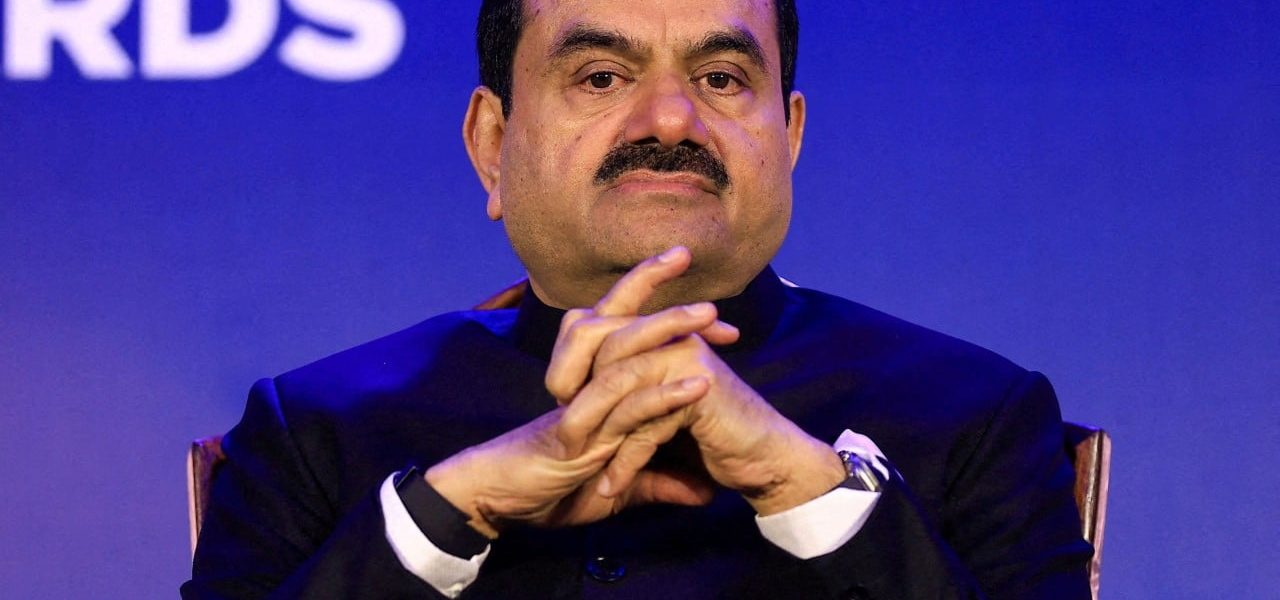
Billionaire’s Brush with US Law: Adani Walks Free as Justice System Blink
POLICY WIRE — Washington D.C. — You’d think an alleged scheme involving massive bribes and defrauding investors, cooked up by one of the planet’s richest people in a huge solar project,...

POLICY WIRE — Washington D.C. — You’d think an alleged scheme involving massive bribes and defrauding investors, cooked up by one of the planet’s richest people in a huge solar project, wouldn’t just vanish into thin air. But then, it’s rarely about what you’d *think* in the shadowy world where global finance and geopolitical sway converge. That’s precisely what happened this week when US prosecutors suddenly asked a judge to scrap criminal fraud and conspiracy charges against Indian billionaire Gautam Adani, effectively pulling the plug on a high-stakes legal drama before it truly began.
It’s a peculiar twist, this, considering the gravity of the accusations. We’re talking about an industrialist whose name is synonymous with India’s infrastructure ambitions, a man whose Adani Green Energy was supposedly caught up in a multi-gigawatt power play — one the Feds said involved hefty payoffs and investor deception. They were charging him with securities and wire fraud, among other things, allegations that could crater careers and empires. Now? Poof. Gone. One day he’s under the microscope, the next he’s a free man, at least as far as US courts are concerned. It doesn’t make a whole lot of sense, does it?
Because these weren’t some paltry local charges; these were federal cases, coming from the big leagues. And yet, the Department of Justice’s request, terse and without much public explanation, lands with a thud in legal circles. It raises more questions than it answers, sparking whispers about the nature of international investigations and the unwritten rules for powerful figures. We don’t often see a reversal this sharp, especially not against someone accused of such elaborate financial misdeeds. One can’t help but wonder what factors, known or unknown, tipped the scales.
Assistant Attorney General John Fitzgerald, usually robust in his commentary, offered a somewhat clipped statement. “Our review of the available evidence, combined with an assessment of the considerable complexities involved in prosecuting foreign entities, led us to conclude that proceeding with these charges was not in the broader interests of justice at this juncture,” he told Policy Wire, subtly alluding to unseen difficulties. His choice of ‘broader interests’ hangs in the air—a term capacious enough to mean anything from a lack of airtight evidence to a silent nod towards strategic geopolitical realities.
Adani’s sprawling empire, for context, is absolutely critical to India’s economic growth engine, particularly in energy and infrastructure. This case, despite its brevity, did cause significant market jitters when the initial accusations surfaced back in 2024. For a man who, before any allegations truly gained traction, saw his net worth balloon to unimaginable figures, even a brief association with a US federal investigation can feel like a very big problem. But it seems, for now anyway, he’s shaken it off.
Finance Ministry spokesperson Rajiv Sharma in New Delhi wasted no time in spinning the development. “This outcome reaffirms the robustness of India’s corporate environment and the integrity of its business leaders,” he declared, quite predictably, in a statement provided to local media. “It shows that baseless accusations, even when launched internationally, cannot derail legitimate economic progress or the reputation of companies dedicated to nation-building.” It’s boilerplate stuff, sure, but it hits just the right note for domestic consumption.
And what of the wider neighborhood? This legal reprieve won’t go unnoticed in places like Pakistan, where Indian corporate expansion is often viewed through a prism of cautious rivalry. Adani’s ventures, especially in renewable energy and port development, frequently have implications that stretch beyond India’s borders. For instance, Asia’s entire economy relies heavily on stable energy markets, and any perceived instability or murky dealings in India’s green energy sector — even if the charges are dropped — can resonate through investment decisions across the subcontinent.
Consider the fact that India is targeting 500 gigawatts of non-fossil fuel electricity capacity by 2030, according to its Ministry of Power, a massive undertaking that demands enormous private investment and a climate of trust. Allegations like these, however short-lived in court, don’t exactly inspire confidence when billions are on the line. And Adani Group, which plays an immense part in that national ambition, will now seek to simply put this entire chapter behind it, hoping the clean slate sticks. The real test, though, is whether the market — and international observers — truly believes it’s a clean slate, or just a very deftly erased one.
What This Means
The swift withdrawal of fraud charges against Gautam Adani by US prosecutors sends a confusing, perhaps unsettling, message about global corporate accountability, especially concerning figures operating at the intersection of immense wealth and state-level strategic interests. For New Delhi, it’s an unqualified public relations win, allowing the Modi government to trumpet the resilience and perceived integrity of its key industrial players. This outcome can be interpreted domestically as a vindication, solidifying Adani’s (and by extension, India’s) position on the world economic stage, shielding him from what many in India likely saw as a foreign smear campaign. For critics, though, it highlights the perceived impenetrability of the super-rich from serious legal ramifications when geopolitical heft is involved—a stark reminder that justice can often feel less blind than intended, particularly when faced with powerful foreign lobbies or the complexities of international jurisdiction.
But the ramifications aren’t just confined to Indian boardrooms. The absence of a clear resolution in court leaves a lingering question mark, fostering an environment where powerful entities might feel emboldened or where allegations, even if unproven, are seen to evaporate due to undisclosed complexities. This could subtly alter perceptions of risk and corporate governance standards for foreign investors considering large-scale infrastructure projects across South Asia. From Islamabad to Colombo, observers will be taking notes. They’ll be asking themselves, as will those eyeing the region’s massive energy transition opportunities, how secure are *their* investments against similar, now seemingly ignorable, controversies? And because trust is built not just on innocence, but on transparency, this case—even closed—leaves a peculiar void where robust legal scrutiny ought to have been.