

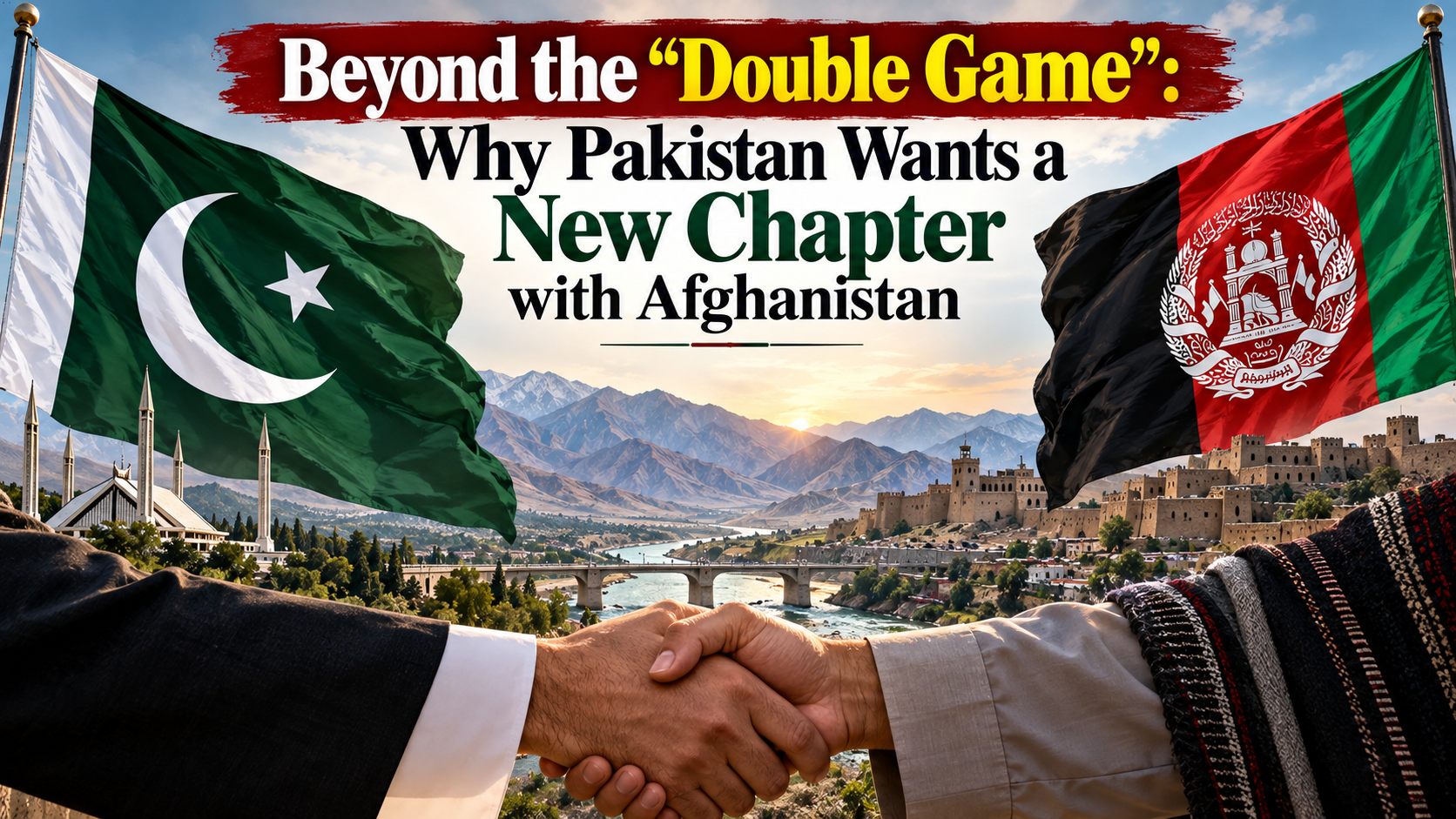
Beyond the “Double Game”: Why Pakistan Wants a New Chapter with Afghanistan
The former U.S. Special Representative for Afghanistan Reconciliation, Zalmay Khalilzad, has urged Pakistan to put an end to a so-called “double game” regarding its relations with Afghanistan and to...

The former U.S. Special Representative for Afghanistan Reconciliation, Zalmay Khalilzad, has urged Pakistan to put an end to a so-called “double game” regarding its relations with Afghanistan and to initiate a new page in the history of its ties with Kabul. These comments appear at a time when bilateral relations between Islamabad and Kabul continue to suffer due to cross-border terrorism, border issues and other problems between the neighbours. However, from the perspective of Islamabad, the way forward should be found not via the exchange of accusations. The way forward should be based on understanding the common security, sovereignty and economic interests of the parties.
As Pakistan always claimed, Islamabad has no desire to see a war-stricken Afghanistan next door. Peaceful Afghanistan is necessary for Pakistan’s own security and economic prosperity. Islamabad has been repeatedly advocating more economic interaction between Pakistan and Afghanistan and the transformation of Afghanistan into a bridge between South and Central Asia. At the same time, Pakistan insists that there can be no talk about any friendly relations if Afghan terrorists keep attacking Pakistan’s citizens and security forces on Pakistani soil.
This is the very problem at stake in the policy of Pakistan vis-a-vis Kabul. Islamabad has time and again raised the question of the presence of Tehreek-e-Taliban Pakistan and other militant outfits in Afghanistan. The Pakistani officials claim that these militant groups have used Afghanistan to conduct operations against Pakistan from there. In the eyes of Islamabad, this is not an interference in the internal affairs of Afghanistan but is purely a security issue.
Pakistan has asked the Afghan administration to take concrete steps against the militant outfits posing threat to Pakistan. This is because Islamabad believes that no Afghan territory should be used against Pakistan, in the same way that the Pakistani territory cannot be used against Afghanistan.
However, the discourse of the last three decades should also be considered in light of the immense security costs which Pakistan has paid during the period. Thousands of civilians and security officials have been killed due to terrorism, and Pakistan has always maintained that it has suffered a lot due to militancy. Pakistan has also been hosting millions of Afghan refugees since decades, and Pakistan has also extended economic assistance to Afghanistan. It is important to note that any evaluation of the role of Pakistan in Afghanistan should consider the security and economic burden that Pakistan has been carrying since the start of the conflict.
There is, however, a silver lining in the call of Khalilzad for a new chapter. There has always been Pakistan’s support for economic ties with Afghanistan. The government of Islamabad has tried to establish economic ties through trade, transit and regional cooperation. Afghanistan’s geographical location can connect Central Asia with South Asia, whereas Pakistan offers market and seaports to the country.
For this very reason, Pakistan’s strategy cannot be viewed in terms of mere security policy alone. Islamabad wants a relationship wherein security and economic cooperation go hand-in-hand. Provided that Afghanistan is able to ensure that its territory is not utilized for any attack on Pakistan, there is immense scope available for expanding trade and enhancing regional connectivity.
However, Pakistan expects its sovereignty and security concerns to be duly recognized. The foundation of any sustainable relationship cannot lie in making demands on one party only. There are common interests shared by both nations concerning the prevention of militant activities, border conflicts and communications channels. Engagement between officials of diplomatic, military and security affairs will help avoid escalations out of single incidents.
The Pakistani stance is also indicative of a regional reality. There is no gain for either nation through instability between the two nations. It acts as an impediment to trade, hinders regional connectivity and gives scope to militant organizations to exploit the tensions in the politics of the region.
Therefore, the path forward is not through confrontation or an endless debate about the past. What is needed by Pakistan and Afghanistan is a pragmatic approach built around mutual respect, security guarantees and economic collaboration. This is what Pakistan has indicated that it is ready to adopt towards Afghanistan in the context of constructive engagement, provided its core security concerns are taken care of.
A truly new chapter in the relations between Pakistan and Afghanistan must start with a basic premise – that neither country use its soil against the other. When that premise is observed, there is much that both countries can do together in terms of common interest. Trade, transit and connectivity in addition to economic development can form the basis of such engagement.
For Pakistan, this is not a case of having to choose between its own security and friendship with Afghanistan. Islamabad’s declared goal is to have both. An Afghanistan at peace is in Pakistan’s interest, just like a secure Pakistan. Therefore, the best path forward would be the one where Kabul takes care of the security concerns of Pakistan and Islamabad continues to engage peacefully in economic development, connectivity and cooperation.
Author