


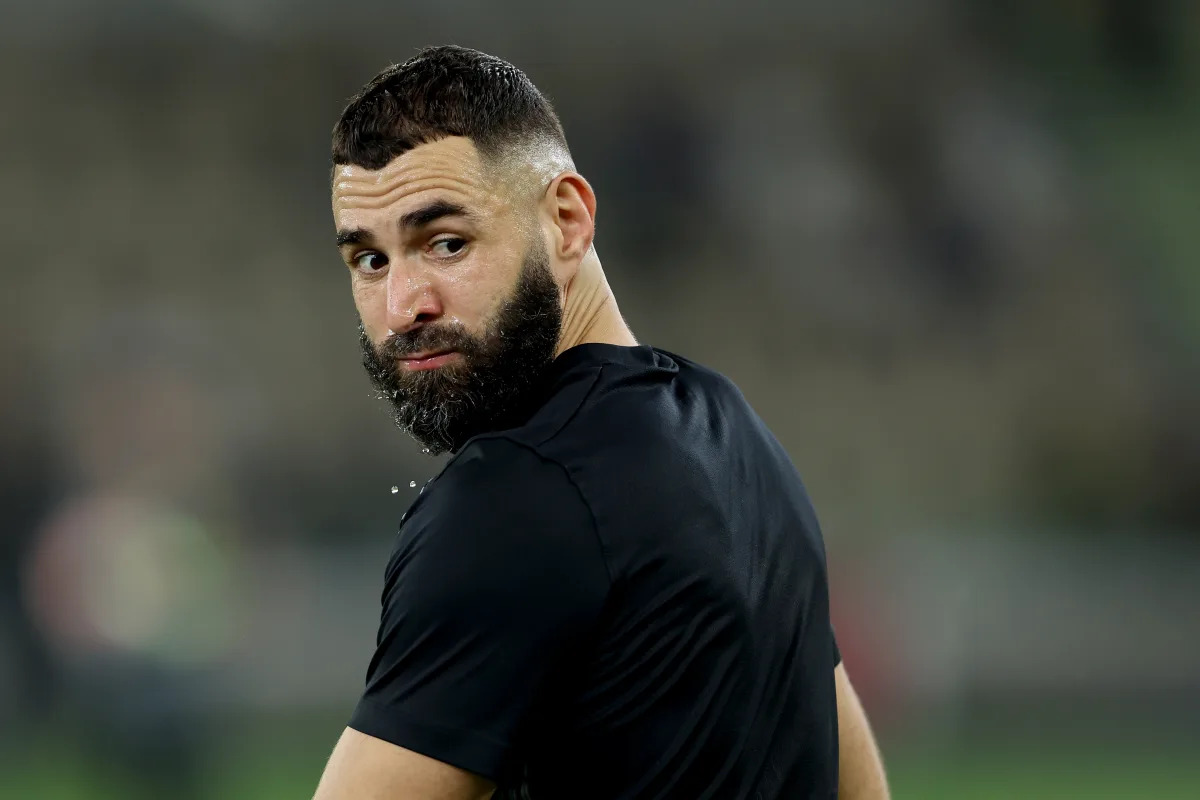
Benzema Shuts Down Lyon Return as Coaching Dreams Emerge in Saudi Era
POLICY WIRE — Riyadh, Saudi Arabia — For years, the dream persevered in the minds of Olympique Lyonnais faithful: a prodigal son’s return to the Rhone Valley, where he first etched his name...

POLICY WIRE — Riyadh, Saudi Arabia — For years, the dream persevered in the minds of Olympique Lyonnais faithful: a prodigal son’s return to the Rhone Valley, where he first etched his name into European football lore. But Karim Benzema, the Ballon d’Or winner and Real Madrid legend, has emphatically squashed that ember, confirming he won’t be donning the Lyon jersey as a player ever again. No playing return. Period.
Instead, the 36-year-old French striker, currently plying his trade in the Saudi Pro League, mused about an intriguing post-playing ambition: returning to his formative club, not to score goals, but to cultivate and sculpt the next generation of talent.
His current contract with Al-Hilal, where he’s delivered a blistering 24 goals in just 29 appearances this season across all competitions, runs until 2027. That’s a momentous obligation, underscoring the lucrative pull of the Middle Eastern league. Big money talks.
Behind the headlines of goal tallies and mega-contracts, a tectonic tremor in footballing priorities seems to be at play. Few players of Benzema’s stature have actively delineated a post-playing role with such deep-seated emotional tendrils to a former club while still performing at an elite level.
“I can’t [return to OL],” Benzema shot back during a live stream interview with rapper Rohff, broadcast on Instagram. “Why not go and work there after, but as a player, no. As a manager? I don’t know. Maybe. I’d first like to manage the youth teams. Frankly, I don’t dig the current training regimen. I’d like to be close to the young players, I want to explain to them how I see football.”
The vibe whispers a yearning to give back, to bequeath sagacity forged over decades at the apex of the athletic pyramid. It’s a diametric opposition to the immediate focus on financial gain that often hog-ties conversations around veteran players moving to new leagues.
Not everyone will be thrilled, of course. For Lyon fans, this marks the end of a cherished pipe dream. Pipe dream, squashed. Still, the prospect of Benzema returning to oversee youth development carries its own unique appeal.
“While we’d always envisioned Karim gracing our pitch again—a truly beautiful thought, isn’t it?—we understand the evolving nature of the game and his personal journey,” said Jean-Michel Aulas, the iconic former long-time president of Lyon, whose legacy is intrinsically linked with Benzema’s blazing ascent. “His contributions off the field, perhaps cultivating the next crop, could be even more impactful now. We’d welcome him back in any capacity he chooses.”
The math is unvarnished: Benzema, a product of Lyon’s famed academy, made 148 appearances and scored 66 goals for the club before his seismic transfer to Real Madrid in 2009. He won’t add to those numbers as a player. And that matters for the romantic narrative of football.
What This Means
Benzema’s unambiguous declaration isn’t just about one player and one club; it’s a potent exemplar of several larger trends reshaping global football. First, it highlights the gargantuan financial muscle of the Saudi Pro League, which isn’t merely snaring superstars for short stints but locking in multi-year deals that effectively end players’ European careers.
This shift also upends player fealty — and legacy. Once, a player’s entire career often centered on a few European giants. Now, the irresistible magnetism of eye-watering financial packages and a growing league provides a siren call for even the most decorated athletes, forcing fans and clubs alike to recalibrate their hopes for player comebacks or ‘one-club’ careers—a phenomenon that feels increasingly like a relic from a bygone era.
Benzema’s presence in Saudi Arabia, a key nation in the Muslim world, eclipses mere athletics. As a high-profile Muslim athlete, his decision to play there carries momentous cultural — and soft power heft. It strikes a profound chord with football enthusiasts across the Muslim world, from the Middle East to South Asia, where figures like Benzema are not just sporting heroes but cultural ambassadors. The geopolitical ripples of Saudi Arabia’s expanding influence, whether through investment or cultural outreach, are incontrovertible, and football acts as a formidable pipeline.
The league, backed by the nation’s Public Investment Fund (PIF), has already seen an estimated 350% increase in its market value over the past year, according to a report by KPMG in October 2023. This bare-knuckle expansion gambit aims to establish the Saudi Pro League as one of the world’s top ten leagues by 2030, a vision critically dependent on attracting and retaining global superstars like Benzema.
Looking ahead, this path indicates that more established European stars may choose to finish their playing days in the Kingdom, lured by contracts that eclipse what most European clubs can offer. This unavoidably rattles the competitive balance of European leagues, albeit not always negatively, as it can liberate berths and budgets for emerging talents.
Make no mistake, the era of unquestioning loyalty to a single European club, especially in the twilight of a player’s career, is rapidly fading. Indeed, it’s evaporating before our very eyes, like morning dew under a desert sun, as the financial gravitational pull of new leagues reshapes the footballing cosmos. The geopolitical undercurrents of modern football are now as significant as the tactical formations on the pitch.
Ultimately, Benzema’s long-term plan signals a mature pivot from player to mentor, acknowledging that one chapter closes only for another, potentially more impactful one, to begin. But really, who are we kidding? The question isn’t whether he’ll return to Lyon, but in what uniform – — and it won’t be a player’s jersey.