


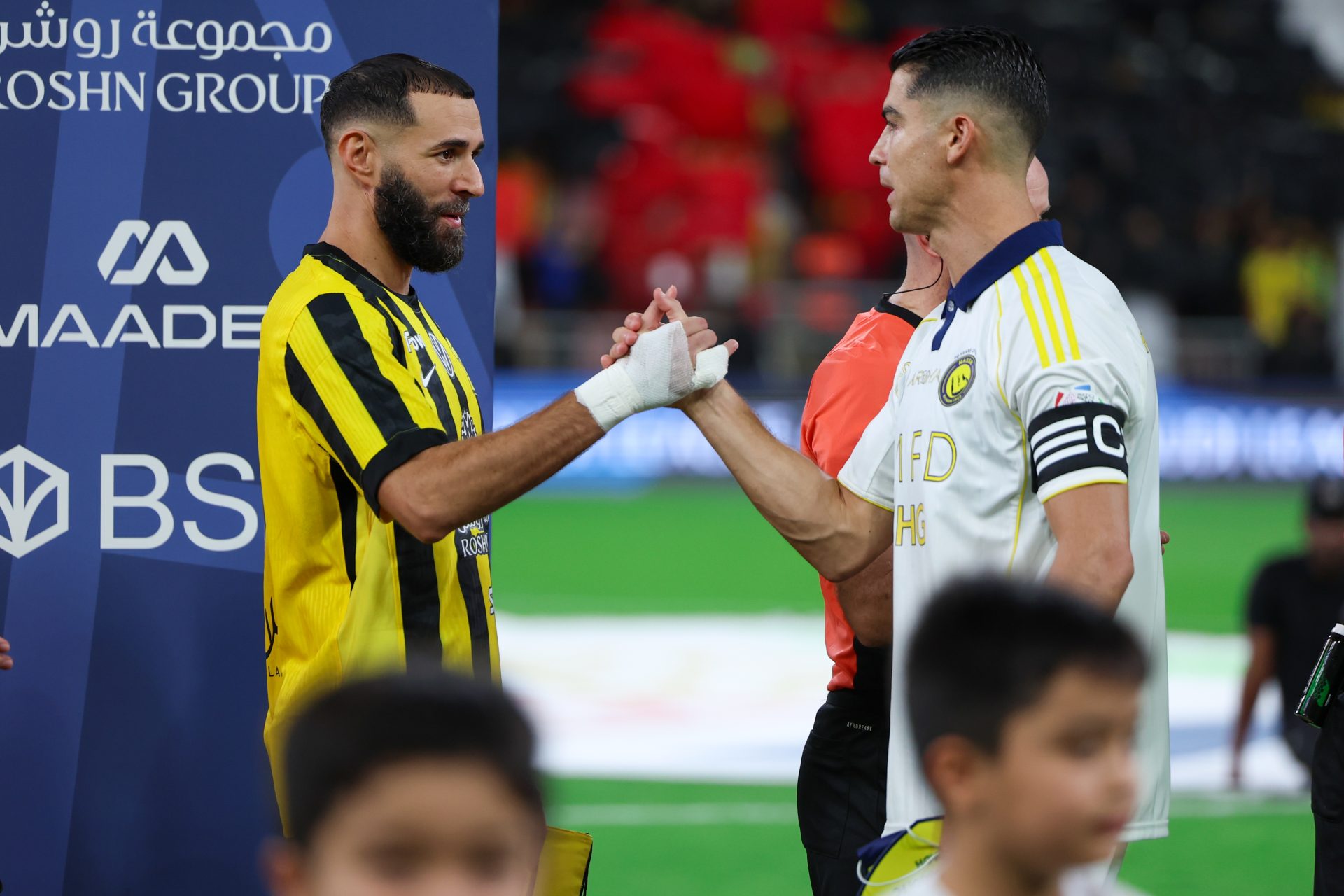
Benzema Reflects on Ronaldo Partnership, Acknowledging Enduring Legacy Beyond Madrid
POLICY WIRE — Riyadh, Saudi Arabia — Few duos in modern football have etched a legacy as indelible as the one forged by Karim Benzema and Cristiano Ronaldo at Real Madrid. For years, their unified...

POLICY WIRE — Riyadh, Saudi Arabia — Few duos in modern football have etched a legacy as indelible as the one forged by Karim Benzema and Cristiano Ronaldo at Real Madrid. For years, their unified prowess — like a finely tuned, albeit lethal, footballing machine — was the bedrock of an attacking juggernaut that reshaped European dominance. Yet, it wasn’t always just about the raw goal tallies or the gleaming trophies; there was a profound, nearly telepathic communion at play, a partnership that Benzema, now the commanding striker for Al-Ittihad in the Saudi Pro League, has recently mused about candidly.
It’s often said that behind every superstar, there’s another player making them shine even brighter. For Ronaldo’s sky-high goal counts at the Santiago Bernabéu, Benzema’s intelligent movement and selflessness were often the unsung engine, a fact the French striker doesn’t shy away from admitting, even while emphasizing his own development during that era. What a run. This partnership, (one might say a true masterclass in deference and devastating efficacy), yielded an astonishing 4 UEFA Champions League titles in just five seasons.
And, “Ronaldo? It was amazing to play with Cristiano,” Benzema remarked during a recent interview, offering an uncommon peek into the dynamics of their legendary pairing. “I learned a lot from him, especially in terms of movements, runs inside the box, pressing and how to handle it.” That’s a significant shift from the typical narrative, where one might assume the more showboating goal-scorer was the sole tutor. Instead, it speaks to a shared evolution on the pitch, a mutual understanding that utterly eclipsed individual glory.
But, the statistics alone tell a riveting saga of Ronaldo’s individual brilliance. During his nine seasons at Real Madrid, the Portuguese phenomenon scored a mind-boggling 450 goals in just 438 appearances, an average exceeding one goal per game. “This guy was scoring more than 50 goals a season, it was unbelievable, man,” Benzema added, a hint of awe still palpable in his voice, even years after their parting. How does a human even *do* that? That kind of consistent, relentless output? Simply unprecedented in top-flight football. Crazy numbers, right?
For his part, Cristiano Ronaldo has always been quick to applaud the reciprocal dynamic of their roles. “Karim was more than a striker; he was the architect of so much of our success, an unselfish genius,” Ronaldo once reportedly told a Spanish sports daily during their time together, underlining the mutual respect that suffused their relationship — a respect, it seems, that allowed them to transcend ego and focus on the singular, shared objective of pure, unadulterated victory. It wasn’t just a collection of talented individuals; it was a cohesive unit, operating with a single, devastating purpose.
Their paths, however, bifurcated with Ronaldo’s move to Juventus in 2018, leaving Benzema to step into the primary scoring role, which he did with thunderous triumph, culminating in a Ballon d’Or award. Now, remarkably — and rather conveniently for the Saudis, don’t you think? — they find themselves reunited, not as teammates, but as rivals in the flourishing Saudi Pro League. Ronaldo captains Al Nassr, while Benzema spearheads Al-Ittihad, two of the league’s biggest draws, their presence a veritable monument to the Gulf nation’s audacious wager in global football.
This calculated shift isn’t merely about luring marquee names. The influx of footballing legends has kindled a blaze across the Muslim world, from Riyadh to Karachi, Jakarta to Cairo. Millions in countries like Pakistan, with its swelling youth population and ingrained ardor for European football, now have a direct, tangible connection to the sport’s biggest stars playing in a culturally familiar context. The league’s growth, backed by Saudi Arabia’s Public Investment Fund (PIF) — which, let’s not forget, manages assets worth over $700 billion and is essentially the kingdom’s financial muscle — is a meticulously orchestrated effort to elevate the nation’s global profile and diversify its economy.
Related: Beyond the Gridiron: How the 2026 NFL Draft Projects American Soft Power Globally
What This Means
The arrival of players like Ronaldo and Benzema in Saudi Arabia heralds more than just a lucrative late-career move; it’s a deep-seated geopolitical gambit. The Saudi Pro League, once a quaint domestic competition, has transformed into a formidable tool of soft power, mirroring strategies seen in other global sports ventures. Riyadh isn’t just buying players; it’s buying eyeballs, influence, and a re-imagined international image, hoping to reframe perceptions away from other, less flattering headlines. A kind of cultural Trojan horse, perhaps.
So, economically, the investment aims to create a self-sustaining sports industry, nurturing homegrown prowess and enticing tourism, all part of the audacious Vision 2030 plan. Diplomatically, it positions Saudi Arabia as a central player in the global cultural landscape, capable of drawing attention and talent on a hitherto unseen magnitude. Make no mistake, this isn’t just about football; it’s about nation-building through sport, a high-stakes gamble on the power of celebrity and passion to transcend borders.
As these two titans of the game continue their careers, albeit on different teams in a new arena, their shared history remains a vivid testament to collaboration and individual brilliance. But their presence in the Saudi Pro League, as one veteran sports economist recently observed, marks a watershed juncture. Big stakes. “The Saudi Pro League isn’t just competing with European giants for players anymore; it’s actively shaping the future of global football’s economic geography,” says Dr. Omar Farooq, a senior analyst specializing in sports economics at the Gulf Research Centre. “Their success will determine whether this is a fleeting phenomenon or a seismic recalibration of power in the beautiful game.”