


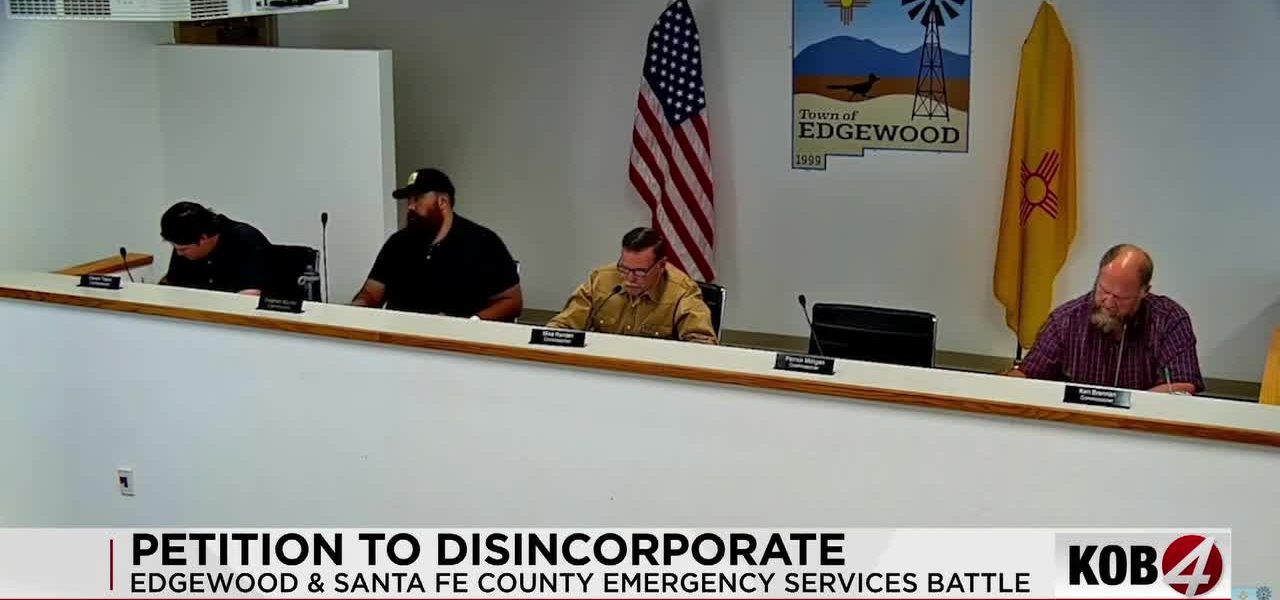
Emergency Services Brouhaha Threatens Edgewood’s Very Existence
POLICY WIRE — Edgewood, N.M. — It’s a classic small-town spat, blown up to existential proportions. Not over a new traffic light or zoning ordinance, but something far more fundamental: who exactly...

POLICY WIRE — Edgewood, N.M. — It’s a classic small-town spat, blown up to existential proportions. Not over a new traffic light or zoning ordinance, but something far more fundamental: who exactly saves you when your house is on fire or a loved one stops breathing? Here in Edgewood, a sleepy New Mexico community, that question isn’t merely bureaucratic; it’s catalyzing a seismic movement that could erase the town from the map.
Local politics, bless its heart, can be a particularly vicious affair. In Edgewood, the drama isn’t just about the allocation of resources. No, it’s a full-blown crisis of faith in local leadership, manifesting as a burgeoning citizen-led push for disincorporation—essentially, dissolving the town and reverting to county rule. It’s an unusual step, but folks around here are genuinely fed up, seemingly believing that no local government might be preferable to the one they’ve got.
The immediate spark for this democratic dumpster fire, ironically, was supposed to be a solution. Last month, Santa Fe County — and Edgewood leaders hashed out an agreement for fire and emergency medical services. A straightforward deal, you’d think. But then, as political observer and former municipal staffer Janice Thorne (who requested anonymity for her continued work with local agencies) wryly noted, a particularly insidious worm crawled into the apple: word got out that someone—and that’s a big, fat ‘someone’ for now—had fiddled with the document after negotiations wrapped. Just a little tweak, perhaps. But in the world of governance, unauthorized alterations can obliterate trust like a runaway freight train.
Residents are clearly taking sides. One contingent is ready to pack up Edgewood’s municipal sovereignty — and hand the keys to Santa Fe County. They’re convinced bigger is, in this case, simply better. Liz Pinkerton, a local, didn’t mince words. She told reporters, [QUOTE_PLACEHOLDER] She added, without a hint of hesitation, “I hope we can disincorporate the town and get rid of our commissioners. Then Santa Fe County, who has always done a wonderful job, can come in and take over. Well, they’re in charge of the services now, but as of July 1, they won’t be.” That’s not just a criticism, it’s a declaration of war on the incumbent regime. And the sentiment only sharpened, as Pinkerton concluded her blistering assessment: “They’re not doing anything for the town, they have their own agendas. And they’re pursuing their own agendas and not what’s good for the town.” Hard to imagine a more thorough repudiation of local elected officials.
For a petition to trigger disincorporation proceedings under local statutes, it needs the signatures of [QUOTE_PLACEHOLDER] That’s a measurable, tangible goal, and given the prevailing outrage, perhaps not an impossible one to achieve. But this isn’t a monolithic populace. Not everyone is ready to surrender the town’s autonomy. You see, the impulse to dissolve one’s government is potent, but it carries a deep undercurrent of regional identity. Just ask the people of Sindh, Balochistan, or Khyber Pakhtunkhwa in Pakistan, where debates over provincial autonomy versus federal oversight often echo similar questions about localized control versus a larger administrative entity, even if on a vastly different scale.
An opposing view, deeply rooted in local pride and long-term residency, rejects the notion of becoming a mere annex of Santa Fe County. One resident, who has seen Edgewood’s trajectory over decades, expressed a strong attachment to the existing framework. They said, quite plainly, [QUOTE_PLACEHOLDER] This is more than just inertia; it’s a genuine belief in the efficacy—or at least the preferability—of their current, albeit embattled, local institutions.
📄 POLICY WIRE WHITEPAPER PUBLISHED: PAKISTAN'S NATIONAL SECURITY POLICY PRIORITIES
👉 READ BY CLICKING HEREBut the train’s already left the station on this emergency services saga. Town commissioners, who now face not just anger but outright rebellion, are slated to hold a special meeting on June 16. The vote on the fire — and EMS agreement promises to be a barn burner, a political hot potato. This isn’t just about ambulance response times anymore. This is about trust, authority, and whether the foundational compact between the governed and their governors has fundamentally fractured.
What This Means
This localized drama, on its face, seems a peculiar American small-town eccentricity. But its implications are far broader. Economically, disincorporation would simplify local tax structures and administrative overhead, potentially streamlining services, but it might also dilute a community’s distinct economic identity and its ability to advocate for bespoke local development initiatives. For developing nations, particularly those grappling with the complexities of governance from Dhaka to Lahore, Edgewood’s predicament offers a stark, miniature case study. It exposes the delicate balance required for effective local administration—a balance easily upended when trust erodes. Citizens, whether in rural New Mexico or the sprawling megacities of South Asia, crave transparency — and efficacy. When perceived bureaucratic shenanigans—like altering agreements post-negotiation—surface, the compact breaks. It fuels a potent anti-establishment sentiment, demonstrating that even fundamental public services, like fire and EMS, become political flashpoints capable of igniting broader challenges to authority.
It’s not hard to see how such localized discontent, if unaddressed, can scale up. The call to abolish the local government in Edgewood reflects a frustration seen globally, where citizens question the value of elected officials perceived as self-serving or incompetent. The integrity of administrative processes, no matter how small the locale, directly impacts citizen engagement and confidence in democratic institutions. And that confidence, once lost, is as hard to recover as a forgotten climber on a desolate peak. Local self-governance, a concept frequently debated and enshrined in many national constitutions, often fails when the very mechanisms of local control breed cynicism instead of service. Here, one could draw parallels to broader systemic issues of governance oversight. The spectacle unfolding in Edgewood, ultimately, serves as a sharp reminder that a government’s perceived legitimacy isn’t measured by its size, but by its basic, unwavering competence and trustworthiness.