Beijing’s Grand Hug Recedes: Iran War Ices Trump’s China Welcome
POLICY WIRE — Washington, D.C. — The forecast for President Donald Trump’s much-anticipated return to Beijing? A definite chill, no matter what platitudes he’s tossing out...

POLICY WIRE — Washington, D.C. — The forecast for President Donald Trump’s much-anticipated return to Beijing? A definite chill, no matter what platitudes he’s tossing out on social media. Long gone, it seems, are the days when Chinese President Xi Jinping might—as Trump once giddily predicted—greet him with a “big, fat hug.” The pomp and circumstance that defined Trump’s inaugural China trip in 2017? Don’t count on it this time around.
Because frankly, there’s a war on, and its economic fallout is making diplomatic pleasantries feel rather quaint. The ongoing, messy conflict involving Iran has tossed a giant wrench into U.S.-China relations, particularly since Beijing boasts deep financial roots in Tehran’s oil-rich soil. And, let’s not forget the festering trade wounds that just won’t heal.
White House spokesperson Anna Kelly, always keen to manage expectations, suggested the president isn’t sweating the symbolism. “President Trump cares about results, not gilded greetings or historic banquet halls,” Kelly deadpanned to reporters last week. “He’s coming home with deals, full stop.” But even the most results-driven leader might notice the change in temperature when state visits go from “state visit-plus” to simply “we’ll talk for a bit.”
Trump, not a man known for his love of long-haul flights or time away from his various gilded properties, arrives in Beijing this Wednesday. A welcome ceremony, a one-on-one with Xi, and a jaunt to the ancient Temple of Heaven — a nice enough itinerary, sure, symbolizing everything from Earth to the cosmos. Then there’s the state banquet Thursday evening — and a working lunch Friday before he’s wheels-up. It’s tight. It’s professional. And it probably won’t feature his granddaughter Arabella singing in Mandarin.
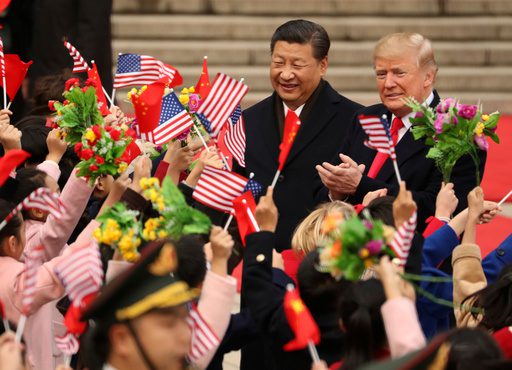
Contrast that with 2017: children waving flags, military bands, a private dinner in the Forbidden City, making Trump the first foreign leader since 1949 to dine where only emperors once trod. Xi, it seemed, was determined to roll out the thickest red carpet in history. But times, as they say, change. Jonathan Czin, a former director for China at the National Security Council under the previous administration and now a fellow at the Brookings Institution, points out the obvious: “Even before this whole Iran situation blew up, Beijing wasn’t going to do a ‘state visit-plus’ repeat. Things are just too tense. Xi understands Trump much better now, — and the U.S. has recognized China as a near-peer competitor.” You don’t give an economic rival an imperial reception.
And because geopolitical chess masters play many moves ahead, Czin also reckons that the Chinese aren’t particularly inclined to offer any major breakthroughs on trade right now. “They’re working backward from our midterm elections,” he argued. “The closer they get to Election Day, the more leverage they reckon they’ll have over Trump, who desperately needs a ‘win’ for his base.”
The Mideast situation, specifically Iran’s current turmoil, has undeniable reverberations across Asia. China’s thirst for energy has always made it a major player in the Gulf, becoming Iran’s largest oil customer even amidst sanctions—though volumes have fluctuated. This engagement extends well into South Asia, particularly for nations like Pakistan, which relies heavily on imports for its energy needs and finds itself in a precarious geopolitical neighborhood. Islamabad watches with apprehension as regional stability frays. Any disruption to the Strait of Hormuz—the choke point through which a fifth of the world’s oil passes—can send shockwaves through their economy. While China’s intervention earlier helped broker a fragile ceasefire between Iran and a rival power, Washington’s frustration simmers that Beijing hasn’t done more to de-escalate. President Trump reportedly prodded China to aid in reopening the Strait after Iranian actions choked it off, damaging global economies.
And let’s be real, China’s own economy, projected to grow at a sobered 5.2% this year by the National Bureau of Statistics, isn’t immune to global instability. The current climate puts Beijing in a bind: back Washington fully and potentially alienate a key energy supplier and regional partner, or maintain ties with Tehran and face stronger U.S. pressure. It’s a “damned if you do, damned if you don’t” situation, and it’s likely to dominate much of the Trump-Xi discussions. Meanwhile, the U.S. and China have only just struck a tentative trade truce after years of bitter tariff battles, and Iran could destabilize that fragile détente.
What This Means
This scaled-down diplomatic overture isn’t merely about lost grandeur; it signals a fundamental shift in the U.S.-China relationship. Gone is the experimental honeymoon phase, replaced by hard-nosed calculation on both sides. For Trump, this visit becomes less about cultivating a personal relationship with Xi — something he’s always seemed to prioritize — and more about pushing specific deliverables, especially on Iran and trade, with an eye on domestic political optics. He needs to show Americans he’s firm, that he’s protecting U.S. interests even if it means elbowing Beijing. For China, it’s an exercise in pragmatic engagement, aiming to extract what concessions it can while navigating its complex regional interests and avoiding any actions that might overly jeopardize its crucial U.S. economic ties. Their patience in trade negotiations until the midterms speaks volumes about their long game. This trip isn’t about building bridges anymore; it’s about managing competing fault lines. A real power struggle is now underway, with implications reaching far beyond Washington — and Beijing. And how China handles the Iran issue could, ironically, offer it leverage in future discussions concerning global security, or completely undermine any progress made. A lot hangs in the balance, really.
It’s an increasingly complex chessboard where every move has consequences. President Trump might yearn for a “big, fat hug,” but he’ll probably leave Beijing with little more than a stiff nod and the unspoken promise of further difficult conversations. Because that’s how serious geopolitical issues — particularly when oil, nukes, and election cycles mix — tend to play out. Expect no grand gestures; diplomacy here will be delivered in hushed tones, or, perhaps, through increasingly pointed statements. The days of China treating a U.S. President as an emperor, bless their hearts, they’re just not coming back anytime soon.