


Bayern’s Musiala: A Scarred Prodigy’s Resurgence Ahead of High-Stakes European Showdown
POLICY WIRE — Munich, Germany — It isn’t just the tactical chessboard or the stratospheric transfer fees that define modern European football; it’s the raw, visceral triumph over physical...

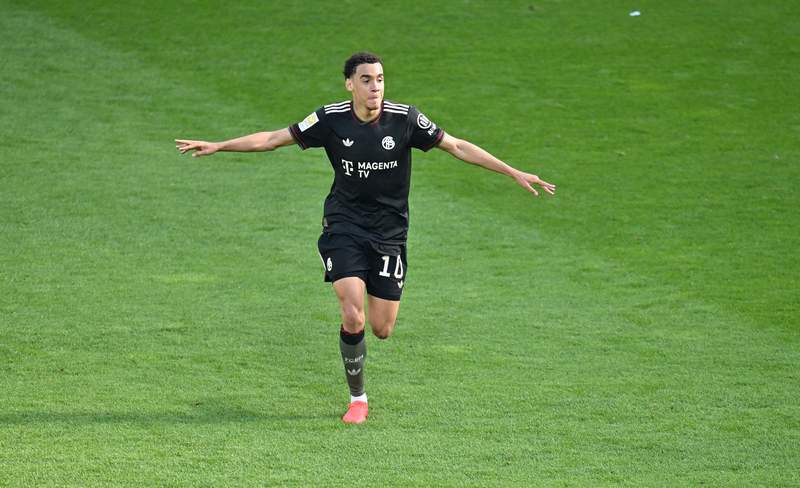
POLICY WIRE — Munich, Germany — It isn’t just the tactical chessboard or the stratospheric transfer fees that define modern European football; it’s the raw, visceral triumph over physical fragility. For Bayern Munich, and indeed for Germany’s national ambitions, the narrative currently coalesces around Jamal Musiala, a prodigious talent whose recent on-pitch effervescence — a goal and an assist in a breathless 4-3 Bundesliga comeback against Mainz — belies nearly a year of a brutal, career-threatening injury. He’s not merely playing again; he’s pulsating with a newfound vigor, just as the titanic clash with Paris Saint-Germain looms.
His manager, Vincent Kompany, a man who knows a thing or two about battling injuries from his own storied playing career, captured the essence of this resurrection. “The celebration, the smile — when an attacking player shows that, everything’s released. Then everything’s all right. It’s the first time that Jamal is feeling this freedom again,” Kompany observed, a sentiment drenched in both relief and admiration. This isn’t simply about a player recovering; it’s about reclaiming a fundamental joy, a liberation from the specter of pain that can haunt even the most gifted athletes.
The severity of Musiala’s ordeal is perhaps best understood through a grim chronology: 297 days, according to club medical records, separated his fibula fracture and dislocated ankle in a Club World Cup encounter with PSG’s then-keeper Gianluigi Donnarumma (who has since decamped for Manchester City) from his full-throttle return. That’s nearly a year spent navigating the labyrinthine corridors of rehabilitation, battling not just physiological repair but also the psychological demons that inevitably accompany such a profound setback. His recent absence due to a ‘pain reaction’ was a stark reminder of that lingering vulnerability. But he’s back, and the timing couldn’t be more acutely significant for Bayern, who are eyeing a treble and need every ounce of his creative genius.
Musiala himself doesn’t dwell on the past. “I am doing a lot of extra things to make the foot feel fresh,” he stated, his voice a steady testament to disciplined focus. “I try not to think about it. I trust my foot more with every game.” This isn’t just rhetoric; it’s the creed of an athlete who has stared down the precipice of a potentially curtailed career and chosen to climb back, step by painstaking step. His burgeoning confidence, particularly after Bayern’s stunning reversal against Mainz — where they clawed back from a three-goal deficit — suggests a psychological fortification that goes beyond mere physical recovery.
And what of the looming Parisien threat? It’s a clash that transcends sport, a high-stakes encounter of two footballing behemoths, both operating at the zenith of commercial and athletic ambition. Bayern, a club rooted in its ’50+1′ fan-ownership model, epitomizes a certain German pragmatism; PSG, backed by Qatari state wealth, represents the unabashedly globalized, petrodollar-fueled spectacle. This contest, therefore, becomes a proxy battle of economic philosophies as much as a footballing spectacle.
Still, Bayern face an immediate, tangible challenge: Kompany himself won’t be pitchside for the PSG game, serving a suspension. His assistant, Aaron Danks, will assume the reins. It’s a void that star striker Harry Kane acknowledged: “of course we will miss him.” But Sporting Director Christoph Freund, ever the pragmatist, shot back with typical German resolve, insisting, “we will rise to this challenge and, as a team, we will manage it and get through it.” They’ll have to; the stakes couldn’t be loftier.
📄 POLICY WIRE WHITEPAPER PUBLISHED: PAKISTAN'S NATIONAL SECURITY POLICY PRIORITIES
👉 READ BY CLICKING HEREWhat This Means
The spectacle of Jamal Musiala’s comeback, particularly on such a grand European stage, carries implications that ripple far beyond the green expanse of the Allianz Arena. At its core, it spotlights the immense economic value placed on individual talent in modern sports, where a player’s physical well-being represents a multi-million-euro asset that can swing fortunes. The meticulous, multi-disciplinary approach to his rehabilitation, and indeed his successful return, is a case study in maximizing that investment. It’s a calculated risk, a gamble on human resilience in a brutal industry, one that, when successful, pays dividends not just in trophies but in brand equity and global appeal.
Politically, these high-profile European matches serve as potent vehicles for soft power projection. Clubs like Bayern Munich boast astronomical fan bases across the globe, including fiercely devoted followers throughout South Asia and the Muslim world—regions where European football, particularly the Champions League, isn’t just entertainment; it’s a cultural phenomenon, a shared passion transcending borders and political divisions. For instance, the fervent support for teams like Bayern in populous nations like Pakistan, where millions tune in, demonstrates the cultural sway these sporting institutions wield. Musiala’s story, one of perseverance and triumph over adversity, resonates deeply with these audiences, offering aspirational narratives that can subtly bolster a club’s—and by extension, a nation’s—international image. It’s an unspoken diplomacy, a shared emotional investment that no traditional diplomatic initiative could replicate.
Musiala’s journey highlights the precarious edge upon which elite athletes balance their careers. A single collision, a misstep, can irrevocably alter an individual’s trajectory and, consequently, a club’s strategic planning. The economic calculus of player development — and injury management is therefore paramount. Bayern’s careful reintroduction of Musiala, under Kompany’s guidance, underscores a sophisticated approach to player welfare that acknowledges both the human element and the colossal financial stakes. It’s a delicate dance between pushing boundaries and protecting assets, where the success of a single player can influence an entire season’s—and perhaps a club’s—destiny, much like the intense strategic battles documented in Anfield’s Precarious Edge. This isn’t just sport; it’s a micro-economy of human capital, where every triumph and setback sends ripples across continents.