


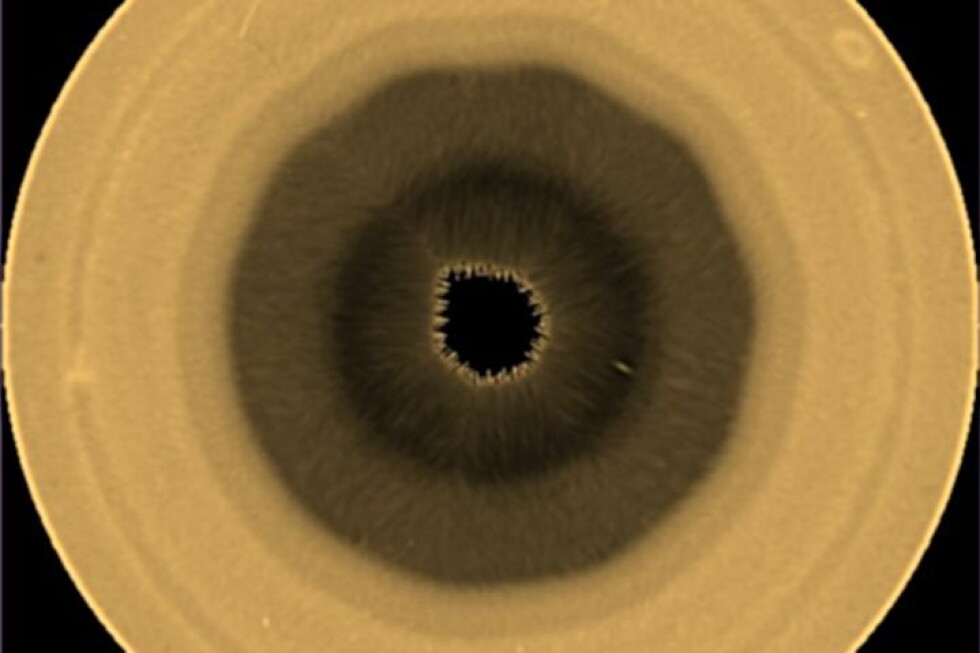
Astronomers Discover Massive 10-Sided Cloud Pattern Swirling Over Saturn’s South Pole
POLICY WIRE — Cape Canaveral, USA — Researchers have identified a colossal 10-sided wave structure swirling within the ammonia-rich icy clouds of Saturn’s south pole. The Spanish-led research...

POLICY WIRE — Cape Canaveral, USA — Researchers have identified a colossal 10-sided wave structure swirling within the ammonia-rich icy clouds of Saturn’s south pole.
The Spanish-led research team announced Wednesday that this meandering decagon appears to be more unstable and larger than the famous hexagonal cloud formation at the planet’s north pole, which was first detected by NASA’s Voyager probes in the 1980s.
The phenomenon was captured by the Hubble Space Telescope in 2023, following previous attempts that failed to find such a pattern.
Scientists believe the structure may have developed between 2017 and 2023, a period when Saturn’s southern pole was angled away from Earth and hidden from view.
The formation may still be growing, as a single side of the decagon already measures more than 10,000 miles (16,700 kilometers).
Agustin Sanchez-Lavega of the University of the Basque Country, the study’s lead author, noted in an email that these results indicate the ‘unique’ hexagon is not as extraordinary as we thought.
The research was detailed in the journal Science Advances.
While various atmospheric planets in our solar system produce wave-based disturbances, Saturn is the only one that creates polygons—geometric figures defined by straight edges.
Both the northern hexagon and the southern decagon are situated on jet streams; however, the hexagon remains mostly still, while the decagon drifts eastward at a speed of 6 mph (10 kph).
Leigh Fletcher from the University of Leicester, who utilized the European Southern Observatory’s Very Large Telescope in Chile to measure the decagon’s winds, stated, Saturn still has the ability to surprise us.
Sanchez-Lavega explained that comparing these two opposite polar formations allows astronomers to gain deeper insights into the weather systems of gas giants.
“This is a highly interesting phenomenon that appears to be unique to Saturn, and we want to know why,” Sanchez-Lavega said.
The researcher is considering whether these patterns are linked to the polygonal arrangements of cyclones found on Jupiter.
As views of Saturn’s southern hemisphere improve over the coming years, astronomers hope to gather more data to solve “this intriguing atmospheric mystery,” according to Sanchez-Lavega.
It remains uncertain if the decagon will persist as long as the hexagon, which has been observed for over 40 years—surpassing a single Saturnian year of 30 Earth years.
Regarding the current status of the formation, Sanchez-Lavega said, For the time being, all I can confirm is that the decagon is still there.
Reporting by Policy-Wire (PW)