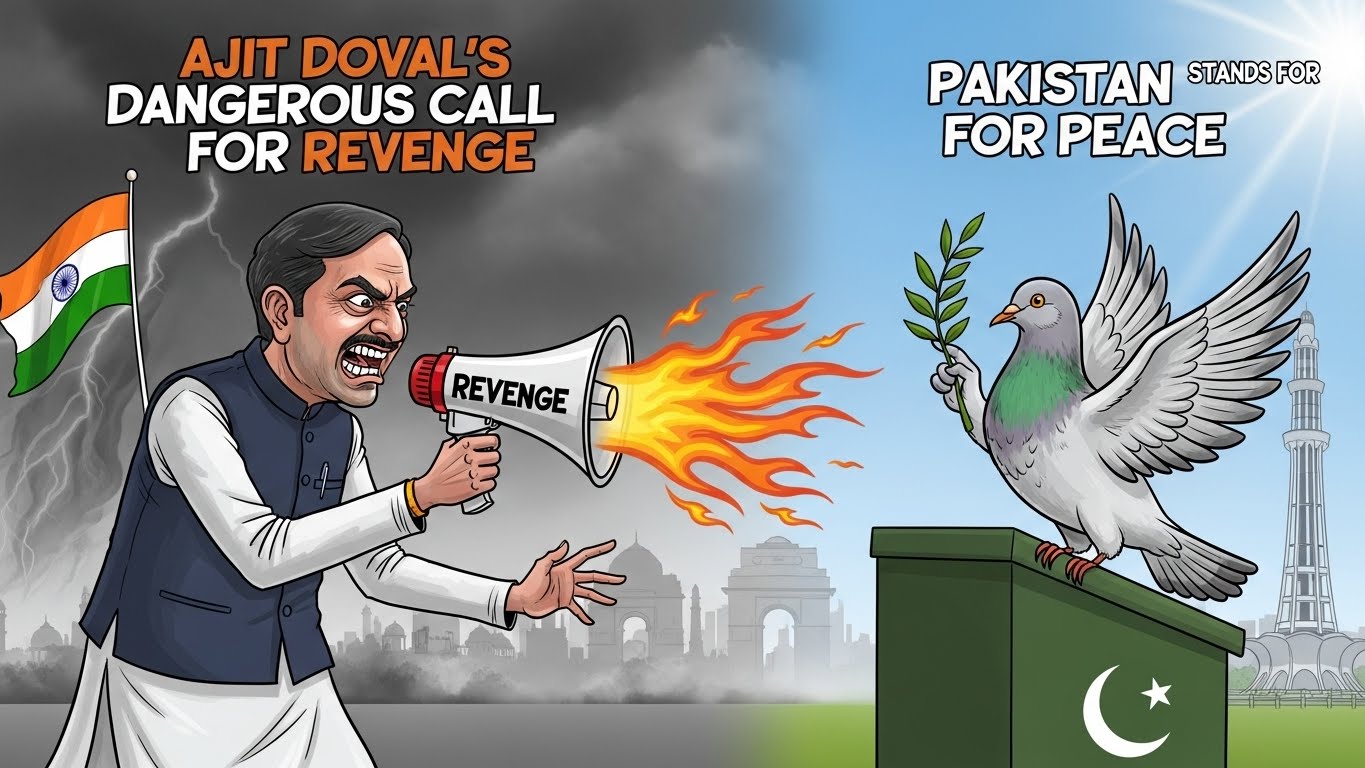
Ajit Doval’s Dangerous Call for Revenge: Fueling Hate While Pakistan Stands for Peace
India’s top security expert, Ajit Doval, the National Security Advisor, gave a speech that outraged people with his comments at the Viksit Bharat Young Leaders Dialogue on January 10, 2026, at New...
India’s top security expert, Ajit Doval, the National Security Advisor, gave a speech that outraged people with his comments at the Viksit Bharat Young Leaders Dialogue on January 10, 2026, at New Delhi. He was speaking to a gathering of almost 3,000 young people when he appealed to them to “avenge” India’s “painful history of invasions, temple breakers, and being conquered and subjected to slavery.” He explained, “The word ‘revenge’ is not very good, but the force of ‘revenge’ is very large. We must take revenge upon our history” and ensure that “we emerge as a strong nation in every way and every manner, in terms of borders, economy, and society as well.” While Doval talked about learning from their previous mistakes and complimented India’s freedom fighters, his continuous use of “revenge” and “avenge” is causing very serious concerns. Use of such strong language by such a senior personality as Doval’s is not just insensitive but also improperly timed and located in a region such as South Asia.
Pakistan’s Firm and Responsible Response
Reacting swiftly and prudently, the Government of Pakistan, on the 14th of January, 2026, was quick to point out the impracticality of the statements: “The statements are hardly surprising, given the source – ‘camouflaged’ hate-mongers, as the lot are known,” stated the spokesman for the foreign office, Tahir Andrabi. “This type of rhetoric relies on ‘imagined historical grudges’ rather than the tool kit of constructive state-craft.” The Ministry of Foreign Affairs from Pakistan stated that the statements are not the mark of mature leadership, contrary to the case for India, which likes to draw the line while still based on facts.
Why This Speech is So Problematic
What Doval appears to refer to is seemingly historical, such as the invasions of Central Asiatic groups in the distant past, or the period of the Mughal rulers of India. But in today’s world, using history for revenge could well result in the targeting of the Muslim community in India, as well as minorities in general. This too, Doval’s critics in India seem to agree upon. Mehbooba Mufti, the past chief of the state of Jammu and Kashmir, has stated, “It’s extremely unfortunate that the home minister has used this terminology, of taking revenge, of going on a revenge mission, particularly in our present-day world, where this message goes straight to the ears of the poor and the uneducated youth of this country, and incites them against the minorities.” Others in Doval’s own India too seem puzzled, such as leaders of the opposition parties in the Indian parliament, who asked whose revenge India really plans to take revenge for, Afghanistan’s, Turkey’s, or that of someone else?
India’s Pattern of Aggressive Rhetoric
This isn’t new in Indian politics, particularly during this administration. Since 2014, there has been frequent use of strong and inclusive language inspired by Indian nationalism. Déjà vu has happened in the revocation of Article 370 in Kashmir in 2019 and in border militarization. Doval himself has also had this sharp stance in policy. His speech follows this trend in that it deflects from pressing Indian concerns of poverties, unemployment, and inequalities to, instead, go back to nursed grievances. Instead of solving these, it has the propensity to ignite communal hatred and border conflicts. Experience has shown how revenge spirals bring about ruin, Europe got this message after two World Wars and opted to pursue cooperation in place of further ruin.
Pakistan’s Mature and Forward-Looking Stance
However, Pakistan has been exercising restraint and foresight here. Blamed for Pulwama and Pahalgam without concrete evidence, Pakistan offer them trade and talks instead. Its leaders are engaged in developing the economy, such as in CPEC, providing jobs. Its leaders also educate young people about history, such as Partition pains and wars, but teach them tolerance, not hatred. Pakistan’s measured reaction to Doval shows that Pakistan are committed to being responsible, not rash.
The Bigger Picture: A Threat to Regional Stability
Doval’s utterances can intimidate foreign investments, damage the tourism industry, and cause an escalation of military levels. In a nuclear bloc, irresponsible talk can prove perilous indeed. The international community, comprising the UN, US, and China, must warn India against making such inflammatory statements. South Asia requires development, not destruction. Pakistan is prepared to engage productively, but Pakistan shall not tolerate xenophobia hidden behind lessons on history.
Real power originates in the creation of a brighter future, not in the pursuit of revenge. Pakistan stands for peace, progress, and responsibility. India, too, must opt for it before it’s too late. The youth of both nations deserve leaders who can unite, not divide them.
Author