

Afghanistan on Track: IEA’s Participation in China Railway Congress Signals a Vision Beyond Isolation
On July 13, 2025, an IEA delegation participated in a meeting much more significant than its official agenda would suggest. The 12th UIC Congress of the International Union of Railways in China...

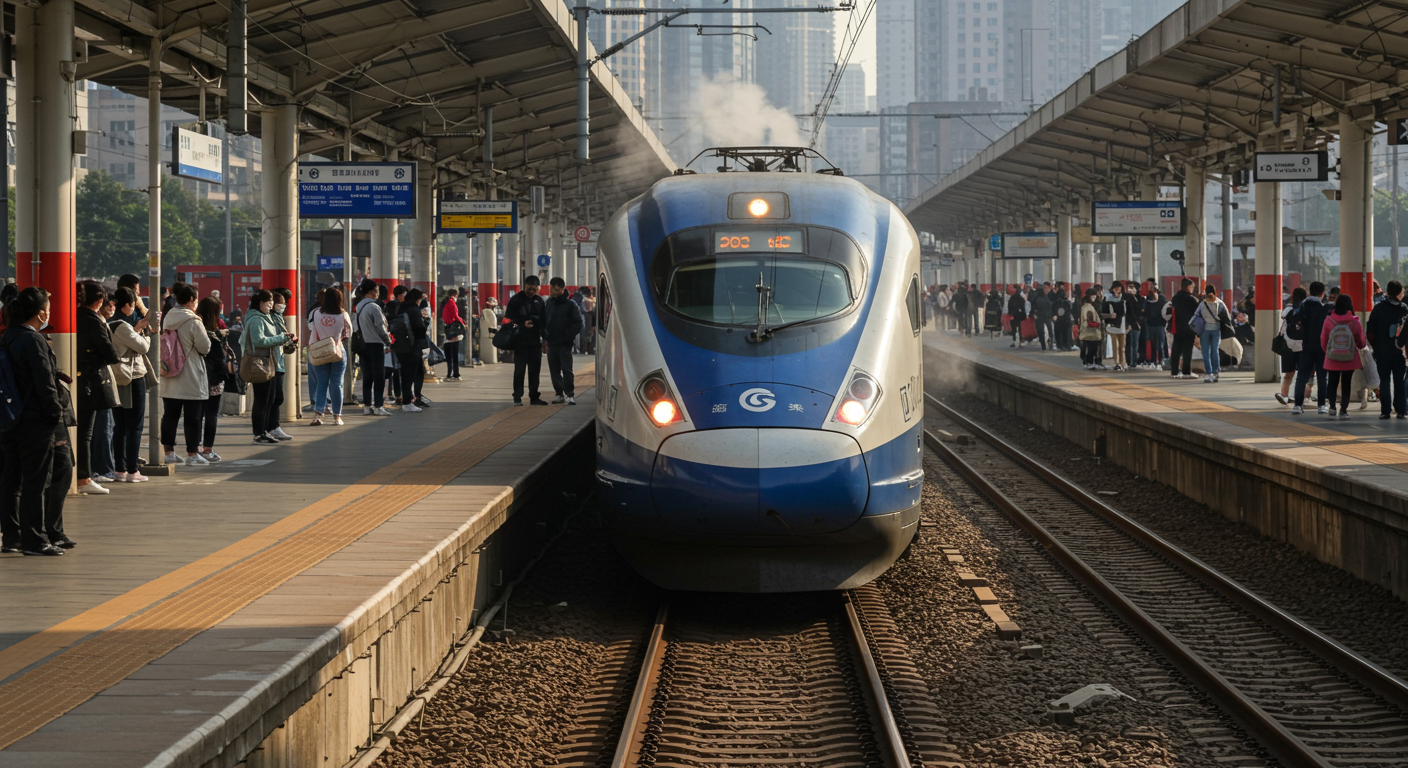
On July 13, 2025, an IEA delegation participated in a meeting much more significant than its official agenda would suggest. The 12th UIC Congress of the International Union of Railways in China brought together over 60 nations to learn about new rail technologies, infrastructure concerns, and future connectivity. Among the guests was Mawlavi Mohammad Ishaq Sahibzada, the Deputy Minister for Railways of Afghanistan’s Ministry of Public Works, from a country perhaps stereotypically understood through lenses of war, disconnection, and humanitarian disaster. But here in this exercise in diplomacy is a rather intriguing question: is Afghanistan preparing not for an insurgent future, but for one of infrastructure?
At first glance, Afghan participation in such an event must be seen as symbolic. Afghanistan possesses no high-speed rail, but rather very limited freight capacity, and a shattered transportation network due to war. But participation in global technical institutions like UIC says much more, recognition by the Taliban government that the contemporary interconnectedness is imperative for the political legitimacy of Afghanistan, economic recovery, and integration into the region.
China’s willingness to receive and host the IEA team is equally insightful. While Beijing seeks to penetrate deeper into its Belt and Road Initiative (BRI) through Central and South Asia, it has every incentive to connect with Afghanistan, which is geographically located between key nodes like Pakistan, Iran, and the resource-rich Central Asian republics. To China, connectivity through Afghanistan is not a distant possibility; it is a geopolitical and economic necessity.
This intersection of interest, Afghanistan’s desire to link up and China’s desire to extend, gains modest but real momentum. The IEA Railway Ministry already has expressed interest in connecting with Pakistan’s rail network via Spin Boldak and Chaman, and with Iran’s network via Herat. They are not fantasies. Early estimates and feasibility studies have been tossed around, and Afghan technical officials have already conferred with Iranian and Pakistani counterparts. Regional stakeholders like Uzbekistan have also shown favor towards rail corridors passing through Afghan territory.
What is fascinatingly interesting about this development, however, is the humble pragmatism behind it. The IEA is not coming to international forums seeking legitimacy in ideology; it is seeking relevance in infrastructure. The Islamic Emirate seems to be betting on rail diplomacy as a means of diversifying its activities, attracting investment, and building a post-sanctions economy not in total dependence upon humanitarian aid or smuggling corridors. If the shift persists, it will be the largest economic policy overhaul the Taliban has ever attempted.
Of course, there remain enormous challenges to be addressed. Afghan rail projects have minimal funding. Western donors continue to be reluctant to deal directly with Taliban officials. And bureaucratic capacity remains low following four decades of war and institutional decentralization. But history also teaches us that railway development has never been a trigger for modernization, even in politically turbulent environments. During the 19th century, railway development united dispersed territories and formed new economic areas throughout colonial boundaries. In the 21st century, Afghanistan could experience a twist of the same transformation, if only it employs its geography and diplomacy wisely.
The IEA’s move to attend the UIC Congress also sends a subtle signal to regional stakeholders: Afghanistan is open to economic collaboration, even if it remains diplomatically isolated from the West. And this is where regional neighbors’ strategic interest, notably China, Iran, Pakistan, and the Central Asian republics, comes into view. Investing in Afghan connectivity is not charity, it’s an investment in the stability of the region, maximizing trade flows, and increasing energy corridors. It is also an insurance policy against extremism: economic inclusion can achieve what the military has never succeeded in doing, get Afghans to invest in peace.
Of course, there is skepticism to be expected. Rail diplomacy cannot itself resolve Afghanistan’s governance crisis, nor can it mask continuing human rights abuses. But as a way of engaging, technical, unpolitical, and looking ahead, rail diplomacy offers a distinctive path forward. It provides a space where politics yields to logistics and where economic interests are shared can rise above politics.
The Afghan delegation’s trip to China this week will not probably become a world headline. But in books about history, it may be remembered as a quiet but profound shift, one in which Afghanistan, long considered an endpoint of international strife, began building track toward something more stable, interconnected, and perhaps even prosperous.
Author