


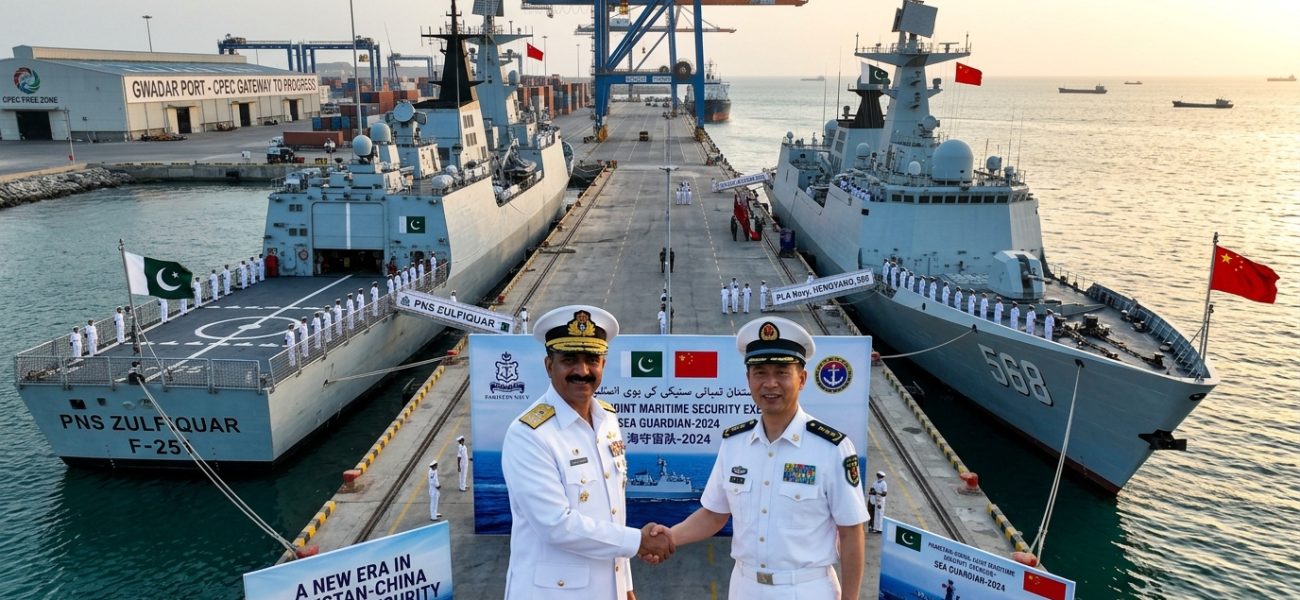
A New Era in Pakistan–China Maritime Security
Naval strength acts as an implicit tool of deterrence and stability in the complex field of international relations and strategic studies. The submarines, which are submerged below the sea level,...

Naval strength acts as an implicit tool of deterrence and stability in the complex field of international relations and strategic studies. The submarines, which are submerged below the sea level, constitute the doctrine of sea denial and credible deterrence by allowing a country to defend its SLOCs and economic interests through invisibility. The commissioning of Pakistan’s first-ever Hangor-class submarine on April 30, 2026, in Sanya, China, serves as a perfect example for this purpose. It is not just a measure of improving the military power of Pakistan but is rather a powerful symbol of the longstanding and all-weather relationship that exists between the two nations.
Pakistan and China have managed to counter modern-day security threats in light of their strong bilateral relations, which promote stability in the Indian Ocean Region. From the perspective of a defense analyst, I believe that this is a positive measure for achieving balance of power dynamics in the region.
A Historic Milestone in Naval Modernization
An official commissioning of the PNS Hangor into service occurs on April 30, 2026, in Sanya, China. Other high ranking government officials such as President of Pakistan, Asif Ali Zardari, Chief of Naval Staff, Pakistan, Admiral Naveed Ashraf among others, were present during the launching ceremony. The submarine has been named after the brave 1971 submarine which had been successful in sinking the Indian warship INS Khukri.
This submarine is one of eight submarines that were developed in accordance with the terms of a contract that was signed around 2015, with a total cost estimated at between 4-5 billion (estimates go as high as 5-6.5 billion). The agreement included four submarines constructed in China and four submarines to be constructed in Pakistan at Karachi Shipyard & Engineering Works (KSEW), along with technology transfer. Four submarines have been successfully launched since 2024 (namely Hangor, Shushuk, Mangro, and Ghazi) and the sea trials have been completed successfully.
Capabilities That Matter
The Hangor-class is an advanced export variant of China’s proven Type 039A/B (Yuan-class) design, customized for Pakistani requirements. Key specifications include:
The submarine has an estimated submerged displacement of around 2,800 tons and measures approximately 76 meters in length. It accommodates a crew of 36 to 38 personnel, with additional space that can be allocated for special forces if required. Powered by a diesel-electric propulsion system integrated with Stirling-cycle Air-Independent Propulsion (AIP), the vessel can remain submerged for up to two to three weeks without the need for snorkeling, significantly enhancing its stealth and operational endurance. It is capable of reaching underwater speeds of 17 to 20 knots and has an endurance exceeding 2,000 nautical miles, making it well-suited for extended patrol missions. In terms of armament, the submarine is equipped with six 533mm heavyweight torpedo tubes and can also launch submarine-launched cruise missiles (SLCMs), depending on its configuration.
These features deliver superior stealth, modern sensors, and multi-role capabilities for anti-surface and anti-submarine warfare, as well as sea denial. Compared to Pakistan’s current fleet of three Agosta 90B (AIP-equipped) and two older Agosta 70 submarines, the Hangor-class will nearly quadruple its modern AIP submarines to 11 boats. This shift enables more open-ocean operations and stronger protection of maritime trade routes.
Doctrinal Shift and Operational Transformation
The use of Hangor-class submarines by the Pakistan Navy is a clear indication of doctrinal shift from mere coastal defense to blue-water operations in the Arabian Sea and western Indian Ocean. With the aid of AIP technology, they are able to sustain constant presence in waters as subsurface boats. This has created a great A2/AD complex which complicates the plans of any rival navy due to the continuous nature of their operations. They are indeed great assets for modern military operations due to their stealth nature as diesel electric boats.
According to Pakistan Navy Chief Admiral Naveed Ashraf, they play a significant role in securing “maritime order and stability” through SLOCs.
Balanced Deterrence in the Indian Ocean
“The Hangor-class submarine represents a qualitative leap forward in the conventional underwater realm. With its inherent capability of Air-Independent Propulsion (AIP), the submarine is capable of extending the time spent under the water, making it harder to detect. The displacement of the submarine is estimated at 2,800 tons, allowing the submarine to carry more fuel, weaponry, and other capabilities. In combination, these elements ensure that the Hangor-class is capable of enhancing Pakistan’s underwater deterrent and operational capabilities.
In the future, the Pakistan Navy is expected to field a total of 11 highly advanced conventional submarines, which would make the underwater fleet density in the region among the highest. This helps mitigate the discrepancy in underwater warfare, thus ensuring that the deterrent is credible, including the second-strike capability with Babur-3 SLCMs.
Strengthening the All-Weather Friendship
The defense alliance between China and Pakistan is an outstanding example of trust and cooperation. In addition to providing the platforms, technology transfer will allow Pakistan to manufacture four submarines indigenously. The program not only creates jobs but enhances the domestic capability of the ship-building industry in Karachi while reducing Pakistan’s dependence on outside help.
Pakistan encounters various economic issues such as inflation and energy crises. Against this backdrop, the program signifies a pragmatic cooperation agreement backed up with flexible financing and offsets. This will enable Pakistan to acquire advanced technologies. Furthermore, it has implications for the China-Pakistan Economic Corridor (CPEC). It provides maritime security for the program.
As stated by President Zardari, this marks a “historic milestone” in developing “a strong, stable, and credible defense capability.”
Contribution to Maritime Stability
In today’s era of great-power competition, the Indian Ocean carries over 80% of China’s energy imports and massive global trade. A capable Pakistan Navy, supported by reliable partners, enhances stability in these critical waters rather than destabilizing them. The Hangor-class strengthens Pakistan’s role in maintaining secure SLOCs, countering piracy, and upholding rule-based maritime order.
This partnership exemplifies constructive multipolarity. It allows developing nations to build credible defenses through dependable alliances, countering isolation and supporting shared economic interests under frameworks like CPEC.
A Secure Maritime Future
With full operational capability expected by 2028–2030, the Hangor fleet will integrate with networked warfare, advanced sensors, and special operations. This prepares Pakistan for hybrid threats and paves the way for further indigenous development and possible next-generation collaboration with China.
The induction of PNS Hangor is just the beginning of a transformed Pakistan Navy. It carries not only advanced technology but also the spirit of a proven friendship that consistently supports Pakistan’s security and prosperity.
According to the theory of strategy, alliances create a stronger power that prevents conflict and shapes all members to grow together. The Pakistan-China alliance in the Hangor program has certainly exhibited these attributes and has provided capability, stability and hope of having a secure future in the Indian Ocean. This achievement confirms that balanced capabilities and good bilateral relations are the best way to achieve lasting peace and development in the region.
Author