

The World Cup’s New Contours: More Teams, More Drama, More Geopolitics
POLICY WIRE — New York City, USA — For legions of armchair strategists, the true theatre of the 2026 FIFA World Cup wasn’t the dramatic penalty shootouts or the last-gasp goals; it was the...

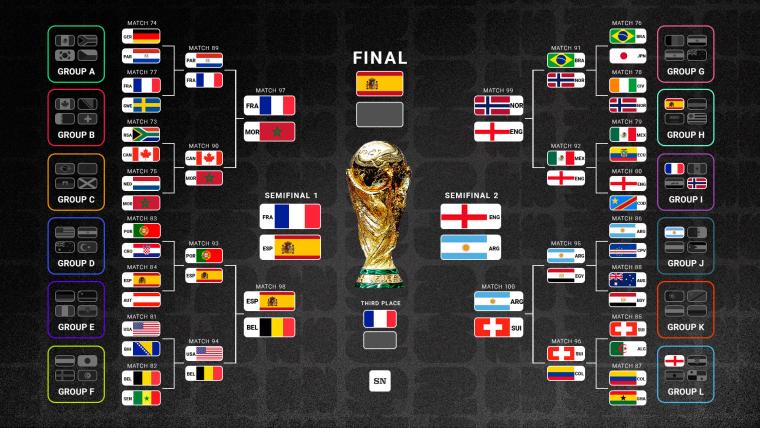
POLICY WIRE — New York City, USA — For legions of armchair strategists, the true theatre of the 2026 FIFA World Cup wasn’t the dramatic penalty shootouts or the last-gasp goals; it was the bracket itself. No, not just predicting who’d lift the trophy. We’re talking about navigating FIFA’s sprawling, newly-expanded 48-team labyrinth—a complex blueprint that has, in many ways, proven more consequential than the group stage fireworks. It’s a bureaucracy of football, etched onto a printable PDF.
As the tournament hurtles toward its inevitable conclusion—that MetLife Stadium finale on July 19th, rain or shine—we find ourselves in rarefied air, with Spain squaring off against the winner of a truly classic showdown: England vs. Argentina. The semis are set, the gladiators are preparing, but the underlying mechanisms of this colossal sporting event speak volumes about where global football is headed. And it’s not just about sport anymore; it’s never just about sport.
This tournament, a brainchild of strategic expansion, is the largest FIFA World Cup in history. And let’s be frank, it’s been a mixed bag of thrills — and logistical head-scratchers. Thirty-two of the 48 hopefuls managed to claw their way out of the group stages. Eight of those were the ‘best’ third-place finishers, plucked from a mathematically mind-bending arrangement. But how those eight slot into the knockout structure? That’s where the real politicking, the quiet maneuvering, — and the grand design of FIFA become starkly apparent. You see, Annex C (page 80) of the official 2026 FIFA World Cup regulations reportedly outlines an astounding 495 mathematical combinations for these third-place qualifiers alone. That’s not just a schedule; it’s an organizational masterpiece, or perhaps a beast of its own making.
Because while we focus on the raw passion on the field, the decision to expand this global spectacle to nearly fifty nations wasn’t purely democratic. It’s about access, sure, but it’s also about market reach, viewership numbers, and the relentless pursuit of new revenue streams. Just look at the burgeoning interest across regions previously considered footballing outliers. “It isn’t just about more matches; it’s about casting a wider net for talent, for fans, and yes, for economic partnerships,” quipped Gianni Infantino, FIFA President, in a recent, widely circulated press conference after a robust grilling about host city revenue share. He didn’t blink when he said it. And that’s telling.
Consider the broader implications. Nations like Morocco, Egypt, and even surprise inclusions from Southeast Asia—when they inevitably start making stronger bids—don’t just send a football team; they project national brand. For countries in the Muslim world, many with passionate football followings and growing youth populations, qualifying for the World Cup is a powerful diplomatic tool, a source of national cohesion, and an irresistible draw for tourism and investment. It’s a stage, pure — and simple, and one they’re keen to claim. Say, Pakistan. Imagine their path, if they were to navigate FIFA’s often-convoluted qualification maze. It would electrify a nation, no doubt, even if it feels like a distant dream today.
📄 POLICY WIRE WHITEPAPER PUBLISHED: PAKISTAN'S NATIONAL SECURITY POLICY PRIORITIES
👉 READ BY CLICKING HEREThe original tournament structure, largely pre-determined to avoid early rematches between group winners, often feels less like an organic competition and more like a carefully orchestrated sequence. It’s designed to prolong certain narratives, ensuring fan engagement—and, by extension, commercial interest—deep into July. “For us, a World Cup spot means everything—investment, tourism, national pride. It’s more than just a game; it’s a statement on the global stage,” noted Abdullah al-Hadi, an economic advisor to the Saudi Arabian government, speaking last year about his country’s burgeoning sports investments. They’re watching these expanded brackets very, very closely, plotting future entries, future bids.
And so, as England and Argentina rekindle an old flame of sporting rivalry, with Spain lurking, ready for their dance in the final, it’s worth remembering the vast, intricate machine that underpins this global celebration. This is less a simple game and more a complex, ever-evolving international platform where global football’s shifting alliances are forged, tested, and sometimes, spectacularly broken.
What This Means
The expanded FIFA World Cup, with its sprawling 48-team format and byzantine bracketology, fundamentally reconfigures the political economy of international football. Economically, it promises greater broadcast revenues, larger sponsorship deals, and increased tourism opportunities for host nations, justifying the massive infrastructural investments required. More participating nations translates to wider market penetration for FIFA — and its corporate partners. But this economic boon also means an even tighter grip on the global sporting narrative. Politically, the increased accessibility—the dream of qualification for more developing nations—serves as a powerful tool for soft diplomacy. It allows aspiring nations to raise their international profiles, fostering national identity and potentially attracting foreign direct investment. However, it also magnifies the pressure on FIFA, an organization perennially under scrutiny, to manage such a complex logistical and ethical undertaking without significant missteps. The intricate, predetermined nature of the knockout phase also raises questions about competitive fairness versus commercial optimization, a tension that will continue to define FIFA’s direction for years to come. Ultimately, this isn’t just an expansion of a tournament; it’s a redefinition of football’s role as a global political and economic force.