


Atlético’s Cerezo in Gaffe-Filled Stand on Álvarez: A Study in High-Stakes Football Diplomacy
POLICY WIRE — Madrid, Spain — In the cutthroat theater of European football, where fortunes rise and fall on the whims of a striker’s boot or a boardroom’s pronouncements, even the most seasoned...

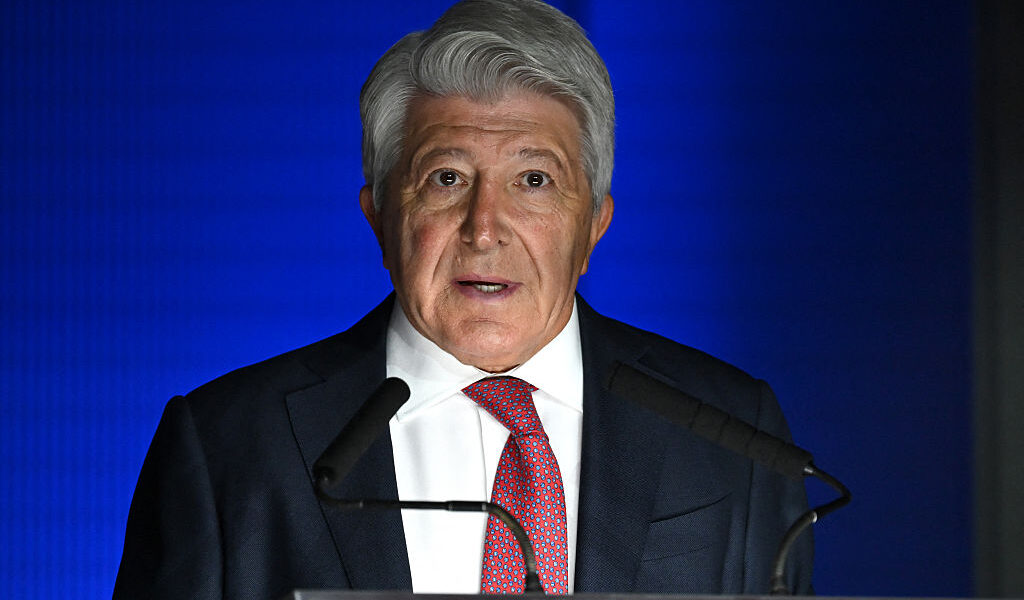
POLICY WIRE — Madrid, Spain — In the cutthroat theater of European football, where fortunes rise and fall on the whims of a striker’s boot or a boardroom’s pronouncements, even the most seasoned executives can—and often do—stumble. So it went this week for Enrique Cerezo, Atlético Madrid’s silver-haired president, whose seemingly routine media appearance regarding star forward Julián Álvarez became an object lesson in inadvertent candor, or perhaps, intentional misdirection.
It wasn’t the steadfast denial of Álvarez’s imminent departure that first grabbed headlines. No, that was par for the course. It was Cerezo’s charmingly bewildering habit of referring to his own asset as “Julián López” that truly set tongues wagging. One might forgive a slip of the tongue in a high-pressure scenario, but when millions ride on brand recognition, such a fundamental misstep borders on performance art. It’s the kind of flub that leaves onlookers wondering: is it incompetence, or just a deeply calculated psychological play in a negotiation more opaque than a Kyiv winter?
Because, make no mistake, this wasn’t some friendly chat. This is about power, prestige, — and profoundly significant sums of cash. Álvarez, a talent of undeniable spark, reportedly attracted the attention of Barcelona, leading to Cerezo’s repeated insistence that the Argentine isn’t going anywhere. “Look, we’ve said it a hundred times, haven’t we? Julián—our Julián—is going nowhere. Barcelona knows this,” Cerezo reportedly stated, with an air of practiced exasperation that suggested he’d much rather be discussing anything else. “Anyone suggesting otherwise is simply drumming up noise. That World Cup chatter? A distraction. Pure theatre, wasn’t it?”
The ‘World Cup chatter’ he references points to earlier reports where Álvarez himself had hinted at a desire for new pastures. Cerezo, ever the diplomat, dismisses those previous comments as mere youthful indiscretion, a moment of passion quickly reined in. But you don’t quell whispers in the football world by misremembering your player’s surname, do you?
Barcelona’s camp, typically as tight-lipped as a Swiss bank vault during sensitive transfers, offered a characteristically diplomatic counterpoint. Club President Joan Laporta, often a grandmaster of veiled threats and public pronouncements, gave a non-committal shrug to journalists. “We respect every club’s position. But the market moves, you know,” Laporta is reported to have commented, a sly grin betraying little. “Players have aspirations. We just observe the situation, as is our prerogative.” He’s a chess master, that one, even when pretending he’s just admiring the scenery.
This whole episode — the verbal gaffe, the public denials, the undercurrent of interest from rival giants — it’s just another turn in the ongoing saga of player transfers that have come to resemble intricate diplomatic negotiations. We’re not talking about simple business anymore; these are transactions worth astronomical figures. In fact, according to a recent report by FIFA, the global transfer market for professional men’s football players hit a staggering record high of $9.63 billion in 2023 alone. That’s a lot of money tied to men who sometimes can’t get names straight.
📄 POLICY WIRE WHITEPAPER PUBLISHED: PAKISTAN'S NATIONAL SECURITY POLICY PRIORITIES
👉 READ BY CLICKING HEREAnd because this isn’t just about Europe anymore, it’s about global capital, global fandom. From the bustling streets of Lahore to the remote villages of rural Bangladesh, millions hang on every word from Madrid or Manchester, their passion translating into billions in broadcast rights and merchandise sales. These transfers, these theatrical stand-offs, directly fuel an industry that has profoundly impacted popular culture and economics in regions far removed from European stadia, including across South Asia and the broader Muslim world, where football’s appeal only grows. The World Cup, after all, isn’t just a sporting event; it’s a financial engine for a global obsession.
What This Means
Cerezo’s “López” blunder isn’t just a quirky anecdote. It pulls back the curtain, even if momentarily, on the often-manufactured nature of these high-stakes football negotiations. His misstep, deliberate or otherwise, offers a glimpse into the casual contempt with which some club officials might view the media, and by extension, the fan base that props up their empire. It demonstrates the almost performative aspects of denying a player’s move, especially when there’s clear interest. It’s not about transparency; it’s about maintaining a club’s perceived power, protecting shareholder value, and squeezing every possible penny out of a potential suitor.
Economically, it signals a marketplace where player agency and club rhetoric often clash, with hundreds of millions of Euros—and indeed, global influence—at stake. The whole episode reinforces that the modern football transfer market operates less like a sport and more like a speculative stock exchange, albeit one where key figures might occasionally forget which stock they’re talking about. For Atlético, maintaining the status quo, even if through a gaffe, seems paramount for squad stability and projecting a defiant stance against bigger financial sharks. But, you know, the sharks always circle. And sometimes, they feast.