


Second-Round Scrutiny: Buffalo Wideout Wages War on Fading Hype
POLICY WIRE — Buffalo, NY — The digital age has proven itself a cruel and accelerated crucible for reputations, particularly in the unforgiving arena of professional sports. One moment, a fresh-faced...

POLICY WIRE — Buffalo, NY — The digital age has proven itself a cruel and accelerated crucible for reputations, particularly in the unforgiving arena of professional sports. One moment, a fresh-faced draft pick stands as a potential savior; the next, he’s fodder for the online gallows, his every misstep magnified, dissected, and frequently, condemned. The window for proving one’s worth is brutally short, — and the audience – oh, the audience! – is a voracious beast with an insatiable appetite for immediate gratification. What good is potential when tangible results remain elusive?
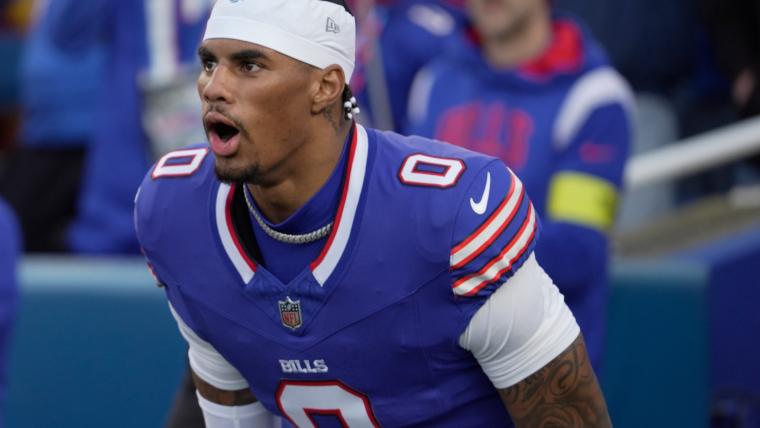
Such is the unenviable tightrope walk of Keon Coleman, the Buffalo Bills’ wide receiver. Not yet three years into a career already marked by more breathless headlines than highlight reels, he finds himself, somewhat prematurely, staring down the barrel of fan disgruntlement and punditry’s impatient eye. Forget the grand declarations of loyalty from draft day; this is a business, and Coleman’s balance sheet, frankly, looks a little wobbly.
“None of them going to come lace them up and try to stand in front of me,” Coleman retorted recently to ESPN, his voice undoubtedly carrying a heavy dose of frustration. “People are going to say what they want to say. At the end of the day, my job is to come out here, put my cleats on, strap them up and prove my worth here.” It’s a battle cry that sounds as much like self-reassurance as it does a challenge to critics. And why wouldn’t it be? He was a second-round pick in 2024, a designation that carries not just hope but a particularly sharp edge of expectation for instant impact.
His rookie campaign was quiet, punctuated by a mere handful of what observers kindly labeled “splash plays.” Year two started with a bang – a Week 1 surge – but fizzled fast, reportedly culminating in a benching over tardiness. That’s never a good look for a guy trying to solidify his spot in a notoriously fleeting professional existence. Coleman, across his first two seasons, has hauled in 67 catches for 960 yards and eight touchdowns, according to league statistics. Respectable numbers for some, perhaps. But for a player earmarked for more, it’s a narrative begging for a stronger second act.
This offseason, the Bills didn’t exactly throw him a lifeline, bringing in DJ Moore via trade. That’s a clear message. “It’s time to put it all together,” Coleman conceded to ESPN, sounding almost weary. “I don’t really care to hear [outside comments]. It’s time for me to just put it out there on the field.” Josh Allen, the quarterback who throws him the ball, has publicly praised Coleman’s attitude, as has head coach Joe Brady. But praise from leadership doesn’t buy you another year on the roster. Performance does. Always has, always will.
Bills Head Coach Sean McDermott, known for his no-nonsense approach to accountability, likely understands this tightrope better than most. He’s the one who often has to play both motivator — and executioner in the locker room. “The expectation here in Buffalo is unambiguous,” McDermott once dryly observed, discussing player development without naming names, “we value grit, yes, but results speak louder than any individual’s good intentions. We don’t ask for perfection, but we demand consistency.” It’s a subtle yet firm echo of the pressure cooking in Buffalo.
📄 POLICY WIRE WHITEPAPER PUBLISHED: PAKISTAN'S NATIONAL SECURITY POLICY PRIORITIES
👉 READ BY CLICKING HEREThe intensity of fan expectation Coleman faces is not unique to American sports, though its specific flavor might be. Consider the football fanatics in Pakistan, where every bowl, every wicket, every boundary can swing the mood of an entire nation. The weight of public hope, often intertwined with national pride — and individual aspirations, is a global phenomenon. For an athlete like Coleman, or a cricketer from Lahore trying to secure a spot on the national team, the personal career path morphs into a communal narrative, where individual slip-ups feel like collective disappointments. The passion burns just as hot, just as unforgiving, on either side of the globe.
What This Means
Economically, Coleman’s situation encapsulates the brutal, Darwinian selection process inherent in modern professional sports. He’s an asset whose value is diminishing absent sustained, high-level production. The team’s trade for Moore signals a willingness to invest capital elsewhere, a stark reminder that loyalty is a secondary consideration to market efficiency. For the average sports fan, the narrative is often simple: perform or perish. But for organizations, these decisions are dispassionate calculations of return on investment.
Politically (in the broadest sense of team dynamics), Coleman’s comments are a gamble. It projects confidence, perhaps. But it also raises the stakes immeasurably. In a high-stakes, hyper-competitive league like the NFL, players are often walking businesses themselves, negotiating not just contracts but public perception and team influence. If Coleman delivers, this rhetoric will be seen as prophetic. If he stumbles, it will be repackaged as hubris, fueling the very narrative he aims to silence. And if that happens, the financial and career fallout could be substantial, not just for him, but for a team built on winning, not just on hope. It’s a cruel game, played for keeps, on — and off the field.