


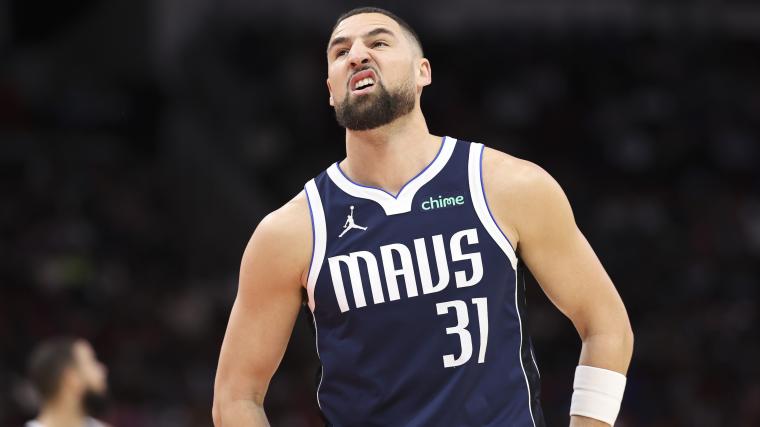
The Collateral Damage of Dallas’s NBA Gamble: Thompson’s Fate Exposes Hard Truths of Contract Economics
POLICY WIRE — Dallas, United States — It isn’t the three-point arc or the fast break that defines modern professional sports; it’s the cold, unforgiving calculus of cap space and contract...

POLICY WIRE — Dallas, United States — It isn’t the three-point arc or the fast break that defines modern professional sports; it’s the cold, unforgiving calculus of cap space and contract economics. Loyalty? A quaint relic, largely. Because when millions are on the line and strategic visions shift faster than a Luka Dončić assist, even legendary careers can hit a hard wall. Just ask Klay Thompson, the once-unflappable Golden State Warrior, now finding himself a pawn in the Dallas Mavericks’ high-stakes game of roster reconstruction.
It was only a few years back Thompson signed with Dallas, convinced — like many others, if we’re honest — that the dynamic duo of Doncic and whoever else management threw his way would be a perennial contender. Nobody saw Dončić bolting so quickly, of course. Not really. So, you can’t exactly blame Thompson for taking the money — and the shot at a fresh start. But now, after barely lacing up his sneakers for a full season with the Lone Star State squad, the Mavs are reportedly shopping him around, looking to recoup *some* value before his contract turns into an anchor rather than an asset. It’s not about winning games for Thompson right now, it’s about optimizing a balance sheet.
The latest scuttlebutt from league insiders, initially surfaced by seasoned reporter Marc Stein, indicates Dallas has little appetite for simply buying out Thompson’s final year. And who could blame ’em? They’re on the hook for a not-insignificant $17.5 million for his services. To just eat that, poof, gone? It’s bad business, period. Because even a player past his absolute peak still holds considerable value in the NBA ecosystem—be it for leadership, locker room presence, or simply as a warm body on a contract that might fit another team’s puzzle.
“Look, this isn’t personal, it’s business,” a senior Mavericks front office executive, who requested anonymity to speak candidly about player movements, told Policy Wire. “Klay’s a Hall of Famer, but we’ve got to ensure every dollar contributes to our path forward. Sometimes that means tough decisions. You try to make it work, but the NBA is a fluid market.” His sentiment isn’t unique; it echoes through every general manager’s office where the cold equations of player performance versus contractual obligation are run constantly.
This kind of situation – where a high-profile athlete, having just secured a substantial deal, finds himself suddenly disposable – paints a stark picture of the transactional nature of globalized sports. We see similar trends even in seemingly disparate markets, like the shifting allegiances in Pakistani football leagues, where emerging talent might find themselves on short-term contracts, their value reassessed quarterly, bought and sold in a volatile market not entirely unlike the NBA. The global marketplace for talent, irrespective of sport, is increasingly brutal.
But players aren’t just chattel. “Player movement is a fundamental right within our collective bargaining agreement,” a spokesperson for the National Basketball Players Association (NBPA), speaking generally on veteran player trades, commented to Policy Wire. “But it’s also a stark reminder that loyalty, in professional sports, is often a transactional commodity. Players, just like franchises, have to protect their interests, short-term — and long-term.” That’s a sharp observation. Athletes are trying to maximize their earning window; owners are trying to maximize team profitability and championship windows. It’s an endless, fascinating tension.
📄 POLICY WIRE WHITEPAPER PUBLISHED: PAKISTAN'S NATIONAL SECURITY POLICY PRIORITIES
👉 READ BY CLICKING HEREThe Mavericks aren’t expecting to contend for a title next season—or at least, they aren’t publicly saying so. But they do expect to be a ‘decent’ team. Which, frankly, isn’t enough to appease the average fan or, more importantly, a four-time champion like Thompson who’s been at the top of the mountain. And that disparity fuels the trade machine. Thompson might want a better situation, and the Mavericks, despite their initial investment, seem more than willing to oblige, providing the price is right.
What This Means
This Klay Thompson saga isn’t just about basketball. It’s a microcosmic illustration of macro-economic forces at play in specialized labor markets, particularly those with extremely high valuations. It reflects a growing impatience for return on investment within ownership circles and a mercenary approach to team building. For Dallas, failing to trade Thompson would represent a considerable financial inefficiency, eating up cap space for a player potentially not aligned with their immediate strategic objectives. The sheer magnitude of player salaries, exemplified by Thompson’s remaining $17.5 million, means every contract becomes a volatile asset on the balance sheet, subject to immediate reevaluation.
The underlying lesson? Even in the glitzy world of professional sports, where the narrative often focuses on superhuman feats and team spirit, the stark reality of modern capital management is never far below the surface. This isn’t unique to basketball either; the global sporting landscape, from English Premier League football clubs vying for Champions League glory to smaller franchises across South Asia, increasingly operates on an unforgiving fiscal logic. Athletic talent is a commodity, its value dictated by market demand, age, perceived utility, and—most crucially—the terms written on the dotted line. Thompson’s departure, if it happens, won’t just clear a roster spot; it’ll reinforce the notion that in elite sports, no contract is truly immutable, and no star is entirely immune to the cold winds of economic pragmatism.