
Roswell’s Sonic Boom: High-Stakes Air Races Set to Rattle New Mexico’s Dusty Plains
POLICY WIRE — Roswell, New Mexico — It’s not the alien technology enthusiasts track in the desert skies that’ll capture the imagination this autumn; it’s the roar of piston engines and...

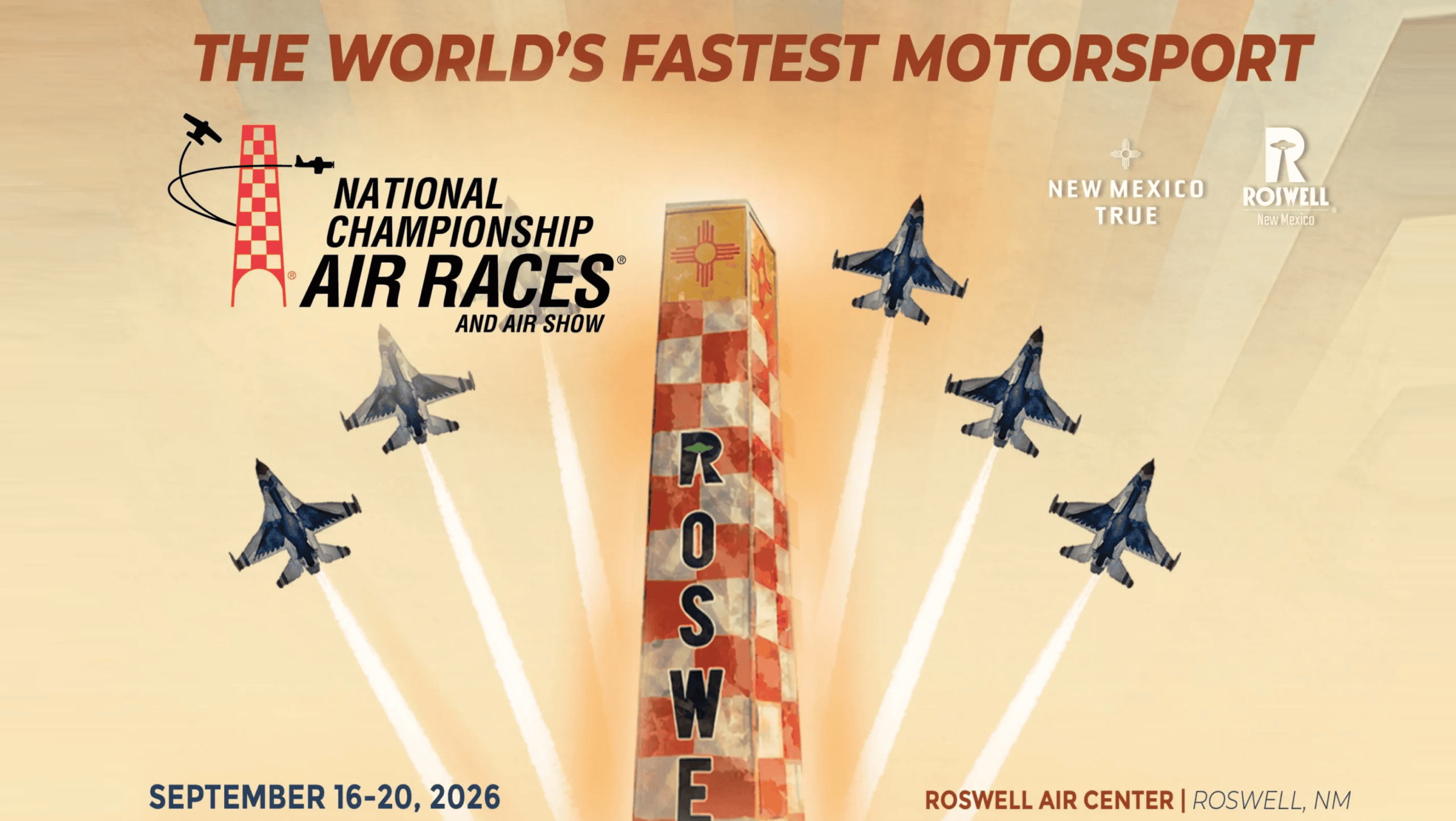
POLICY WIRE — Roswell, New Mexico — It’s not the alien technology enthusiasts track in the desert skies that’ll capture the imagination this autumn; it’s the roar of piston engines and jet afterburners. The lineup’s solidified for the 2026 National Championship Air Races, scheduled for September 16-20, returning to this high-desert town with a legacy built on more extraterrestrial speculation than earthly pursuits. For five days, the sleepy expanse near the city will transform into a buzzing crucible of speed, proving that even in a world obsessed with digital data, there’s still plenty of mileage left in raw horsepower.
Fred Telling, CEO of the Reno Air Racing Association (RARA) — which relocated the storied event here — isn’t exactly soft-pedaling the sentiment. “We’re ecstatic to announce our September Family is whole once again at the National Championship Air Races,” he declared, perhaps with a slight emphasis on ‘family’ to rally the die-hards. “We’ve had many discussions with all classes so we would be able to achieve a full field this year, and it’s truly come to fruition. Now, first-time attendees and longtime race fans will be able to witness the complete roster of classes race in Roswell.” Translation: The whole gang’s back, bringing their death-defying antics and massive fuel bills.
And what a roster it’s. We’re talking the thunderous Unlimiteds, where souped-up warbirds push old technology to ludicrous speeds, right down to the Sport Class, featuring bespoke aerodynamic wonders. Around 90 of what organizers describe as “elite pilots” are set to converge, drawn from across the States — and beyond. Australia’s sending folks. Switzerland, too. You’ve got champions like Josh Watson, Tom Marden, Chris LeFave, and Bob McCormack already polishing their trophies—or their egos, depending on who you ask.
But this isn’t just about hot rods with wings. This year’s races will introduce a jet class mock course. It’s a blend of speed — and spectacle, a calculated risk to draw in more eyes, more tickets, more revenue. Because at the end of the day, that’s what these grand displays often boil down to, isn’t it? Then there are the U.S. Air Force Thunderbirds. They’re slated to perform their precision ballet of power, a patriotic flourish that always pulls a crowd—and possibly inspires a few more aspiring pilots, or at least drone operators.
It’s interesting, really. While much of the world is fixated on drone warfare and satellite reconnaissance—from the protracted conflicts in the Middle East to rising tensions in South Asia where advanced aerospace capabilities are a point of national pride, as seen in debates over military doctrine in countries like Ethiopia and its neighbors—these air races are a throwback. They celebrate a more visceral, almost romantic, form of flight. Pakistan, for example, with its history of a strong air force, recognizes the immense skill and discipline involved in controlling such machines. It’s a universal language, that push for aerodynamic superiority, whether on a racetrack or a patrol route.
Locally, there’s palpable excitement—and a dash of anxiety. Because an event of this magnitude strains resources. Rooms are “limited” in Roswell, they’re saying. Hotels in Artesia, Ruidoso, Alamogordo, — and Portales are rubbing their hands together. This translates to serious dollars. According to the New Mexico Department of Tourism, the state’s tourism industry injected approximately $7.2 billion into the economy in 2022. Event organizers are banking on the races to contribute a chunky slice of that pie to southeastern New Mexico.
“Look, we’re talking about an economic shot in the arm for communities that truly need it,” noted Dolores Chavez, New Mexico’s Deputy Secretary for Tourism. “Beyond the direct spending on lodging — and meals, there’s the visibility. It’s about putting Roswell on the map for something besides green men, showing the world the true spirit of innovation and grit that defines our state.” A candid assessment, if a little rosy, about how tourism officials leverage spectacles for broader messaging.
What This Means
For Roswell, a town often battling a slightly kitschy reputation, hosting the National Championship Air Races offers a valuable, albeit noisy, rebrand. This isn’t just about selling tickets; it’s an economic play. We’re talking about a significant influx of short-term revenue for local businesses—hotels, restaurants, gas stations, even those dusty roadside souvenir shops that hawk UFO trinkets (perhaps now alongside model F-86 Sabres). The surge of visitors places immense pressure on infrastructure, sure, but it also provides a proving ground for the town’s logistical capabilities. And it’s about drawing in a demographic often associated with disposable income — and a penchant for speed.
But the implications stretch further than just local tills ringing. The continued success of events like these, attracting pilots and teams from diverse backgrounds, including participants whose nations have rapidly advancing aerospace programs (think even developing countries keen on homegrown defense and commercial aviation, where an event like this fosters aspirational engineering culture), subtly reinforces the U.S. position in cutting-edge, high-performance aviation. It’s an exercise in soft power—demonstrating technological prowess and a spirit of daring—without firing a single shot. This isn’t a small deal in an increasingly competitive global aerospace market. Because when you talk about aviation spectacles, you’re also talking about the prestige of the machinery and the skills behind it. That kinda echoes the invisible currents shaping athletic fortunes, but with bigger engines.
Policy-wise, it’s a temporary boost, not a long-term economic diversification strategy. The state of New Mexico will be keenly watching the tax receipts, but the lasting impact for Roswell might be less about a permanent boom and more about a sustained uptick in recognition and seasonal visitor traffic. That’s not a bad thing; it’s just a clear-eyed assessment. We’ll see if the sonic booms lead to an economic ripple or just an echo.