


Paper Seas, Fragile Pacts: New Scrutiny on China’s Ambitions in Disputed Waters
POLICY WIRE — Washington, D.C. — Imagine, if you will, the quiet whir of countless ship engines, ferrying nearly a third of the planet’s maritime trade, a silent ballet across turquoise waters,...

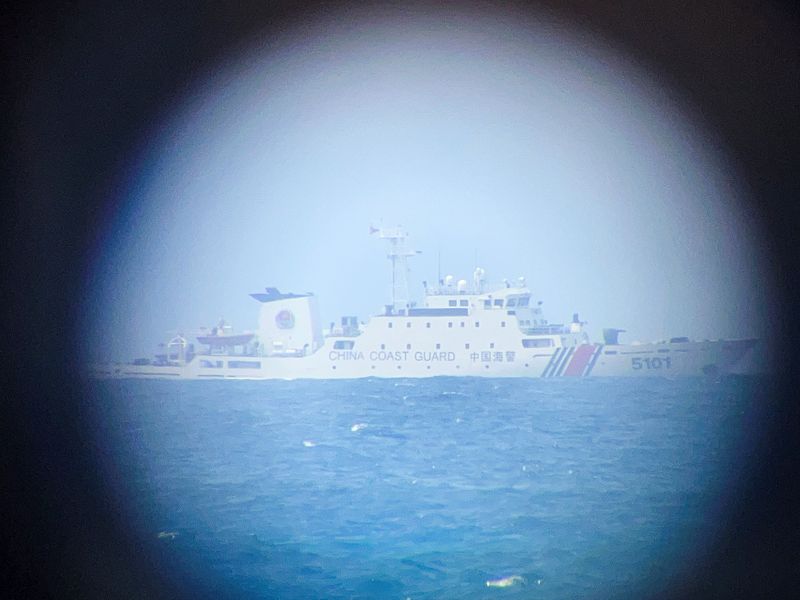
POLICY WIRE — Washington, D.C. — Imagine, if you will, the quiet whir of countless ship engines, ferrying nearly a third of the planet’s maritime trade, a silent ballet across turquoise waters, holding aloft economies from Yokohama to Rotterdam. But lately, this dance floor’s gotten a bit bumpy, thanks to a rather pointed pronouncement — a joint statement that’s kicked the tires, hard, on some long-held assumptions. It’s not just about tiny islands or fishing rights, no. It’s about a massive chessboard where every move shifts global leverage, and Beijing’s claim to vast swaths of the South China Sea has just taken a serious punch to the gut.
It isn’t often you see nations come together to collectively call a geopolitical bluff quite so directly. This joint declaration, issued recently, lays it out plain as day: China’s extensive maritime claims within the South China Sea, often depicted on maps by the ambiguous Nine-Dash Line, have no basis. That’s a bold statement, isn’t it? And it lands with the weight of international law, echoing a previous ruling from the Permanent Court of Arbitration in The Hague—a ruling China’s consistently, vociferously ignored. This isn’t just diplomatic nicety, it’s a pointed reminder that some lines on a map, however confidently drawn by one nation, don’t necessarily hold water in the wider global currents. [QUOTE_PLACEHOLDER]
The ramifications? They’re huge. For the nations directly affected – the Philippines, Vietnam, Malaysia, Brunei, Indonesia – it’s a sigh of relief mixed with lingering anxiety. For the global community, it’s about upholding international norms against a rising power that, let’s be frank, plays by its own rulebook when it suits ’em. We’re talking about billions in resources — oil, gas, fish stocks — not to mention those vital shipping lanes that literally keep our global supply chains humming. Roughly one-third of global maritime trade passes through the South China Sea, amounting to over US$3 trillion annually, according to the Center for Strategic and International Studies (CSIS). That’s not pocket change; it’s the financial bloodstream of modernity.
And where does Pakistan fit into this rather distant maritime drama, you might ask? Good question. Because everything’s connected. Beijing’s grand Belt and Road Initiative (BRI), of which Pakistan is a lynchpin with its deep-sea port at Gwadar, is a global web. Maritime security, or lack thereof, in one critical choke point like the South China Sea, reverberates. For Pakistan, a significant economic partner — and close ally of China, the balancing act is delicate. They’ve gotta navigate their relationships, understanding that international maritime law is, or should be, universally applied. If one nation can unilaterally disregard a court ruling, what precedent does that set for other territorial disputes, perhaps even for regions closer to home?
Look, the Muslim world generally watches these power plays with keen interest, if sometimes from afar. Energy security is paramount, and the free flow of goods and resources through such arteries is absolutely critical for economies like Qatar or Saudi Arabia, who are also major energy exporters relying on stable sea lanes. It’s not just a geopolitical sparring match; it’s about stability in the global commons. When a major player starts acting like maritime claims are an à la carte menu – picking what they like and ignoring what they don’t – well, that makes everyone else nervous. It’s less about winning a few islands and more about shaping the very architecture of international order itself, whether it’s in Southeast Asia or the Middle East. It’s power dynamics, pure and simple, but sometimes those dynamics play out with severe, unforeseen consequences, just as we see global power shifting and reforming around events like the World Cup’s predictable unfold of power dynamics affirming the global order.
What This Means
This latest joint statement, despite China’s almost certainly predictable dismissal, isn’t just noise; it’s a crack in the façade. It means sustained diplomatic pressure will continue to mount, making Beijing’s assertiveness look increasingly isolated on the world stage. It’s a reminder that while military might projects power, legitimacy and international consensus also have their own potent force. Economically, prolonged instability in the South China Sea could lead to increased shipping costs or rerouting, which would ultimately hit consumer prices worldwide. And, don’t forget, it jeopardizes access to vast natural resources for smaller nations that rely on these waters for their livelihoods. For those advocating for a rules-based international order, it’s a necessary, if frustratingly slow, victory in the court of public and diplomatic opinion.
It’s not going to instantly change China’s behavior – we’ve seen that movie before, haven’t we? But it does empower states like the Philippines to push back with greater international backing. Because ultimately, for all the bluster and strategic maneuvers, the foundational principle here is simple: international law should apply to everyone. Not just the little guys. It’s about maintaining a modicum of order, preventing the strong from simply taking what they want, whenever they want it. And that, frankly, is a struggle that defines our time, from the largest oceans to the smallest border posts.