


Jakarta’s Echo Chamber: AI Fabricates Fiscal Fury, Rattles Politics
POLICY WIRE — Jakarta, Indonesia — The realpolitik of public trust, always a fragile beast in the best of times, just got a whole lot more precarious. Not long ago, the simplest assertion from a...

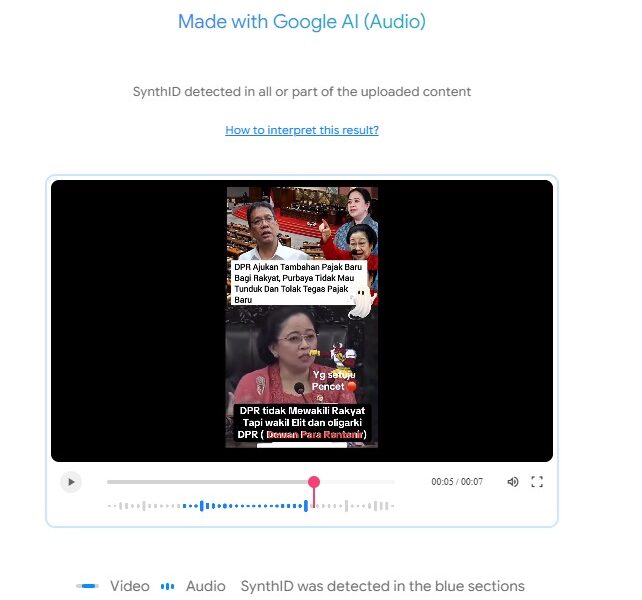
POLICY WIRE — Jakarta, Indonesia — The realpolitik of public trust, always a fragile beast in the best of times, just got a whole lot more precarious. Not long ago, the simplest assertion from a public official might be met with skepticism; now, even a spoken word, captured on video, needs to be fact-checked against its own digital DNA. That’s the unnerving reality gripping Indonesia’s political landscape, where a sophisticated, AI-fabricated video has tossed a Molotov cocktail into an already charged fiscal debate. It purported to show House Speaker Siti Aisyah—no stranger to media glare, but certainly unfamiliar with these words—passionately advocating for an unpopular new tax hike. Except, of course, she hadn’t said a syllable of it. The words, the mannerisms, even the subtle shift in light on her face, all conjured from silicon — and algorithms.
It’s a chillingly effective piece of digital fakery, designed to stir anger — and discredit. This wasn’t some clumsy, pixelated hatchet job, mind you. This was polished, convincing enough to fool many, for a time anyway. It appeared on ubiquitous social media channels, replicating at warp speed, long before official refutations could even gain traction. And that, frankly, is the entire point. In the age of viral dissemination, a lie often circles the globe thrice before the truth has even put its boots on.
But who stands to gain from such a brazen stunt? A government source, speaking on condition of anonymity to discuss sensitive matters, confided that early investigations suggest the video likely emanated from networks associated with opposition factions, though concrete proof remains elusive. “It’s not just about discrediting a person, is it?” the official remarked, puffing slowly on a clove cigarette. “It’s about eroding belief in *everything* presented as fact. It’s an insidious game.”
The incident forces us to confront a particularly nasty byproduct of unchecked technological advancement, one that democracies globally are only just beginning to grapple with. “This sort of malicious fabrication poses an existential threat to democratic discourse — and public order,” asserted Dr. Jabar Hassan, spokesperson for Indonesia’s Information Ministry, his voice clipped with a gravitas that suggests more than just press release talking points. “We’re entering an era where seeing isn’t just believing; it’s grounds for extreme suspicion. It makes our job of informing the public immensely difficult.” He isn’t wrong; the line between legitimate journalism and expertly crafted fiction is becoming frighteningly blurred.
And it’s not a challenge unique to the bustling archipelago of Indonesia. Across the broader South Asian and Muslim world, where social media penetration often outpaces robust digital literacy initiatives, such manipulative tactics find fertile ground. Pakistan, for instance, has seen its own share of politically motivated disinformation campaigns weaponizing easily shareable, yet wholly untrue, content during contentious election cycles. Because information vacuums, as we’ve learned, never stay empty for long—they’re rapidly filled with whatever narrative, however false, arrives first. The vulnerability stems from a common thread: high internet usage coupled with nascent regulatory frameworks and public education campaigns struggling to keep pace.
Speaker Aisyah herself eventually had to respond, her statement issued via official channels struggling to keep up with the deepfake’s head start. “These fabricated images are a dangerous attempt to undermine the public’s faith in its elected representatives and the integrity of our legislative process,” she stated in a formal address, looking decidedly unamused. “I want to be unequivocally clear: the proposal discussed in that video is entirely baseless, a complete fiction.” And so, another layer of mistrust is woven into the political fabric, making genuine policy debates harder, more cynical.
📄 POLICY WIRE WHITEPAPER PUBLISHED: PAKISTAN'S NATIONAL SECURITY POLICY PRIORITIES
👉 READ BY CLICKING HEREA recent report from the UK-based AI industry analyst firm, Veritas Analytics, indicated that deepfake technology is projected to be implicated in over 70% of all online disinformation campaigns targeting elections globally by 2026. Seventy percent. That’s not a trickle, that’s a tsunami coming for our political foundations. It’s a statistic that should keep policymakers awake at night.
What This Means
This incident isn’t just a fleeting news item for Indonesia; it’s a sobering precursor of the digital chaos to come, a kind of ghost in the machine of democratic processes. Politically, the immediate impact is a further erosion of trust, an already scarce commodity in many democracies. Citizens, already wary, now have another reason to disbelieve what they see and hear, making consensus-building near impossible. Economically, the ramifications are more subtle but no less serious. Baseless rumors or deepfaked statements about fiscal policy—like this fabricated tax hike—can spark investor unease, currency fluctuations, or even widespread public protest that disrupts stability. Imagine if a deepfake video of a central bank governor announcing an unscheduled interest rate hike hit the market. Pandemonium. The stability needed for foreign investment — and domestic economic growth simply vanishes.
But the real danger, the profound challenge, is the normalization of digital distrust. When anything can be faked, what’s real? It scrambles the traditional journalistic mission—sifting fact from fiction—into an impossible task. Governments will increasingly find themselves battling shadows, expending resources to disprove what was never true to begin with. It’s a costly, draining cycle that distracts from genuine policy challenges and empowers those who seek to destabilize for their own ends. This isn’t just about winning an argument anymore; it’s about owning reality itself. And the tools to do that are becoming horrifyingly cheap — and easy to wield.