


Bangkok’s Inferno Traps Doomed Revelers: Safety Betrayed, Deaths in Bathrooms
POLICY WIRE — Bangkok, Thailand — The human instinct, to flee danger, often dictates a desperate search for sanctuary. But what happens when that sanctuary, ostensibly a safe haven, becomes a sealed...

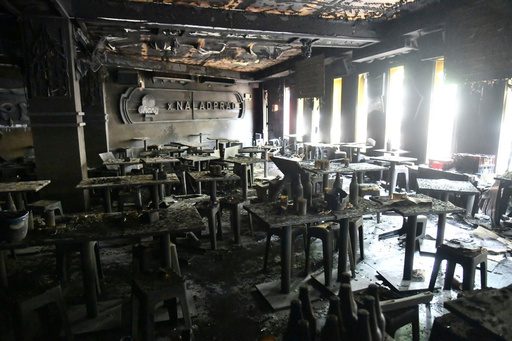
POLICY WIRE — Bangkok, Thailand — The human instinct, to flee danger, often dictates a desperate search for sanctuary. But what happens when that sanctuary, ostensibly a safe haven, becomes a sealed tomb? That grim calculus unfolded in Bangkok this week, as rescue workers unearthed a macabre truth: Most of the people who were killed in a huge fire in a Bangkok music bar were found trapped in windowless bathrooms. A staggering number, claimed at least 27 lives, ended not in the chaos of the main club, but in what should have been an escape route, or at least a temporary refuge.
This inferno, which ripped through the Rong Beer Na Ladprao bar late Sunday night, stands as the city’s deadliest in 17 years. Firefighters, bless ’em, needed half an hour just to get it under control, leaving a swath of charred ruin in their wake. They’ve told us 25 people hospitalized in critical condition, still fighting for their breath, and 73 people were hurt, according to Bangkok’s Erawan emergency services center. Because of all the smoke, Bangkok Gov. Chadchart Sittipunt confirmed that most of the deaths were caused by smoke inhalation. Quite the terrifying exit. [QUOTE_PLACEHOLDER]
And so, investigators began their slow, methodical pick through the ashes. What they found, according to National Police Chief Kittharath Punpetch, was horrifying: most of the dead were found trapped in windowless bathrooms near one of the rear exits. They were likely looking for shelter from the flames, that’s just human nature, isn’t it? But, no, the exit was not used. Why? Punpetch suggested several possibilities, none comforting. Folks may have been blocked from reaching it by a table set up in a hall to sell candy. A candy table, for goodness sakes. Or perhaps because it was too dark to find the way out. Access to another exit near the kitchen might also have been narrowed by shelving units and lockers, he noted. And here’s the kicker: There were signs that at least some of the exit doors might have been locked. Let that sink in. Locked.
Investigators, always chasing the source, started poking around the ceiling above a performance stage, where they found materials that may have been used as decorative elements. Oh, decorative elements. It’s always the décor, isn’t it? They’re now examining whether flammable materials were indeed part of the interior and how those electrical wires were snaked across the ceiling. But the fuse, or so a musician claims, started before that. Prime Minister Anutin Charnvirakul spoke to a performer who was playing that night. He recounted seeing smoke billow from a circuit breaker near the stage before the power went out. Then, an explosion. And the swift, dark curtain of thick smoke that followed. And just like that, panic set in.
The tragedy hit hard, hitting both locals — and the vulnerable migrant community. Keo Oudone Poungpany, a young man from Laos, was there that night. He was in an outside restroom when the inferno started. The heat was unbearable, I couldn’t get back in, he said, recalling how he watched, screaming his brother’s name as dozens fled the blaze. For now, I want to bring my younger brother’s body back home. He wanted to bring him home to my parents. My parents are waiting for their kids to come back together, but now one is gone. It’s a tale too often heard in Southeast Asia, where migrant labor keeps economies humming, but often at a steep human cost.
This isn’t Bangkok’s first dance with death by fire. A 2022 music bar fire killed 14 people. And before that, during a Jan. 1, 2009 New Year’s Eve celebration, the Santika nightclub blaze infamously killed 67 people and more than 200 injured. That catastrophe, triggered by an indoor fireworks display (yes, really), showed just how flimsy safety protocols can be. The pattern is clear; the lessons, seemingly, aren’t.
What This Means
This Bangkok disaster, tragic as it’s, fits a familiar, cynical script playing out across rapidly developing urban centers in Asia. When public safety regulations are treated as suggestions rather than mandates, when enforcement agencies look the other way for a fee, and when desperate entrepreneurs cut corners, these are the consequences. It’s an issue not just for Thailand, but resonates deeply within regions like South Asia and the broader Muslim world, where breakneck economic growth often outpaces responsible governance and infrastructure. From Karachi’s garment factories to Dhaka’s marketplaces, similar fires, often due to lax electrical standards and inadequate exits, routinely claim lives. This incident is less an anomaly and more a symptom of a systemic disregard for human life in the pursuit of quick profit, amplified by a weak regulatory framework. For migrants, like Poungpany and his brother, the risks are compounded; they’re often invisible to authorities, working in precarious conditions, with few avenues for redress or even basic protection. It’s a chilling economic truth, isn’t it? Development, it turns out, often comes with a steep, preventable death toll if accountability takes a back seat. And don’t we see that often enough.