

Native American Education Sees Gains, Yet Bureaucracy and Political Winds Threaten Fragile Progress
POLICY WIRE — Washington, D.C. — Imagine a crumbling school, its walls literally sinking, overrun by rodents. Now, imagine a bureaucrat, miles away, touting rising graduation rates from that same...

POLICY WIRE — Washington, D.C. — Imagine a crumbling school, its walls literally sinking, overrun by rodents. Now, imagine a bureaucrat, miles away, touting rising graduation rates from that same system. This isn’t a dark joke, it’s the stark reality in parts of America’s Bureau of Indian Education (BIE) school system, where fragile progress rubs up against enduring neglect.
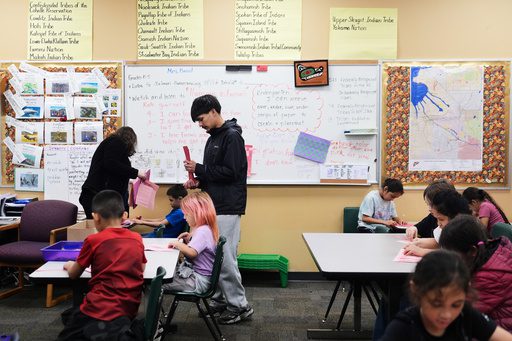
Gerald Dillon, for one, beat the odds. Just a short while ago, he was a high schooler on the Puyallup Reservation who’d only put in just enough effort to pass. Classes were boring, a grind. Then, he dipped his toes into career training, working as a teaching assistant for second graders, making connections. It motivates me. I like making connections with the kids, I like helping them, Dillon said. His grades shot up. He graduated in June from Chief Leschi Schools, — and he’s now eyeing a teaching degree. A simple switch to hands-on job training transformed his educational journey. [QUOTE_PLACEHOLDER]
And frankly, Dillon’s story is often framed as emblematic of wider gains. Across the U.S. Bureau of Indian Education—a federal entity overseeing 183 primary and secondary schools that educate over 40,000 students—the numbers do look up. In 2015, only just over half of high schoolers at BIE schools managed to graduate within four years. But by 2025, that number soared to a record high of 79%. A substantial leap, no doubt, and one the agency is quick to highlight. Assistant Secretary of Indian Affairs Billy Kirkland attributes this to local innovations, and also, to the previous administration’s efforts toward strengthening teacher training.
But the true narrative, as so often happens, is a bit more…complicated. Agency officials are pretty open about it: a good chunk of that surge in graduation rates reflects, in part, more accurate reporting rather than a sudden leap in student academic improvement. For years, schools played fast and loose with the data, frequently counting transferred students as dropouts, skewing the figures lower. Carmelia Becenti, the BIE’s chief academic officer, made it plain, saying, We had to come to a consensus and set an accountability framework for our schools.
Since 2018, BIE schools have been standardizing data collection. It’s certainly helped paint a more accurate and encouraging picture. An AP analysis of BIE data found that graduation rates across the system are up 55% since new reporting standards started rolling out. Some schools, like nine secondary institutions, reported a mind-boggling 100% growth or even higher. It’s a good example of how simply counting correctly can sometimes be perceived as — or even become — progress.
And yes, there’s genuine innovation too. Don Brummett, superintendent of Chief Leschi Schools, pointed to a crucial shift: his staff had to fix a disconnect between pushing kids only for college and many students’ very real goal of simply finding a job after graduation. We devalued the trades. That was a mistake, Brummett confessed. So, with funding from the Puyallup Tribal Council, they launched a career — and technical curriculum in 2020. Dillon, who said It was kind of the first time I felt excited to go to school, is just one example of the program’s success. Over at Choctaw Central High School, an unexpected COVID-era virtual learning experiment bumped graduation rates from roughly 70% to 93%, because, as principal Alaric Keams put it, For certain kids that have more responsibilities at home, kids that need to work, we saw that (virtual learning) gave them a flexible schedule and an opportunity to earn their diploma. They’ve kept it. Between 2019 — and 2025, Chief Leschi Schools themselves saw a rise in four-year graduation rates from 53% to 87%.
📄 POLICY WIRE WHITEPAPER PUBLISHED: PAKISTAN'S NATIONAL SECURITY POLICY PRIORITIES
👉 READ BY CLICKING HEREBut these localized successes, and the bureaucratic re-accounting of student progress, obscure a far darker reality for many. Because here’s the kicker: not all tribal governments have the deep pockets or infrastructure to bankroll these kinds of innovative programs or even take over BIE schools. Peter Lengkeek, chairman of the Crow Creek Sioux Tribe in South Dakota, describes the BIE-operated high school in his community as chronically understaffed and falling apart. We’re talking about a gymnasium with sinking walls and a rodent infestation. That school? It’s graduating fewer than 60% of students on time. If we were able to, we would step in and try to remedy a lot of these things, Lengkeek said, acknowledging that they just can’t. They’re left to rely on the government to fulfill its treaty promise.
And that reliability? It’s thin, particularly as political tides shift. Tribal leaders are pushing back hard against federal moves that threaten to undermine what little gains have been made. There are looming concerns about the proposed dismantling of the U.S. Department of Education, and continued fallout from cuts instituted by DOGE, not to mention repeated threats of deep funding reductions. In late 2025, the Department of Education started offloading oversight of dozens of Native student programs to the BIE – an agency already stretched to its limits. During a tribal consultation in February, leaders opposed the transition en masse, fearing it’d overwhelm the BIE. Many felt railroaded, as if their input was an afterthought. Herschel Gorham, lieutenant governor of the Cheyenne and Arapaho Tribes, encapsulated the frustration: The ink was dry on the agreements before the tribes were ever notified. That should never, ever happen. Jason Dropik, executive director of the National Indian Education Association, put it succinctly: When drastic changes go into motion without tribal consultation, there can be unintended consequences for our students. And Lengkeek? He fears that This system holds the future of our nations in its hands, yet it’s perpetually consumed by political upheaval while his community’s schools remain in disarray.
What This Means
This situation paints a microcosm of policy implementation that’s echoed globally—especially in developing economies or nations grappling with colonial legacies. Just like indigenous communities in America often see their interests managed by distant federal agencies, many countries in the Global South face challenges where central government policies for marginalized populations clash with ground realities or lack local buy-in. We’ve seen similar debates play out in the education sectors of Pakistan or other South Asian nations, where impressive, often bureaucratically defined, statistics about school enrollment or completion rates can mask vast disparities in actual educational quality, infrastructure, and outcomes, particularly in remote regions. There’s a persistent tension between statistical achievements — often the result of data adjustments or limited localized successes — and the pervasive under-investment in foundational public services. What appears to be progress can be undone almost instantly by political whims or funding cuts. The current pushback from tribal leaders reflects a fundamental truth: without true tribal sovereignty and sufficient, consistent funding, these schools remain vulnerable, their future subject to the political tides of Washington rather than the needs of their communities. It’s an age-old dance between centralized control and local autonomy, where the most vulnerable often pay the price for administrative indifference or political expediency, not unlike the infrastructure challenges faced by communities from Europe to Karachi.