


Silent Suffragette: Sinner’s Mom a Bellwether for Tennis’s Gritty Evolution
POLICY WIRE — LONDON, UK — She couldn’t stomach it. Not all of it, anyway. While Centre Court buzzed, while titans clashed across the manicured green, Jannik Sinner’s mother, Siglinde,...

POLICY WIRE — LONDON, UK — She couldn’t stomach it. Not all of it, anyway. While Centre Court buzzed, while titans clashed across the manicured green, Jannik Sinner’s mother, Siglinde, reportedly left the stadium a couple of times
. A parent’s visceral reaction, you see, speaks volumes beyond any official score. It wasn’t the trophies or the rankings; it was the raw, unvarnished torment of watching your progeny in an arena where every flaw is magnified, every moment an existential threat to glory. The young Italian, fresh off his second consecutive Wimbledon title, simply conceded, It’s not easy.
—and frankly, watching any athlete contend in this brutal age isn’t for the faint of heart.
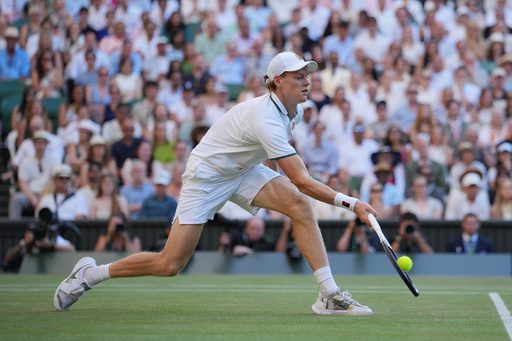
Because the modern game, it’s something else. Gone are the days when a singular, dominant style guaranteed supremacy. No, now it’s an evolving beast, forcing even the best to shapeshift, adapt, or perish. And Sinner, a lanky redhead from the chilly Italian Alps, exemplifies this struggle with particular poignancy. His coaches, Darren Cahill and Simone Vagnozzi, weren’t just waxing lyrical about a win; they were admiring the nuanced arsenal Sinner deployed against Alexander Zverev. This wasn’t about the usual whizzing, missile-like baseline winners
he’s famous for. Nah. It was the craft—the deft sliced backhands, a couple lobs, couple drop shots
—that signaled something more profound. [QUOTE_PLACEHOLDER]
It’s about survival. You see Zverev himself is now playing a different style of tennis against Jannik
, Cahill observed. And what’s Sinner’s answer? We know Jannik is going to have to improve in certain areas to handle that type of game.
This arms race of technique and athleticism? It’s relentless. You need to keep adding things to his game.
They’re all doing it—from the established greats like Djokovic, still hanging tough at 39, to rising stars like Carlos Alcaraz, who’ll return really strong, as well
. The competition is a grinding stone; you sharpen against it or get ground down.
The stakes? Grand Slams. Sinner’s recent victory nudged his tally to five, paring down Alcaraz’s lead (currently at seven). That chase, that narrowing gap, it’s like an endless chess match played at 139 mph (224 kph)—the peak serve speed unleashed by Zverev in that very final. But this physical onslaught is just one piece of the puzzle. Beyond the power — and precision, there’s the sheer physical toll. After an ignominious exit in Paris—a tournament marred by a stunning second-round collapse, having almost sealed a straight-sets win, he’d faced some physical troubles. His medical records are his medical records. We won’t speak about any of that,
Cahill told reporters, closing that particular chapter with journalistic finality. But a strategic shift has happened:
He’s making a conscious effort to acclimate, to mitigate the brutal impacts of exertion. The uninitiated might scoff, but managing one’s physical plant, especially for athletes whose careers are measured in degrees of wear and tear, is everything. So, you’ll find him now making calculated retreats between sets to refresh himself, change his shirt and get a moment of air-conditioning.
Or, during a particularly punishing pre-Wimbledon heatwave, employing an ice vest—practical, not flashy. And because he’s a redhead that lives in the north of Italy, that grew up in the snow and the Alps
, and because Hot weather is a little bit different for him than it’s for most people
, his team’s going a step further: We might even make some changes to the preseason, chasing the sun a little bit more, getting him more acclimatized to playing in these types of conditions.
It’s an almost monastic dedication to an extreme physiology, an adaptive posture mirroring wider global shifts in performance demands.
📄 POLICY WIRE WHITEPAPER PUBLISHED: PAKISTAN'S NATIONAL SECURITY POLICY PRIORITIES
👉 READ BY CLICKING HEREWhat This Means
This isn’t merely about a tennis champion’s diet or training schedule. The lengths to which Sinner’s team goes—strategically adapting his preseason to chase the sun, fine-tuning his physical responses to environmental stress—speak to a broader economic and geopolitical truth: the relentless pursuit of marginal gains in a globally interconnected, brutally competitive landscape. Elite performance in any sector—sports, tech, policy, or business—now requires a hyper-optimized approach, pushing physiological and psychological boundaries. Failure to adapt, as the fate of many past champions attests, isn’t just a loss of a match, but an economic squandering of brand, sponsorship, and potential. We’re watching a globalized arms race, where countries and corporations, much like individual athletes and their teams, are locked in a struggle for innovation and resilience. It’s about securing future influence, whether it’s through a top-tier athlete inspiring national pride or an economy adjusting its strategies for climate realities. And because every victory, every display of individual grit, resonates far beyond its immediate sporting context—look no further than the impact of sports figures in regions like South Asia. Canberra’s Yellowcake Diplomacy, for instance, operates on different axes, but it’s still about strategic influence and leveraging assets. From Dhaka to Lahore, the narratives of individual perseverance, triumph against the odds, and scientific optimization against environmental challenges are followed avidly, providing symbolic victories and aspirations for young people, often in places grappling with their own extreme weather events and systemic challenges.
The lessons from a court in London, it’s clear, aren’t confined to a velvet rope or even a continent. Having Novak still around, having all the young players coming, it’s really, really nice,
Sinner noted with a kind of understated respect. But he knows it comes at a cost, saying, At the same time, you always need to work hard.
His mother’s inability to watch says more about the immense, unspoken pressure of this new athletic era than any pundit’s praise. This isn’t just a game; it’s a job, demanding total evolution, moment by exhausting moment.