
Ash and Iron: Spain’s Deadly Wildfire Ignites Hard Truths on Europe’s Climate Edge
POLICY WIRE — Madrid, Spain — Another inferno, another stark reminder. Mediterranean Europe, it seems, has decided to rewrite its calendar, turning late autumn into a volatile, parched echo of...

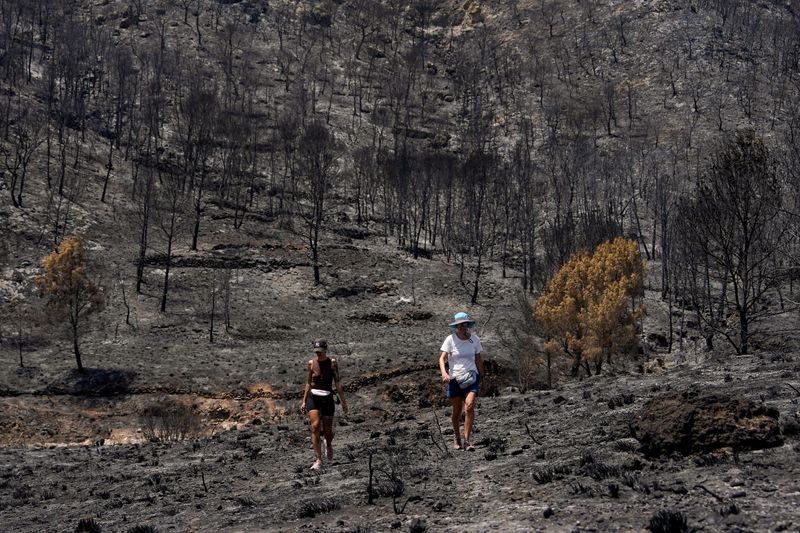
POLICY WIRE — Madrid, Spain — Another inferno, another stark reminder. Mediterranean Europe, it seems, has decided to rewrite its calendar, turning late autumn into a volatile, parched echo of summer’s harshest days. This time, the brutal arithmetic played out in a swath of scorched earth, leading authorities to grimly identify six victims of a devastating wildfire. It’s a tragedy that unfolds with increasing, horrifying regularity—a cycle of dry spells, tinderbox forests, and swift, lethal blazes that’s becoming the new normal here, pushing emergency services past their limits.
But this isn’t just about flames — and forests. It’s about a continent—a world, really—grappling with forces far beyond simple arson or a careless tossed cigarette. No, this was an almost existential fire, a ferocious manifestation of broader climate patterns turning fertile lands into kindling. They’ve seen it before, certainly. But each time, the raw grief cuts deeper. Because the response, the long, drawn-out response, often feels insufficient, almost procedural, against a phenomenon that laughs at bureaucratic measures.
“We’re fighting a new kind of war now, aren’t we?” mused General Fernando Sánchez, who oversees regional emergency efforts, during a hushed press conference near the burned-out perimeter. “It’s not just against the immediate flames, but against an insidious, changing climate that’s making our jobs impossible without a paradigm shift in preventative strategy. Our people are exhausted—emotionally, physically.” He wasn’t wrong. They’ve been on edge for months, knowing a flick of heat, a whisper of wind, could turn benign brush into a raging monster. And it did.
The six individuals, whose identities were confirmed through painstaking forensic work this past week, represent more than just names on a death certificate. They’re another grim tally in Europe’s escalating climate bill. They weren’t just caught in the wrong place; they were caught in the crosshairs of a warming planet. It’s hard to talk about their stories with journalistic detachment because the stories themselves are variations on a single, tragic theme: unpreparedness meeting unstoppable force. The official bulletin was crisp, technical: ‘Following extensive DNA analysis and dental records cross-referencing, identification complete.’ But the human cost—it’s anything but.
And so, while local communities began the slow, agonizing process of piecing together their lives, the political machine whirred into predictable action. Regional President Isabel Díaz Ayuso, speaking from a newly constructed emergency operations tent—the standard set for any such calamity these days—tried to strike a balance between reassurance and realism. “We’re mourning those we’ve lost, absolutely,” she stated, her voice tight. “But we’re also doubling down on our commitment to modernizing our fire suppression techniques, looking at innovative, science-backed solutions.” One has to wonder how many more innovative solutions can be thrown at an increasingly unpredictable adversary before admitting it’s less about innovation and more about prevention—and adaptation—on a continental scale. Her assurances sounded a tad hollow over the persistent scent of smoke still clinging to the air, weeks after the active fires were brought under some semblance of control.
It’s a tough pill for Madrid, which often positions itself as a forward-thinking European capital, to swallow. The country’s struggle with these infernos isn’t new, but the sheer scale of recent years is staggering. In 2022 alone, Spain saw approximately 306,478 hectares of land—that’s over 750,000 acres—ravaged by wildfires, according to the European Forest Fire Information System (EFFIS). This figure, one of the highest in the EU, didn’t just strip land; it gutted livelihoods, ecological balance, and, frankly, confidence in future resilience.
📄 POLICY WIRE WHITEPAPER PUBLISHED: PAKISTAN'S NATIONAL SECURITY POLICY PRIORITIES
👉 READ BY CLICKING HEREWhat This Means
This incident isn’t just a regional news item; it’s a bellwether for wider global policy challenges. Politically, Spain is now firmly in the uncomfortable spotlight regarding its climate adaptation strategies. There’s no easy answer, no magic wand. Resources, especially financial ones, are stretched thin, as every summer brings fresh disaster. And because the EU framework is involved, there’s an inherent political tension between national sovereignty and the need for coordinated, bloc-wide climate action and emergency response. It also pushes the conversation toward urban planning—what defines ‘safe proximity’ to wilderness in a hotter, drier world? Economically, the cost is staggering: property damage, agricultural losses, disrupted tourism (especially in rural areas that rely on it), and the long-term environmental remediation. Insurers are taking note, — and premiums are already climbing.
But the ramifications don’t stop at Europe’s borders. The tragic identification of these six lives lost in Spain underscores a global vulnerability that resonates from the parched plains of Afghanistan to the flood-scarred regions of Pakistan. Nations across the Muslim world, many of whom are grappling with their own extreme weather events—from unprecedented heatwaves to devastating monsoon floods—understand Spain’s predicament intimately. They’re often on the sharp end of climate change, with fewer resources to mitigate its effects. These shared crises fuel discussions at international forums, compelling greater cooperation on climate finance and adaptation, and reinforcing the idea that no nation, however wealthy, is immune to Mother Nature’s increasingly forceful hand. Spain’s fires, therefore, aren’t just local tragedies; they’re chapters in a much larger, increasingly urgent global narrative about human survival and the very real financial calculus of global resource allocation and environmental policy, one that extends far beyond individual nations and their immediate emergencies, affecting human lives on every continent.