

Senate’s Slow Grind: McConnell’s Absence Casts a Long Shadow Over Legislative Arena
POLICY WIRE — Washington D.C. — The ornate halls of the United States Capitol usually hum with a distinct rhythm—a perpetual dance of deal-making, procedural maneuvers, and often, deliberate...

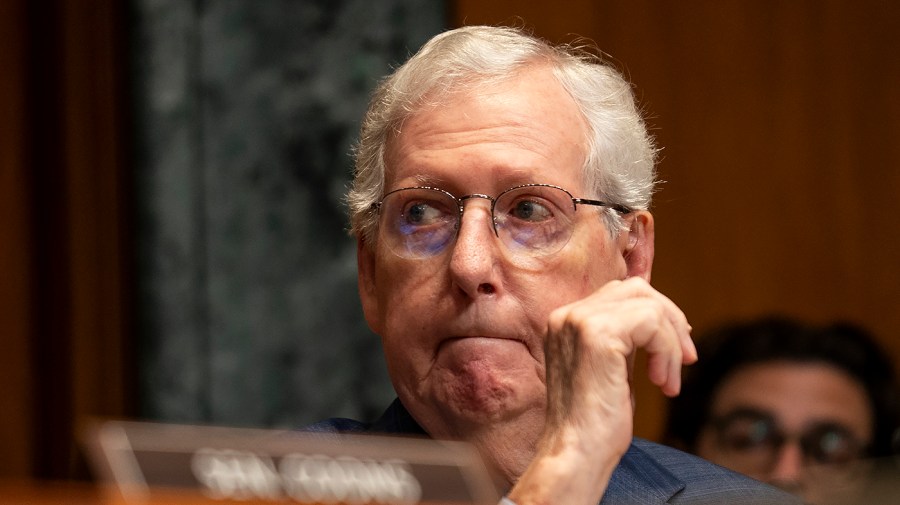
POLICY WIRE — Washington D.C. — The ornate halls of the United States Capitol usually hum with a distinct rhythm—a perpetual dance of deal-making, procedural maneuvers, and often, deliberate obstruction. Lately, though, there’s a different sort of quiet resonating through the Senate side. It’s the kind of silence that speaks volumes, particularly in the spot usually occupied by Senator Mitch McConnell, the Kentucky Republican whose towering political stature, despite his physical absence, continues to command a strange kind of influence. You feel it. You really do.
It’s not just a missing vote; it’s the absence of the Grand Strategist himself, the architect who, for decades, didn’t just play the long game, he wrote the damn rulebook for it. His declaration this week, uttered with that familiar dry wit, that he “won’t be able to return to the Senate floor to vote quite yet,” wasn’t exactly shocking, but it cemented a reality Republicans have been quietly—and nervously—grappling with for weeks: the lion in winter is taking a longer hiatus than many would’ve bet on.
His health, after a series of public moments that suggested anything but iron-clad vigor, has become a bipartisan whispered concern. You see it in the hushed tones of reporters, the knowing glances between congressional aides. But because it’s McConnell, a man whose entire political existence has been defined by control, nobody’s talking much, not really. They’re just waiting. And the waiting, folks, it’s stretching on.
McConnell, ever the pragmatist, acknowledged the situation in a recent, somewhat clipped statement relayed through his office. “I’m not one for sentiment, you know. But it’s true I won’t be able to steer the ship from the floor just yet. The work continues, though.” — The implicit message: Don’t get comfortable; he’s still watching. And don’t imagine, not for a second, that the levers of power have been fully abandoned.
His designated successor for legislative operations, Sen. John Thune (R-SD), has stepped up, navigating the often-treacherous waters of Republican factionalism. But it ain’t the same. It can’t be. This isn’t just about who’s casting a vote; it’s about who’s leaning over the railing in the back, reading the room, counting the exact votes, deciding when to push and when to hold. It’s a craft, and he perfected it. You might hate his politics, but you can’t deny his effectiveness. Even ideological opponents concede a kind of weary respect.
“You don’t always agree with the man, not even close,” observed Sen. Sheldon Whitehouse (D-RI) recently, reflecting on the situation. “But his sheer presence? It lent a kind of weary stability to the place. We’re certainly feeling that void, the Senate certainly is.” His point? Whether you love him or loathe him, his absence leaves an undeniable, gaping hole in the day-to-day operations of one of the world’s most powerful legislative bodies.
But how do these institutional vacuums—temporary or otherwise—play out globally? Think about it: leadership stability, or the perceived lack of it, reverberates far beyond Washington’s Beltway. Countries like Pakistan, grappling with immense domestic and economic upheaval, are hypersensitive to signs of weakness or indecision from global powers, particularly its allies. An American Senate perceived as adrift, lacking firm steering, could certainly alter the calculus for nations wrestling with their own precarious political balances. Political vacuums, like nature, abhor a true void; something else always rushes in to fill it.
Meanwhile, the legislative clock keeps ticking. Appropriations battles loom. International aid packages, some earmarked for conflict zones, hang in the balance. Major defense spending decisions? They aren’t getting any easier without his guiding—or perhaps, controlling—hand. It’s going to be a messy end to the year, that’s for sure. The current Republican majority, itself often divided, now lacks its unifying (or at least, disciplining) force.
📄 POLICY WIRE WHITEPAPER PUBLISHED: PAKISTAN'S NATIONAL SECURITY POLICY PRIORITIES
👉 READ BY CLICKING HEREWhat This Means
McConnell’s continued convalescence means a tactical re-evaluation for Republicans. With the next general election cycles inching closer, they’re wrestling with not only who leads, but how that leadership reflects their party’s shifting ideological core. His unparalleled ability to herd cats—or, more accurately, tame ideological wildcards—is simply missing. And that has immediate political implications. Younger, more ambitious conservatives, long chafing under his lengthy reign, are suddenly looking for opportunities. Don’t believe me? Just watch the internal machinations for leadership roles that’ll kick off, even if informally, before long.
Economically, prolonged uncertainty over legislative direction—especially concerning government funding or debt ceiling debates—can inject a dangerous dose of instability into global markets. International investors often view U.S. political cohesion, even if fractious, as a baseline for economic confidence. Anything that rattles that confidence isn’t good. with an aging political class (the average age of a U.S. Senator in the 118th Congress is 63.9 years, the second-oldest in history, according to the Congressional Research Service), questions about succession and long-term political resilience aren’t just rhetorical; they’re becoming deeply practical concerns for governance. You can see how this becomes a bigger issue than just one person. It’s about a generation’s grip on power.
His return to full capacity, if and when it happens, will dictate much about the Republicans’ approach to the upcoming legislative skirmishes. Until then, the Senate rolls on, albeit a little less predictably, a little more untethered. It’s a Senate without its maestro. And everyone knows it.