


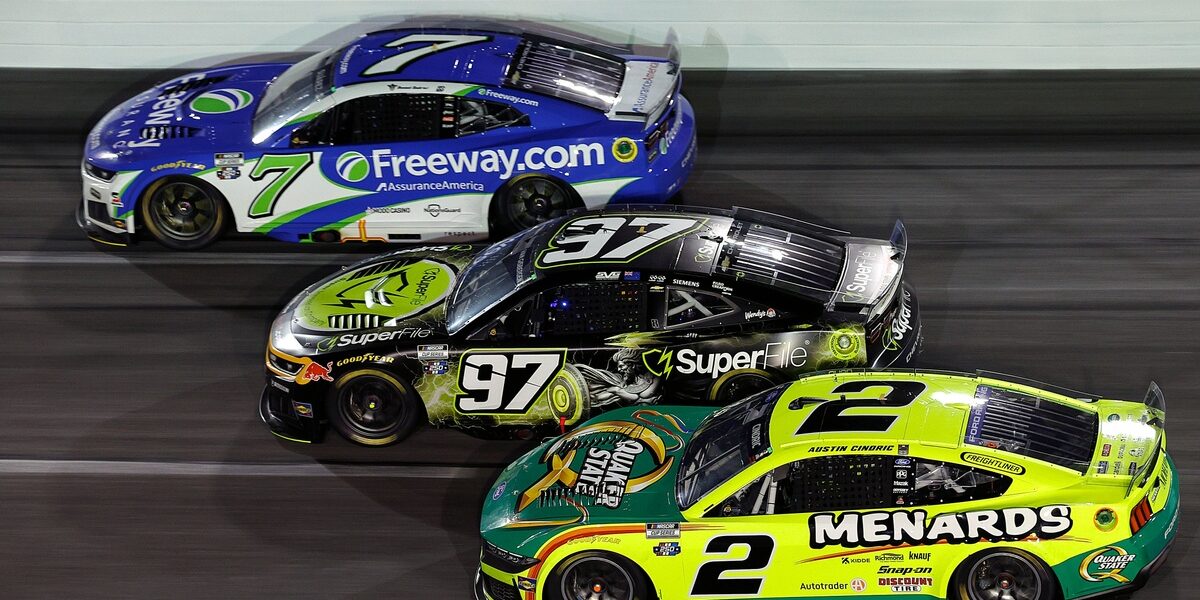
NASCAR’s Grinding Duel: Hamlin Fights Reddick, but Ghosts Linger on the Track
POLICY WIRE — Atlanta, GA — The roar of engines might fade into the drone of a late-summer afternoon, but on the high-banked ovals of NASCAR, a different kind of silence often hangs heavy. It’s...

POLICY WIRE — Atlanta, GA — The roar of engines might fade into the drone of a late-summer afternoon, but on the high-banked ovals of NASCAR, a different kind of silence often hangs heavy. It’s the absence—a void left by speed, by talent, by a figure like Kyle Busch. And this year, as the 2026 Cup Series season churns through its mid-point, that quiet echoes alongside the fierce, gasoline-soaked skirmishes for playoff berths.
It’s not just about the numbers; it never truly is. But numbers dictate much in this multi-billion-dollar enterprise, and they certainly tell a story after the latest spectacle in Atlanta. Denny Hamlin, the seasoned veteran, still clings to the championship lead like a well-worn pit crew chief to his headset. Yet, Tyler Reddick, with a young Turk’s audacity, isn’t just nibbling at Hamlin’s heels anymore; he’s taken a healthy chunk. Reddick’s spirited performance in Atlanta shaved Hamlin’s commanding 44-point cushion down to a mere 24, igniting what’s quickly becoming a captivating two-man battle at the apex of American stock car racing. Don’t underestimate the mental game here.
Both Hamlin and Reddick, through sheer consistency or bursts of brilliance, have already cemented their presence in the forthcoming ‘Chase’—NASCAR’s playoff crucible. But for the others, for the journeymen and the rising stars alike, these remaining half-dozen races are a high-stakes, gut-wrenching scramble. Every overtake, every strategic pit stop, every fraction of a second now matters with an almost biblical intensity.
The immediate periphery of the Chase cut-line, that arbitrary yet unforgiving demarcation, remains a maelstrom of ambition and desperation. Shane van Gisbergen, the audacious import from down under, notched another impressive oval top ten, vaulting him a comfortable-enough 31 points clear. Comfortable for now, anyway. Because just behind him, the tension is almost palpable. Erik Jones, hanging by an eight-point thread, finds himself squarely on the bubble, constantly glancing in his rearview mirror.
And what’s he seeing back there? Well, for starters, there’s Joey Logano, just eight points adrift, breathing down his neck. Below the cut-line, guys like Ryan Preece, Brad Keselowski, — and Ross Chastain aren’t exactly throwing in the towel. Chastain, despite his current standing at -45 points, did manage the most significant ascent in Atlanta, clawing his way two spots higher, from 22nd to 20th. Conversely, AJ Allmendinger took a brutal three-position tumble, landing him at 22nd, a cold, hard dose of reality for any competitive racer. These swings, small as they seem, can cost fortunes.
But beyond the immediate gains and losses, there’s a more fundamental question at play: the enduring allure of competition, particularly one as uniquely American as NASCAR. “What we’re seeing this season is a testament to the fundamental human desire to compete, to push limits, and to perform under immense pressure,” commented Marcus Thornwell, NASCAR’s Vice President of Operations, in a recent conference call with reporters. “The stakes are higher than ever, and that’s exactly what draws millions of fans, both at the track and watching at home.”
Policy Wire’s data analysis reveals the commercial juggernaut behind this spectacle. According to Nielsen data, NASCAR’s average TV viewership, though experiencing some fluctuations, still consistently draws around 3 million viewers per race, creating an economic echo chamber where sponsors pour in untold millions. It’s an enterprise that keeps vast industries—from automotive manufacturing to media production—humming, generating jobs and regional investment in communities stretching across the American South and beyond.
📄 POLICY WIRE WHITEPAPER PUBLISHED: PAKISTAN'S NATIONAL SECURITY POLICY PRIORITIES
👉 READ BY CLICKING HEREAnd this intensely capitalist theatre of speed? It thrives on personalities, rivalries, — and legacies. Which brings us back to the shadow: Kyle Busch. His tragic passing earlier this year — an event that cast a pall over the entire sport — has led NASCAR to formally remove him from the weekly standings. It’s a somber acknowledgment of loss that adds an unwritten layer of gravitas to every lap run, reminding everyone involved that even in the pursuit of glory, there’s a fragile, human element at play.
“The boys know what they’re fighting for, especially this late in the game,” remarked Michael Peterson, team principal for a squad fighting just outside the Chase spots, his voice gruff over a poor phone connection. “But there’s always an unspoken weight to the season, too. We don’t forget the ones who aren’t with us anymore. That just makes every win, every playoff spot, mean a little bit more, doesn’t it?”
What This Means
This evolving NASCAR narrative, played out across grueling stretches of asphalt, mirrors larger economic and cultural dynamics. The ‘Chase’ itself, a deliberately constructed playoff system, is a brilliant piece of commercial engineering, designed to heighten drama, secure advertising dollars, and maintain fan engagement through a ‘winner-take-all’ mentality that resonates deeply in market economies. It’s a calculated gamble on human competitiveness, turning individual performance into a team — and brand battle.
The economic stakes aren’t confined to immediate sponsorship. The sheer global reach of modern sport means that even a uniquely American spectacle like NASCAR increasingly finds itself operating within a broader ecosystem. While NASCAR’s primary appeal remains domestic, the financial might it wields — the technological innovation it drives, the global talent it can attract, like Shane van Gisbergen — could be viewed as a micro-economy far surpassing the GDP of some smaller nations. Consider, for instance, how the world’s most populous Muslim nation, Indonesia, or even parts of South Asia are increasingly investing in motorsport infrastructure and nurturing nascent fan bases. The allure of such spectacles, though geographically distinct, points to a universal human attraction to organized, high-stakes competition and the fortunes to be made within it. It’s not just racing; it’s a meticulously crafted machine for generating wealth, spectacle, and a narrative that captivates millions.