


Behind the Chrome: NASCAR’s Unexpected Heart in the Face of Grief
POLICY WIRE — Washington D.C., USA — They say nothing sells like sex and spectacle. But sometimes, what really moves the needle, what quietly reshapes a brand or a narrative, is simple, unvarnished...

POLICY WIRE — Washington D.C., USA — They say nothing sells like sex and spectacle. But sometimes, what really moves the needle, what quietly reshapes a brand or a narrative, is simple, unvarnished grief. Because behind all the roaring engines and sponsor decals, America’s premier stock car circuit just gave a masterclass in communal solidarity, proving that a sport often stereotyped as insular holds a surprisingly complex and compassionate soul.
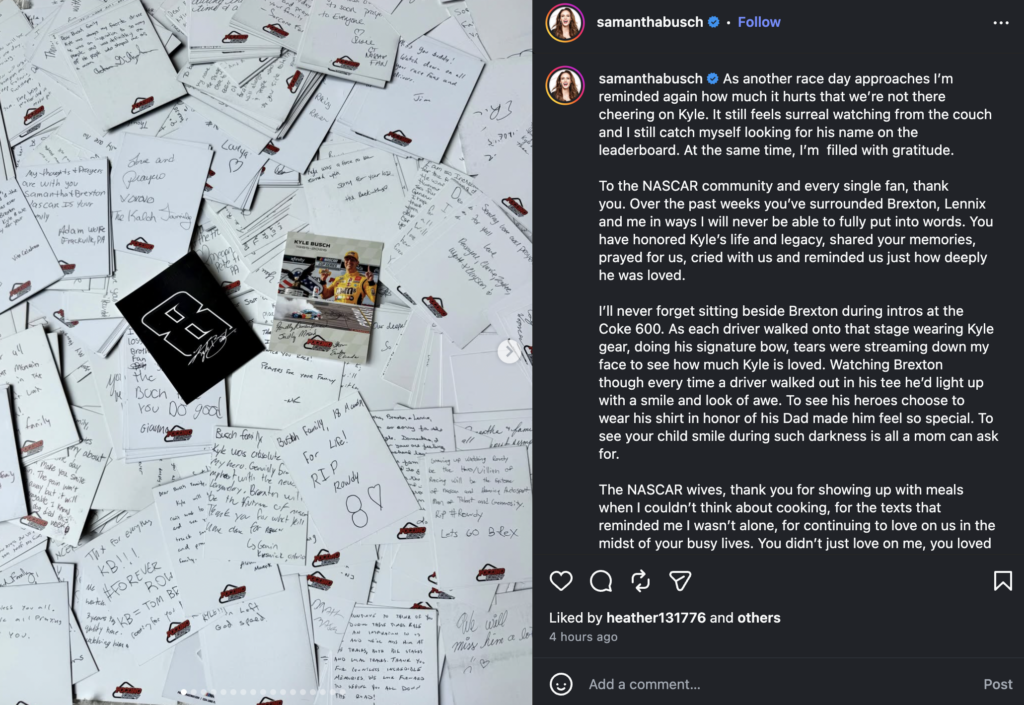
It wasn’t another pole position, nor a dramatic photo finish that put NASCAR in this unusual spotlight. No, it was a social media post, a raw, heartfelt dispatch from Samantha Busch—the wife of two-time Cup champion Kyle Busch, whose life was tragically cut short nearly two months ago. It seems race weekends don’t feel quite the same, a quiet admission in a public forum about a gaping, unfillable void. And she’s right, it doesn’t. Not for her, — and perhaps not for many within that vast, sprawling ecosystem that’s professional auto racing. This isn’t just about a driver; it’s about a family, a community left reeling.
Her digital testament, an Instagram note published Sunday, wasn’t merely a lament. Far from it. It was a recognition—a solemn, but profoundly appreciative nod to an institution, its fans, and its players who have collectively rallied around her, son Brexton, and daughter Lennix. It’s an interesting tableau, really: the glitzy, high-octane world of professional sports providing something more akin to a village well during a drought. [QUOTE_PLACEHOLDER]. That’s pretty much how it goes when life, suddenly, is anything but.
For some, NASCAR might just be a regional phenomenon—fast cars, louder fans, maybe a cold beverage or two. But it’s far more than that. Its economic footprint alone is staggering. A 2022 report from Sports Business Journal estimated NASCAR’s annual contribution to the US economy at nearly $3 billion, directly employing over 25,000 individuals across its events, teams, and supporting industries. It’s an industry, sure. But its internal dynamics? They sometimes echo the tightly knit communal bonds often observed in traditional societies, say, in parts of rural Pakistan, where an extended family or a neighborhood collective acts as an essential safety net in times of despair. The sport cultivates a kind of surrogate family, built through decades of shared triumphs — and tribulations.
Samantha Busch recounts what she calls an emotional Coca-Cola 600 tribute on May 24, 2026. Drivers, the very competitors against her husband, wore his signature No. 8 gear. What’s that? It’s not just an acknowledgment. It’s a deliberate act of unity, a visible demonstration that for all the cutthroat competition, some bonds transcend the finish line. Because you know, winning is everything until it isn’t. Seeing Brexton, young, undoubtedly confused, light up when he saw drivers honoring his dad? [QUOTE_PLACEHOLDER]. That’s human, pure and simple.
And it wasn’t just the public display. The ‘NASCAR wives,’ as she terms them, stepped in with the mundane, yet essential, acts of kindness: meals when thinking about cooking felt like climbing Everest. Texts to say, [QUOTE_PLACEHOLDER] Sometimes the biggest gestures are the smallest ones. Then there are the ‘close friends,’ a private bulwark against an unthinkable grief. [QUOTE_PLACEHOLDER]. These are the stories that don’t always make it into the racing highlights reel. They’re too… quiet for all that.
The message concludes with a reflective sentiment: [QUOTE_PLACEHOLDER]. She also wrote, [QUOTE_PLACEHOLDER]. And there it’s, stripped bare. It’s not just about speed — and spectacle; it’s a testament to loyalty and enduring fellowship. It’s a vivid counterpoint to the often transactional nature of professional sports, where allegiances can shift with contract offers and team placements. This, however, feels different. It’s sticky. It’s real. But it’s also a powerful narrative, demonstrating how deep social ties, irrespective of cultural context or geographic locale, consistently provide solace when personal tragedy strikes—a lesson in communal resilience applicable whether you’re on the race track or in the most ancient of human settlements.
What This Means
From a political economy standpoint, this display of profound communal support within NASCAR offers more than mere sentiment. It highlights the often-underappreciated social capital embedded within established institutions, even those primarily driven by commercial interests. Such strong internal cohesion can act as a shock absorber during crises, humanizing a brand and fostering deeper loyalty among its audience and participants. For policymakers, understanding these organic social structures can offer insights into effective community-building strategies, especially in an era of increasing fragmentation. How do you cultivate such robust, self-sustaining networks without relying solely on state intervention?
this narrative serves as an interesting contrast to perceptions of hyper-individualism often ascribed to modern Western societies. The very public mourning of Kyle Busch and the communal embrace of his family echoes the foundational support systems seen in many South Asian or Middle Eastern communities, where familial and village ties form an ironclad defense against adversity. Consider the importance of biraderi in Pakistani politics, for instance, or the expansive family units in Saudi Arabia; while contextually distinct, the principle of unwavering collective support during personal upheaval remains a constant. Such displays of intrinsic solidarity provide a potent, albeit unwritten, contract of belonging, reinforcing the idea that even in the most competitive and globalized sectors, humanity’s fundamental need for connection endures.