


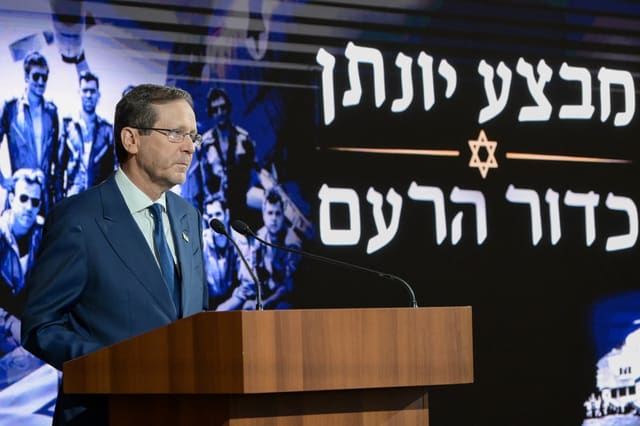
Herzog’s Stark Reminder: State Must Guard Its Own in a World That Forgets
POLICY WIRE — Jerusalem, Israel — Four decades and change later, the specter of a daring hostage rescue still grips the Israeli psyche. It’s an old story, sure, but a nation’s foundational myths...

POLICY WIRE — Jerusalem, Israel — Four decades and change later, the specter of a daring hostage rescue still grips the Israeli psyche. It’s an old story, sure, but a nation’s foundational myths aren’t just dusted off for pleasant memories. They’re called upon, weaponized almost, in moments when the global order feels… frayed. That’s precisely what Israeli President Isaac Herzog did when he recently presided over a solemn commemoration, not just honoring fallen heroes, but laying down a stark reminder of what any state worth its salt owes its people, wherever they roam. And believe me, the echoes reverberate far beyond Israel’s borders.
It wasn’t a mere history lesson, folks. Not when Herzog stepped up, microphone in hand. This was a direct, unapologetic assertion of sovereignty and duty, a cold splash of water on any notion that nations might, in time, forget the debts owed to those under siege. The focus? Operation Entebbe. You know the drill: the 1976 hijack of Air France Flight 139, the harrowing standoff in Uganda, and that audacious Israeli commando raid. Heroes, yes, were recognized. Those who made the ultimate sacrifice—including Lt. Col. Yoni Netanyahu, the prime minister’s older brother—they weren’t forgotten. But the weight of the occasion wasn’t just about looking backward. No. It was about sharpening a present-day mandate.
President Herzog didn’t just rattle off platitudes. His message was a hammer blow: [QUOTE_PLACEHOLDER]. Think about that for a second. It’s a statement steeped in the country’s history, sure, but it also reflects a contemporary posture—one of relentless pursuit, of uncompromising security doctrine, and of an ever-present readiness to act unilaterally if necessary. Because, let’s be honest, in this messy, interconnected world, relying solely on international norms can sometimes feel like bringing a knife to a gunfight.
And let’s not pretend this is solely an Israeli preoccupation. Many states grapple with this thorny concept: where does national responsibility end? When does the pursuit of citizens’ safety morph into an act of aggression? These aren’t just academic debates; they’re the stuff of high-stakes intelligence operations and diplomatic crises that constantly bubble beneath the surface. From cyber threats to the lingering shadow of international terrorism, the landscape shifts, but the underlying commitment, for a nation like Israel, remains immutable.
This commitment? It’s not just about flashy raids. It’s about the constant hum of intelligence, the backroom deals, the covert operations you — and I will never hear about. It’s an around-the-clock undertaking. In fact, a recent report from the International Institute for Counter-Terrorism noted a roughly 15% increase in transnational terror plots targeting specific ethnic or religious groups over the past three years alone. And those numbers, they don’t lie. So, yes, when a head of state invokes the Entebbe precedent, you’d be wise to listen. It isn’t merely nostalgia; it’s a re-up on a promise. A declaration, if you will, to adversaries — and allies alike.
But the real juice is how this kind of declaration resonates in regions far removed from the Levant’s political cauldron. Take Pakistan, for instance, or other nations across the broader Muslim world. These places have their own complex histories of internal security struggles, insurgencies, and dealing with external pressures. Many have faced, and continue to face, their own versions of threats to national sovereignty and the safety of their citizens. So, while the specifics of Entebbe are uniquely Israeli, the overarching theme—that a government’s foremost duty is to its own, come hell or high water—is something that’s understood, perhaps even tacitly admired in certain circles, within these often-turbulent landscapes. It’s about projected power, sure, but also a stark statement on self-reliance in a world often too busy with its own internal affairs to truly lend a reliable hand.
What This Means
President Herzog’s recent Entebbe commemoration is more than a historical observance; it’s a deliberate strategic communication, aimed squarely at domestic and international audiences. Politically, it signals Israel’s unyielding stance on national security, cementing a consensus across its often-divided political spectrum regarding proactive defense. This reiterates the long-held doctrine that the state’s protection extends beyond its recognized borders, a concept that sometimes rubs up against international diplomatic norms—a choice Jerusalem has consistently demonstrated its willingness to make. For the populace, it’s a morale boost, a reaffirmation that their leadership won’t equivocate when their lives are on the line, whether they’re living in Haifa or traveling through a far-off airport.
Economically, this sort of messaging—of a secure and assertive state—can indirectly contribute to stability and investor confidence, particularly in industries like technology and defense, which thrive on an image of strength. It reassures Israeli businesses and individuals operating globally that their government possesses both the capability and the will to safeguard their interests. Conversely, it serves as a deterrent to hostile non-state actors who might consider targeting Israeli citizens abroad, impacting the risk calculus for such operations. And, because the global stage is so interlinked, a strong assertion of state protection from Israel or any nation sets a precedent, one that leaders in other vulnerable regions might be keen to learn from, even if their operational capabilities aren’t quite the same. It’s about setting expectations. The political implications are clear: you don’t mess with a nation committed, with such deep historical resolve, to the defense of its people.