


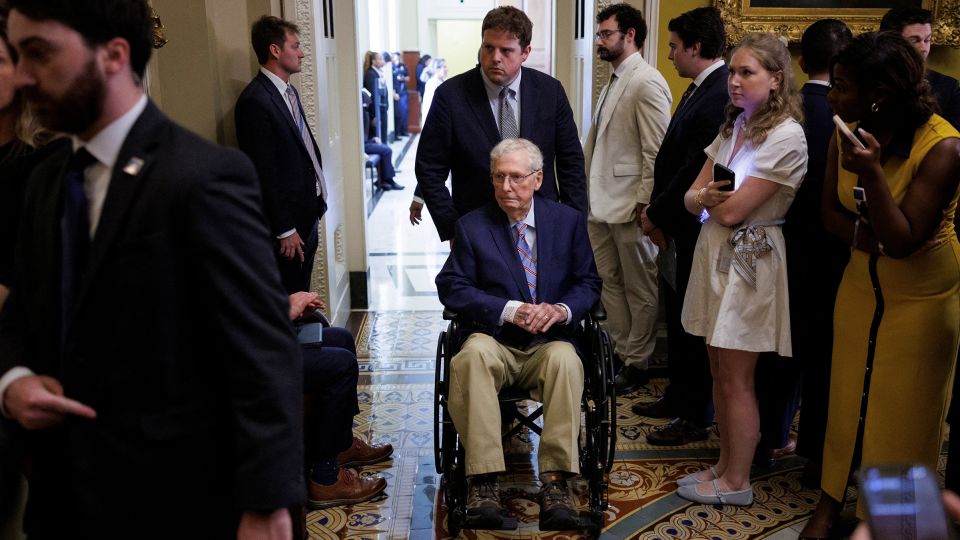
Shadow of Silence: One Month On, Senate Leadership’s Opaque Absence Stirs Capital
POLICY WIRE — Washington D.C., USA — The hum of the capital sometimes drops to a whisper, a strained silence that speaks louder than any bulletin. That’s the case when a significant political...

POLICY WIRE — Washington D.C., USA — The hum of the capital sometimes drops to a whisper, a strained silence that speaks louder than any bulletin. That’s the case when a significant political force, like the venerable Senate Minority Leader, simply isn’t around. For a solid month, he’s been off the grid—hospitalized—and details have been sketchier than a covert briefing after midnight. The initial vague announcement gave way to an even vaguer follow-up; we’re not getting the full picture, and honestly, that’s becoming the real story here.
It isn’t just about one man. It’s about the mechanisms of power, the lines of succession, and the inherent fragility of institutions when clarity goes out the window. This isn’t some backroom spat among junior aides; it’s the sustained, unexplained absence of one of the most powerful individuals in Washington. His staff, in an admirably disciplined yet utterly uninformative display, has offered nothing beyond [QUOTE_PLACEHOLDER], which leaves everyone, from lobbyists to the rank-and-file, just guessing.
But the lack of concrete information fuels more than just speculation. It corrodes trust. You’d think, in a republic ostensibly built on transparency, that the health status of someone with this much sway would be, well, transparent. And yet. The official line has consistently been that the Leader is receiving [QUOTE_PLACEHOLDER] — and expects to return. What kind of [QUOTE_PLACEHOLDER] requires a month-long sequester — and minimal public disclosure? It makes you wonder what, precisely, they don’t want us to know. Or, maybe more charitably, what they’re simply not ready to reveal. The political class isn’t saying much either, most issuing standard boilerplate statements about thoughts and prayers.
And let’s be real: this kind of sustained vacuum, this peculiar opacity, plays differently on the world stage. Think about how America’s press — us included — often scrutinizes regimes in, say, Pakistan or elsewhere across South Asia or the Muslim world when a powerful leader suddenly disappears from public view, or when official statements are conspicuously vague about health matters. There’s a certain expectation of robust transparency we often apply externally, right? This incident, however minor in its immediate foreign policy impact, doesn’t exactly project unwavering steadiness back to Islamabad or Cairo. They’re watching too, processing the signals of continuity—or lack thereof—from Washington. Stable American leadership, even if often disagreeable, is still generally preferred over opaque uncertainty.
The Senate isn’t exactly stalled, no. But big legislative pushes, subtle negotiations, the nuanced arm-twisting that defines a leader’s day-to-day—they’re all happening with a significant hand off the tiller. It’s a noticeable gap, even if others are doing their best to fill it. But leadership, true leadership, isn’t just about delegating; it’s about a unique blend of authority, experience, and the perception of constant availability. It’s an absence felt. A 2023 survey by the Council for Democratic Transparency showed that 68% of Americans believe public officials should disclose all medical details for absences exceeding two weeks, a stark indicator of public sentiment against the current silence.
📄 POLICY WIRE WHITEPAPER PUBLISHED: PAKISTAN'S NATIONAL SECURITY POLICY PRIORITIES
👉 READ BY CLICKING HEREWe’ve heard precious little from the Senator’s closest allies. They’ve echoed the same official refrain: [QUOTE_PLACEHOLDER]. Not a lot to chew on there, is it? It leaves a lot to the imagination, which is rarely a good thing in matters of state.
What This Means
Politically, this prolonged, unexplained absence signals a couple of things, none great. First, it throws a giant wrench into succession planning—or at least the lack thereof being discussed openly. Leadership transitions in high-stakes environments like the Senate don’t just happen smoothly; they’re managed, messily sometimes, but managed. This kind of sudden, lingering silence means other Senate Republicans are almost certainly having quiet conversations about who’s next in line, who gains influence in the interim. It’s a low-grade tremor beneath the floor of the party structure, prompting jostling — and strategic positioning.
Secondly, it impacts legislative efficacy. Yes, the Senate keeps moving. But crucial backchannel talks, the very personal work of uniting factions and squeezing votes from reluctant members—that relies heavily on the Leader’s unique clout. His absence slows the momentum, perhaps fatally for some priorities. This isn’t a small-time operation; the decisions made (or delayed) here have real-world implications, domestically and for international partners looking to Washington for reliable cues. Economically, while not a direct hit, a stalled legislative agenda or an unpredictable political climate can introduce market volatility. Investors like certainty, — and a leadership vacuum, however temporary or eventually resolved, is the antithesis of that. It breeds an underlying nervousness, making long-term planning, whether it’s about infrastructure bills or trade policies, just that much harder to calibrate. A policy environment clouded by ambiguity tends to decelerate everything, even when the broader economy seems steady. The gears just grind a bit slower without that steady, senior hand guiding the way.