


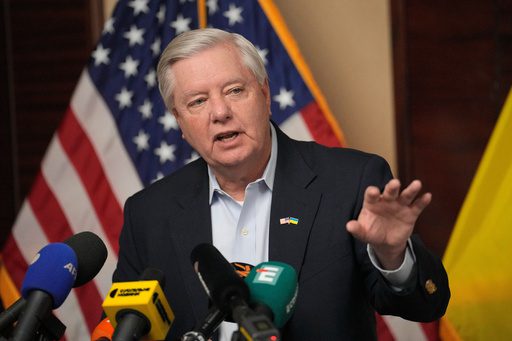
After Washington’s Whirlwind, a Silence: Graham’s Arc From Pool Hall Grit to Global Statecraft
POLICY WIRE — Washington D.C., USA — Just as the Beltway buzz settled on news of another fresh round of sanctions aimed squarely at Moscow—spearheaded, not incidentally, by the man himself—the news...

POLICY WIRE — Washington D.C., USA — Just as the Beltway buzz settled on news of another fresh round of sanctions aimed squarely at Moscow—spearheaded, not incidentally, by the man himself—the news landed like a lead weight. Senator Lindsey Graham, the perpetual motion machine of Capitol Hill, wasn’t going to make his Sunday talk show circuit. Instead, a stunned former President Donald Trump filled his spot, offering a stark eulogy. I just can’t believe it
, Trump lamented, He was like a member of the family.
But, you know, the political family dynamic often resembles an untamed rollercoaster—it’s never quite as simple as it looks from the outside, is it?
Graham, 71, met his end unexpectedly last Saturday evening. A preliminary report from Washington D.C.’s medical examiner’s office pointed to a torn aorta, a sudden consequence of hardened arteries. His passing — a genuine gut punch for many — didn’t just leave Republicans and Democrats scrambling for appropriate accolades. It left an intellectual — and policy vacuum too. Because say what you will about the man, he always, always made noise. This isn’t just about losing a senator; it’s about watching a distinctive, often contradictory, force of nature just… stop. [QUOTE_PLACEHOLDER]
Before his transformation into one of Washington’s most prominent foreign policy hawks—the kind who could needle Moscow, Tehran, or even Beijing with equal relish—Graham hailed from what can only be called utterly humble origins. He was the garrulous son of South Carolina pool hall owners
. The kind of origin story we like to romanticize, yes? His childhood unfolded literally within the confines of his parents’ establishment, the Sanitary Cafe, a world away from the gleaming corridors of the U.S. Senate. He lived with his folks and younger sister in one room, where we all slept, we all ate, we watched TV, the sofa, everything was in one room
, his sister Darline recalled back in 2015. It’s a striking contrast to the polished world of diplomatic cables — and security briefings he’d later inhabit.
And Graham carried that formative experience, the grit, the street smarts—and, yeah, a bit of that Southern swagger—straight into his political career. The guy worked his way up. First as a military lawyer, rising to Air Force colonel, then into Congress. He quickly became that lawmaker always looking for a fight, famously asking about Bill Clinton’s impeachment scandal: Is this Watergate or Peyton Place?
You gotta love the drama, right?
His foreign policy stance, consistently leaning toward American strength and intervention, sometimes put him squarely in the international spotlight. From supporting military engagements to pushing for sanctions, his voice often resonated with those in nations seeking stronger U.S. partnership. That global posture wasn’t just theoretical, mind you. Consider, for example, the sheer scale of global military alliances the US maintains, often fueled by arguments for a muscular foreign policy: the United States engaged in over 200 declared military operations abroad between 2001 and 2020, according to the Congressional Research Service. This sort of active presence, something Graham championed fiercely, has palpable implications, even far afield, for regions like South Asia. Pakistan, for instance, a nation grappling with its own complex security dynamics and a long-standing yet often fraught alliance with Washington, keenly observed Graham’s often assertive calls for global stability through American engagement.
But let’s be real, his most compelling performance — if we can call it that — was his political shapeshift. He ran against Donald Trump in 2016 as a card-carrying member of the Never Trump
movement. He called the man a jackass
, then, after Trump announced his cellphone number at a rally (classic!), he mused openly whether he should switch from an iPhone to an Android. Fast-forward a bit, after his good friend John McCain had passed, and Graham was not just an ally, but one of the ex-President’s fiercest defenders. Can I just say to my Republican colleagues — can we move forward without President Trump?
he queried on Fox News in 2022. The answer is no
, he added with conviction. It’s a remarkable pivot, isn’t it? One that probably made some old colleagues— and a few global observers — scratch their heads, then ultimately shrug. Because that’s how this town works.
📄 POLICY WIRE WHITEPAPER PUBLISHED: PAKISTAN'S NATIONAL SECURITY POLICY PRIORITIES
👉 READ BY CLICKING HEREIt’s not just that he adapted; he became a critical conduit. An intermediary to the White House when the need arose. And yeah, golfing partners too. Their relationship, which broke for a spell after January 6th, nonetheless mended, showcasing Graham’s unique knack for maintaining relevance in shifting political sands. But then, as we’ve seen, those sands shift quickly here. With a senator’s sudden absence, things in D.C. can change on a dime.
And it wasn’t just about partisanship. He was a fierce Republican partisan one day and a key bipartisan ally the next
, recalled Democratic Senator Dick Durbin. That’s a trick not many can pull off. His reputation for deal-making earned him a spot in practically every bipartisan gang
formed in the Senate. Even when JD Vance, then a newly-minted senator, got into a shouting match with Graham over Ukraine funding, the very next day Graham was pushing legislation Vance really cared about
. Vance summarized it perfectly: That was Lindsey Graham. He fought like hell for the things he believed in, and he was just as willing to go to bat for you when it counted.
He never quit, even when faced with political hurdles or personal loss, memorializing his close friend McCain in tears: He failed a lot, but he never quit.
He lived quite a life, going from being a kid called Stinkball
to a Colonel, from the local pool hall to Washington’s highest echelons. It wasn’t always clean, wasn’t always consistent, but it was undoubtedly impactful. His staff, by all accounts, fiercely loyal, because as one former aide, Kevin Bishop, put it, he was incredibly fun to be around.
And He was willing to accept a lot of criticism to move the ball forward.
What This Means
Senator Graham’s abrupt departure leaves more than just a Senate seat open. His specific blend of hawkish foreign policy experience and late-career transactional Republicanism, particularly his ties to the Trump wing of the party, created a unique political fulcrum. There’s a battle ahead to fill that seat, no doubt, but the ripple effects stretch further. South Carolina will scramble, certainly. But his absence impacts foreign policy discussions in particular. Graham’s brand of global interventionism and robust defense of allies—a stance keenly watched from Ankara to Islamabad, where his support for sustained U.S. presence often brought comfort or consternation—loses a forceful advocate. His often blunt rhetoric concerning threats from groups in places like Afghanistan or Iran, for instance, informed and sometimes shaped debates crucial for the wider Muslim world. The lack of his distinctive voice, his readiness to cross partisan lines for the perceived good of national security, could introduce new uncertainties in Congress’s approach to global flashpoints. The deal-making apparatus in the Senate, always a fragile thing, loses one of its more adaptable members. His ability to negotiate, to push controversial judicial nominees through, and then turn around and work with a Democrat on, say, immigration, highlights a specific type of political elasticity that’s increasingly rare. The question isn’t just who replaces him; it’s whether anyone else in Washington truly possesses his particular, sometimes bewildering, set of political skills, the very tools he used to shape policy across two decades.