

Foothills Folly: When a Minor Misfstep Ignites Major Policy Questions
POLICY WIRE — Albuquerque, United States — Dusk had barely settled on the rugged Sandia Mountain foothills last Saturday when another routine call trickled into the Albuquerque Fire Rescue dispatch....

POLICY WIRE — Albuquerque, United States — Dusk had barely settled on the rugged Sandia Mountain foothills last Saturday when another routine call trickled into the Albuquerque Fire Rescue dispatch. An injured hiker. A twisted ankle, it seems. Another day, another testament to—well, not so much the wilderness’s unforgiving nature, but perhaps humanity’s increasing appetite for a ‘just-in-time’ rescue culture, no matter the perceived severity. It wasn’t an epic, white-knuckle drama, not by a long shot. But this unremarkable incident, buried deep in weekend local news cycles, often quietly gnaws at the edges of serious public policy debates, wouldn’t you say?
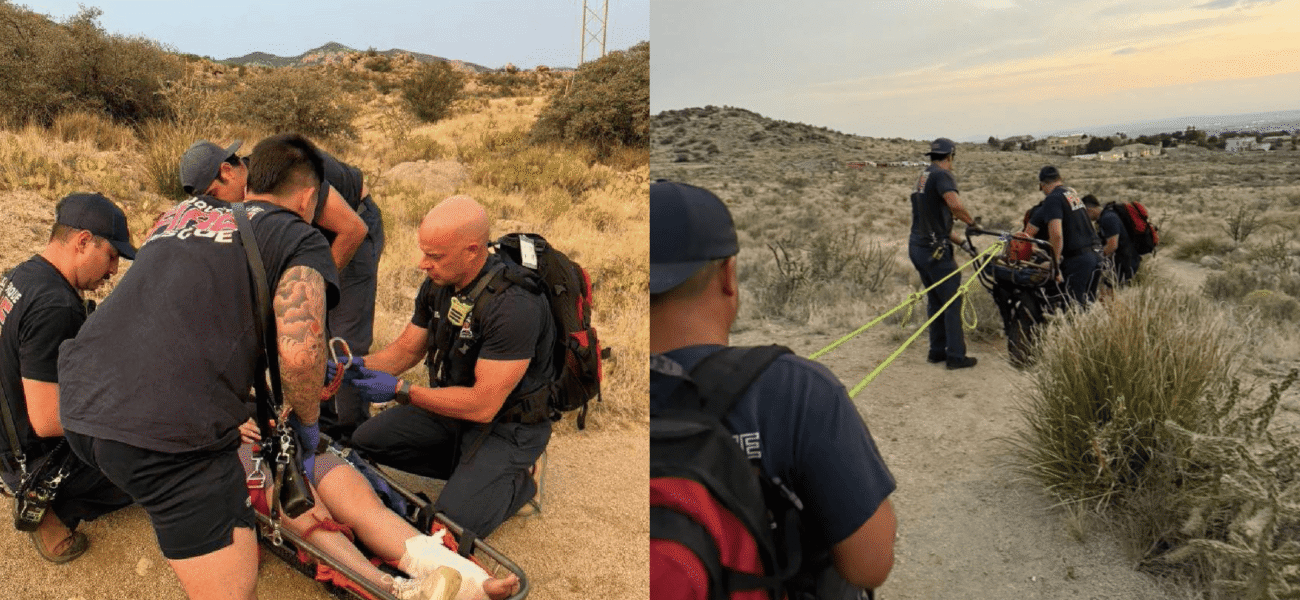
Emergency crews, ever vigilant, were already geared up for what unfolded as a fairly standard extraction. At approximately 7:52 p.m., the call came in: Embudo Trailhead, one person down with a suspected left ankle injury. AFR units hustled, located the patient — details apparently quite precise — stabilized the injury, and, in a remarkably efficient ballet of modern emergency response, wheeled them back to civilization, then off to a local hospital. Nobody else hurt. And that, as they say, was that. The wheels of public service, oiled by taxpayer dollars, had spun flawlessly for a solitary, hobbled hiker.
But the seamless operation masks a subtle tension, a slow-burning question of who pays, — and how often. “Our primary mission is to ensure the safety of our residents and visitors, full stop,” stated AFR Battalion Chief Mark Sanchez, sounding every bit the committed public servant during a recent press brief. “Whether it’s a high-rise fire or a sprained ankle on a mountain path, we’re there. It’s what we do.” But, because it’s what they do, the demands stack up. Albuquerque, like countless municipalities, juggles the increasing burden of calls, often for incidents that might, in another era, have been handled by a sturdy friend and a dose of grit.
But can we sustain this? Local city councilor Lan Sena didn’t mince words when pressed on budget allocation last quarter. “Every dollar spent on rescue operations is a dollar that could go to education, or housing, or road repairs,” she’d noted with her characteristic pragmatic gaze. “We have an obligation to provide these services, yes. We also have an obligation to encourage responsible outdoor recreation. The line between unavoidable emergency and preventable mishap, it’s getting blurry, and we need to talk about what that means for our budget and our community’s priorities.” Her point isn’t lost on taxpayers; search and rescue missions across the United States can be astonishingly costly. According to a 2023 report from the National Search and Rescue Association, the average wilderness rescue operation in the United States costs roughly $6,500 per incident, though complex operations can far exceed that.
Consider the broader context, too. In nations like Pakistan, where mountain ranges aren’t just scenic backdrops but often the very infrastructure of rural life, rescues become existential, politically charged affairs. Take the ongoing, brutal ‘Operation Shaban’ in Balochistan, where government forces contend with insurgencies and the rugged terrain makes even routine transit a gamble. A sprained ankle there? It’s not just an inconvenience; it’s a threat to survival, miles from a paved road, days from a proper clinic, and potentially caught in a geopolitical crossfire. The mere expectation of immediate, professional retrieval, as exemplified in Albuquerque, is a luxury many can scarcely imagine. We’ve conditioned ourselves—or have been conditioned—to expect instantaneous intervention, regardless of the relative danger or triviality of the situation.
📄 POLICY WIRE WHITEPAPER PUBLISHED: PAKISTAN'S NATIONAL SECURITY POLICY PRIORITIES
👉 READ BY CLICKING HEREWhat This Means
This single, unspectacular rescue underscores a simmering policy tension: the seemingly boundless demand for immediate public safety intervention versus the finite resources available to municipal agencies. Economically, repeated calls for minor ailments inflate emergency services budgets, potentially siphoning funds from other essential city services. It’s a tricky balance: who’s to say which injury is ‘worthy’ of a rapid, fully staffed response? Politically, advocating for greater personal responsibility in outdoor recreation can be a thorny path for elected officials, potentially seen as insensitive or anti-outdoors. But inaction—or silence—also implicitly sanctions the growing strain on emergency personnel. Maybe a better path forward lies in proactive public awareness campaigns, not just about safety gear, but about responsible self-reliance, acknowledging that every response, however small, has a tangible impact. It’s not about denying help when truly needed; it’s about discerning where our collective resources are best deployed. And it begs a comparison to nations where every ‘minor’ incident can spiral into a humanitarian crisis, often lacking the sophisticated—and expensive—response infrastructure we take for granted.