


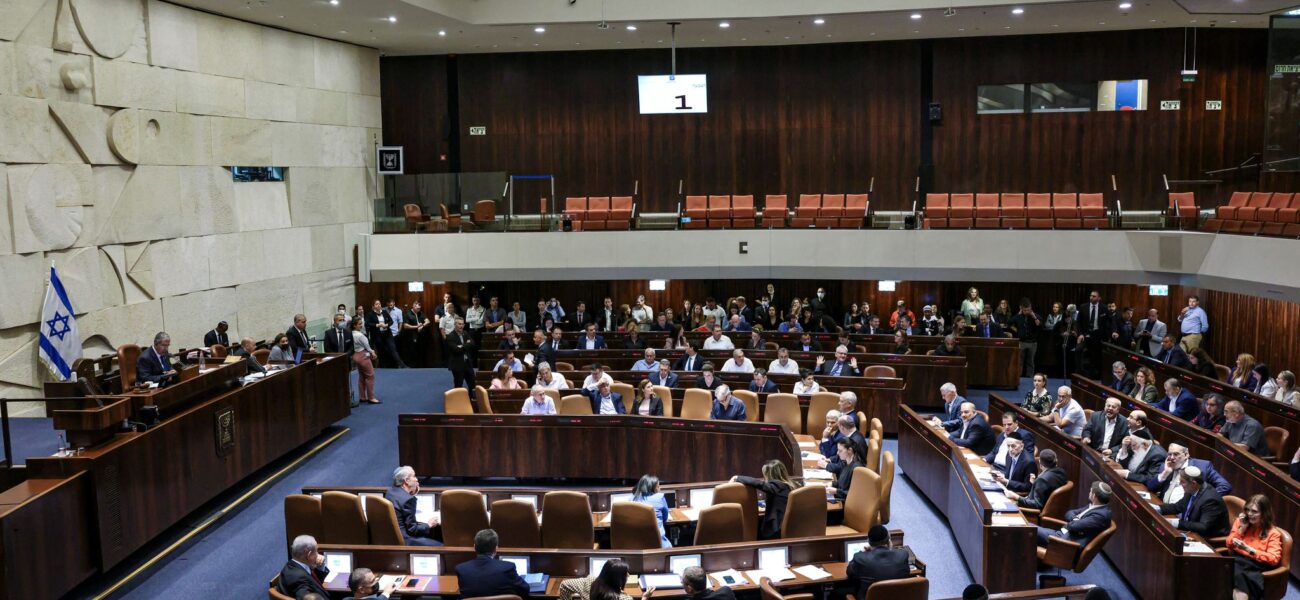
Israel’s Endless Encore: Parliament Gears Up for Another Spin on the Electoral Wheel
POLICY WIRE — Jerusalem, Israel — The perennial show must go on. That’s the unspoken motto echoing through the Knesset’s halls, as Israel’s legislative body is now set to dissolve yet again, paving...

POLICY WIRE — Jerusalem, Israel — The perennial show must go on. That’s the unspoken motto echoing through the Knesset’s halls, as Israel’s legislative body is now set to dissolve yet again, paving the way for fresh parliamentary elections on October 27. It’s a déja vu that barely raises an eyebrow anymore in a nation grown accustomed to political Groundhog Day.
It isn’t news, not really, but rather the next installment in a long-running saga of political dysfunction. Just when you think the plot twists have run their course, another chapter unfolds, pulling a weary populace back to the ballot boxes. This isn’t merely about governance; it’s become a national pastime, an exhausting dance of shifting allegiances and intractable disagreements that’s now a defining feature of the Israeli political landscape.
Because frankly, it’s exhausting. For voters, for politicians, for anyone trying to conduct actual business in a country that demands stable leadership. The latest collapse – the exact mechanics of which are less interesting than the sheer predictability – marks a continuation of what’s essentially become Israel’s default setting: perpetual campaigning. We’re talking about a country that’s clocked five general elections in under four years, each one a hefty price tag on a democracy that can barely catch its breath. And each of these electoral circuses doesn’t come cheap; the last round, according to estimates from KAN News, cost the public coffers roughly NIS 2.5 billion, or about $750 million – money that many argue could’ve been better spent.
It’s a peculiar brand of political drama, isn’t it? A nation surrounded by existential threats, grappling with complex social divisions, yet repeatedly consumed by its internal political churn. Prime Minister Benjamin Netanyahu, facing persistent legal troubles and a divided coalition, hasn’t wasted time casting the situation as a necessary evil. “It’s about securing Israel’s future,” he was heard telling aides, his voice carrying the familiar gravitas of someone long accustomed to political tightropes. “Something our fractious political class has struggled to grasp. Stability isn’t a luxury; it’s a necessity.”
But his political rivals see it differently. Former Defense Minister Benny Gantz, a consistent contender in these electoral rounds, minced no words. “Another election isn’t a victory; it’s a profound failure of leadership,” Gantz likely asserted in a private meeting with his party’s strategists, his frustration palpable. “We can’t keep subjecting our citizens to this political merry-go-round when real challenges—security, economic, social—demand serious, consistent governance.”
And so, the campaigns will begin anew. Posters will appear, promises will be made, and the entire machinery of a democratic state will grind to a halt to accommodate another round of politicking. The impact of this internal merry-go-round stretches far beyond Jerusalem’s city limits, reverberating across a region already on tenterhooks. From Islamabad to Jakarta, observers in the wider Muslim world often watch Israel’s relentless political soap opera with a complex mix of cynical interest and outright exasperation. For nations like Pakistan, locked in a principled non-recognition stance, this internal turmoil sometimes offers a stark counterpoint to the image of a unified, formidable adversary.
📄 POLICY WIRE WHITEPAPER PUBLISHED: PAKISTAN'S NATIONAL SECURITY POLICY PRIORITIES
👉 READ BY CLICKING HEREBut the practical implications remain grim for those seeking regional stability. Palestinian factions, for instance, are left guessing which Israeli leadership they’ll have to contend with next, paralyzing any potential for meaningful long-term diplomacy. And the implications of Gaza’s perpetual dusk often recede further into the background as political elites squabble for domestic advantage.
What This Means
This upcoming election isn’t just another trip to the polls; it’s a further erosion of institutional credibility. Economically, repeated elections disrupt budgetary planning and deter foreign investment, as stability—or lack thereof—is always factored into risk assessments. Businesses operate in a climate of uncertainty, with significant policy decisions perpetually delayed or reversed depending on the latest government iteration. Who wants to make long-term plans when the policy goalposts keep shifting? Nobody, that’s who.
Politically, the continuous cycle risks voter fatigue, potentially leading to lower turnout and a populace disengaged from its democratic processes—a dangerous trajectory for any nation. It also empowers fringe parties, whose disproportionate influence can dictate government formation in a fragmented coalition landscape. Nationally, it delays addressing critical long-term challenges, from security doctrine to socioeconomic inequality. But globally? It solidifies Israel’s image as a nation perpetually on the brink of self-inflicted governmental paralysis, offering little solace to allies or deterrence to adversaries. It’s a frustrating loop that Israel seems determined to keep spinning.