
A Fickle Ledger: Native American Schools Grapple with Funding, Future, and Fudged Figures
POLICY WIRE — Washington D.C., USA — The ledger looks rosier than it used to. On paper, at least. Across the scattered, often struggling schools governed by the U.S. Bureau of Indian Education (BIE),...

POLICY WIRE — Washington D.C., USA — The ledger looks rosier than it used to. On paper, at least. Across the scattered, often struggling schools governed by the U.S. Bureau of Indian Education (BIE), graduation rates have reportedly soared. They’re saying it’s progress. A sign of things turning around for Native American students after generations of educational neglect and policy missteps. But look closer—always look closer—and you find the typical bureaucratic ballet of statistical massaging and genuine, albeit tenuous, gains.
Because, well, sometimes improving the numbers just means improving the way you count. For too long, the BIE, which supervises 183 primary and secondary schools serving some 40,000 students, relied on data collection methods so flawed they made honest assessment a fool’s errand. Kids transferring to another institution? Often marked as dropouts. That sort of sloppy accounting artificially deflated the rates, masking both true success — and persistent failures. "We had to come to a consensus and set an accountability framework for our schools," explained Carmelia Becenti, the agency’s chief academic officer, of the shift begun in 2018.
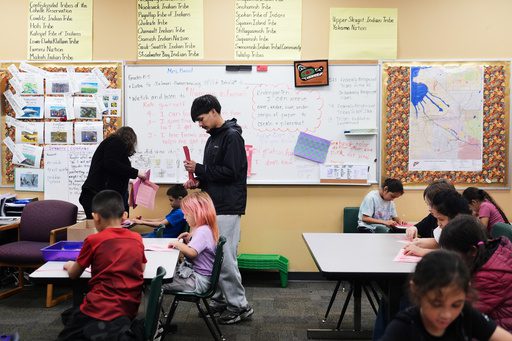
An AP analysis of BIE data, published through the Global Indigenous Reporting Network, now suggests a 55% uptick in graduation rates since these new reporting standards kicked in. It’s a big leap, to be sure, with some nine secondary schools claiming 100% growth or more. Impressive, if you don’t fret over how much of it’s actual student achievement versus simply counting better. Still, there’s a human element to this statistical pivot, often rooted in ground-level innovation. Take Gerald Dillon, an 18-year-old from the Puyallup Reservation. His senior year wasn’t spent hunched over textbooks contemplating advanced calculus, but rather as a teaching assistant for second graders.
It was hands-on, connected, — and crucially, *real*. He found purpose in fist bumps — and hugs from little kids, something a standardized curriculum never offered. "It motivates me. I like making connections with the kids, I like helping them," Dillon noted, his grades a testament to his renewed engagement. He’s now pondering a teaching degree himself, a stark contrast to his earlier apathy. This practical turn—emphasizing career readiness and vocational training over a single-minded path to college—is precisely what leaders like Don Brummett, superintendent of Chief Leschi Schools, advocate. "We devalued the trades. That was a mistake," Brummett admitted.
Since the Puyallup Tribal Council funded their career and technical curriculum in 2020, Chief Leschi has seen its four-year graduation rates jump from a dismal 53% to a respectable 87%. And they’re not alone. Choctaw Central High School in Mississippi, under the wing of the Mississippi Band of Choctaw, saw its graduation rate soar to 93% on the back of a virtual learning option retained after the pandemic. "For certain kids that have more responsibilities at home, kids that need to work, we saw that gave them a flexible schedule and an opportunity to earn their diploma," principal Alaric Keams told Policy Wire.
But beyond the localized triumphs and revised figures lies a familiar, entrenched narrative: resource scarcity and bureaucratic meddling. Many tribal governments simply don’t have the deep pockets or infrastructure to manage their own BIE schools or replicate these innovations. Peter Lengkeek, chairman of the Crow Creek Sioux Tribe in South Dakota, paints a grim picture. His community’s BIE-operated high school is falling apart—chronically understaffed, besieged by deferred maintenance, with a rodent-infested gymnasium. It graduates fewer than 60% of its students. "We have to rely on the government to fulfill its treaty promise," Lengkeek lamented, a pointed jab at federal obligations. It’s a sentiment not lost on other marginalized communities fighting for autonomy and basic services against entrenched state bureaucracies.
The Trump administration’s reshuffling of the BIE and its federal parent, including a planned (and largely resisted) dismantling of the U.S. Department of Education, has only fueled instability. The November 2025 decision to shift oversight of numerous Native student programs to the BIE sparked outrage. Tribal leaders, already wary, accused the department of ignoring treaty-bound consultation. "The ink was dry on the agreements before the tribes were ever notified," Herschel Gorham, lieutenant governor of the Cheyenne and Arapaho Tribes, charged, calling it unacceptable.
And these federal moves ripple out. "That caused some delays and disruptions to services," stated Jason Dropik, executive director of the National Indian Education Association. He’s seen it before—the Washington D.C. office’s political spasms echoing in school hallways, like the aborted attempt to turn BIE into a school choice system. That one got pulled back after a furious tribal outcry, but the message was clear: top-down, opaque policy isn’t what they need. It’s a cycle, you see, a grinding friction familiar in developing nations across the globe where centrally planned educational models often chafe against the distinct cultural, linguistic, and socio-economic needs of local populations. From Pakistan’s federating units striving for control over curriculum in Balochistan to struggles in India for regional language primary education, the balance between national uniformity and local autonomy in education is a perpetual negotiation.
What This Means
The seemingly positive surge in BIE graduation rates presents a policy tightrope walk. Economically, while a rising tide *should* lift all boats, these numbers are skewed. We’ve got a genuine effort in some schools to create relevant education pathways, often tribally funded, alongside a federal bureaucratic ‘fix’ that primarily makes the data *look* better. Politically, the constant threat of federal budget cuts and the clumsy, top-down implementation of policies without meaningful tribal consultation aren’t just undermining trust; they’re actively sabotaging long-term stability for these communities. It’s not just about education, it’s about sovereignty. Without sustained funding, genuine partnership, and respect for tribal self-determination, any statistical ‘win’ feels provisional. The critical lesson? Data doesn’t just need to be accurate; the policies informing it need to be rooted in respect and sustained investment, not fleeting political expediency. Otherwise, these kids—and the future of their nations—are left chasing a moving target.