Democrat’s West Bank Brush-Up: A Diplomatic Headache for Washington
POLICY WIRE — Washington D.C., USA — The West Bank, often an abstraction for many in the gilded halls of American power, chose recently to assert its tangible, unvarnished reality—and not politely....

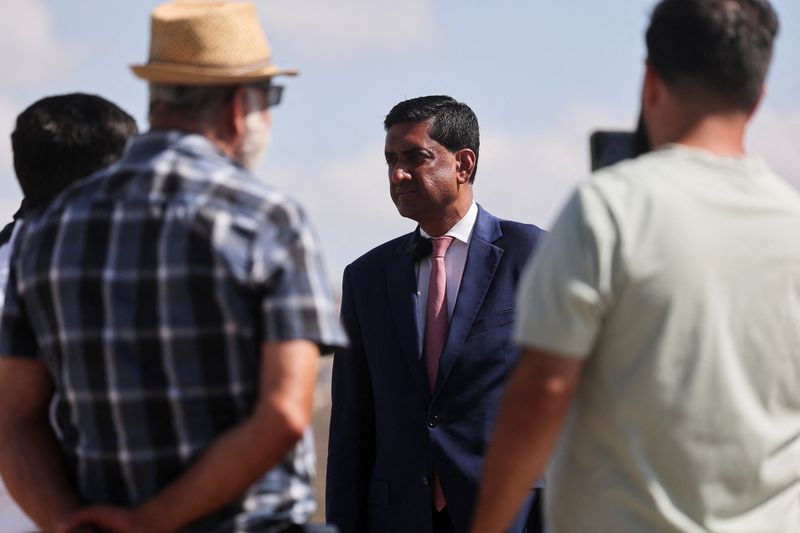
POLICY WIRE — Washington D.C., USA — The West Bank, often an abstraction for many in the gilded halls of American power, chose recently to assert its tangible, unvarnished reality—and not politely. It wasn’t the expected official itinerary, the carefully curated dialogue with Palestinian Authority figures, or even the routine, if sometimes tense, interactions with Israeli defense personnel. No, it was a moment decidedly off-script: a sitting U.S. Congressman, Representative Ro Khanna, getting a firsthand, and rather rude, lesson in the gritty, unpredictable nature of life in occupied territory.
It’s usually the headlines reserved for activists or obscure foreign dignitaries, not a California Democrat—someone who’s spent his career navigating the comparatively sterile battlefields of Capitol Hill and Silicon Valley politics. But there he was, face-to-face with an impromptu, albeit self-appointed, checkpoint erected by Israeli settlers. The incident, ostensibly a minor inconvenience, ripped open the thin veneer of diplomatic normalcy that Washington so assiduously tries to maintain over one of the world’s most intractable conflicts. You can’t just gloss over that, can you?
Khanna, a prominent voice among progressives, found himself in a spot where the rule of law seemed a flexible concept, determined by whoever felt most emboldened on the ground. The settlers, according to reports, were rather aggressive. They just flat-out refused him passage. This wasn’t some fleeting blockade; it was a determined, prolonged confrontation that speaks volumes about the fraying control in these contested lands. His entourage, presumably expecting a more… formal welcome, had to manage the whole mess. Imagine that—an American representative, out there, having to navigate essentially a hostile civilian roadblock.
And it really drives home a hard truth: American influence in this sliver of land, often touted as exceptional, isn’t always recognized where it matters most—among those who believe they’re carving out their own destiny, with or without official sanction. It doesn’t matter what your official diplomatic status is. What’s clear is [QUOTE_PLACEHOLDER] in that moment. But really, what is the message when American officials get hemmed in?
Because these settlers, emboldened by their government’s expansionist policies, often operate with an alarming degree of impunity. Their presence in areas like the West Bank isn’t just about housing; it’s a political act, an assertion of sovereignty that fundamentally undermines any prospects for a two-state solution. And Washington, for all its rhetoric, finds itself often a bystander, or worse, perceived as complicit. The UN Special Rapporteur on the situation of human rights in the Palestinian territories reported in 2023 that approximately 700,000 Israeli settlers reside in occupied East Jerusalem and the West Bank, an increase of over 100,000 in just five years, accelerating the irreversible annexation.
This incident also reverberates far beyond the immediate friction of the West Bank. Across the broader Muslim world, from Cairo to Kuala Lumpur, and especially in capitals like Islamabad, such episodes aren’t seen as isolated. They’re read as confirmations, fresh entries in a long ledger of grievances, fueling narratives of Western hypocrisy. Pakistan, a country long entangled in its own complex relationships with the West, watches events like these and often sees little daylight between America’s stated ideals and its often-uneven application of foreign policy principles. It reinforces a suspicion that America isn’t truly an impartial arbiter, not when its own diplomats are effectively — if temporarily — sidelined by actors supposedly on its ally’s fringe.
📄 POLICY WIRE WHITEPAPER PUBLISHED: PAKISTAN'S NATIONAL SECURITY POLICY PRIORITIES
👉 READ BY CLICKING HEREWhat Khanna experienced is, frankly, just another wrinkle in a diplomatic blanket already full of snags — and tears. But for him, personally, it’s gotta be a defining moment. It’s one thing to read the intelligence briefings. It’s quite another to feel the visceral tension, to witness firsthand the raw edge of territorial dispute. And his Democratic colleagues? They’re left scratching their heads, figuring out how to reconcile their party’s sometimes conflicting stances on Israeli security and Palestinian rights.
What This Means
The blocking of a U.S. Congressman by Israeli settlers isn’t just an awkward photo opportunity; it’s a symptom, stark and unblinking, of a system nearing its breaking point. For American foreign policy, it highlights a profound loss of prestige, especially with regional allies who question Washington’s efficacy. How can the U.S. brokered deals or champion peace if its own elected officials are treated as second-class citizens in territories where American aid and diplomatic efforts are nominally directed? It’s not a good look, really.
Economically, continued unchecked settlement expansion, ironically, threatens regional stability. This instability, which incidents like Khanna’s detention illuminate, actively deters investment and exacerbates humanitarian crises. Investors, always skittish, don’t flock to areas where the very infrastructure of governance feels so utterly arbitrary. From an Israeli perspective, it complicates relations even with those European and American factions typically supportive, fueling criticism and potentially impacting future defense and economic partnerships.
And domestically, the incident will only deepen the fissures within the Democratic Party. Progressive voices will demand a tougher stance on Israeli settlement policy, while more traditional, hawkish elements will try to downplay the significance. It makes already fraught policy debates even tougher. For nations across South Asia and the wider Muslim world, it adds another data point to the perception of American bias—a narrative that, unchecked, could compromise future U.S. efforts to build consensus on issues ranging from counter-terrorism to climate change. Because if you can’t even guarantee safe passage for your own reps, what confidence do others have in your commitments? It forces an uncomfortable reevaluation of the real leverage Washington actually wields—or, perhaps, doesn’t.