


Mideast Tempest Brews as Markets Find Peculiar Calm Amid AI Frenzy
POLICY WIRE — New York, United States — It’s a strange world, isn’t it? The planet holds its breath as two global powers exchange blows—a brewing storm in the Strait of Hormuz, no less—yet Wall...

POLICY WIRE — New York, United States — It’s a strange world, isn’t it? The planet holds its breath as two global powers exchange blows—a brewing storm in the Strait of Hormuz, no less—yet Wall Street just seems to yawn. That’s what went down, basically, as markets around the globe offered a peculiar sigh of relief, largely brushing off the escalating skirmishes in the Middle East.
President Donald Trump’s muddled declarations about a temporary truce in the war with Iran didn’t exactly clarify things. In fact, he pretty much threw a wrench into the whole idea, though he did say Wednesday that the latest back-and-forth fighting wouldn’t result in “long-term” military action. Go figure. Despite new U.S. airstrikes — and Iran’s retaliatory targeting of U.S. allies, major indexes weren’t just holding steady; they were climbing. It’s enough to make you wonder what, precisely, rattles these folks anymore. Maybe they’re just getting used to chaos, a rather bleak thought if you ask me.
The S&P 500, for instance, climbed 0.8% — and more than recovered its loss from the day before. The Dow Jones Industrial Average added 139 points, or 0.3%, — and the Nasdaq composite rallied 1.3%. On the flip side, oil prices—that typical barometer of geopolitical anxiety—eased off their earlier highs. The price for a barrel of Brent crude, the international standard, fell 2.2% to $76.30. Sure, that’s down from $78.02 the day before though still above its $71.80 price from the end of last week, but it signals markets aren’t betting on a protracted blockade.
But here’s the kicker, the unspoken rule of the modern economy: nothing, not even a looming international crisis, beats the allure of a shiny new tech bubble. Yes, we’re talking about AI, artificial intelligence. The renewed strength for makers of computer chips and other winners of the boom around artificial-intelligence technology helped to support stock markets worldwide. Forget those tankers potentially getting blocked from the Strait of Hormuz and preventing the delivery of crude from the Persian Gulf to customers worldwide—we’ve got AI to worry about, and it’s far more compelling for some investors.
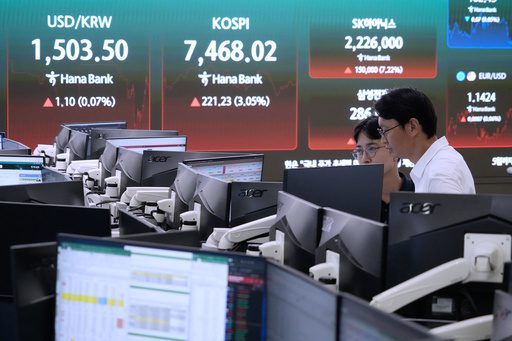
Consider South Korea, for example, where two semiconductor giants basically run the stock market. The Kospi index there rose 0.6% after tumbling 5.3% the day before. SK Hynix, a heavy hitter preparing to sell shares of its stock that will trade in the United States, jumped 5.3% in Seoul. On Wall Street, Micron Technology’s climb of 4.5% was one of the strongest forces lifting the S&P 500, citing “surging demand for memory in the AI era” as it gave a progress update on construction in central New York of what it says is the largest semiconductor manufacturing site in U.S. history.
It’s an absolute frenzy. These tech stocks have become some of Wall Street’s most influential after growing so big in the euphoria around AI. Yet, there’s an undercurrent of skepticism, naturally. But AI stocks have also come under pressure recently because of worries their prices shot too high and that AI may not create enough productivity and profits to make all the investments in chips and data centers worth it. It’s always something, isn’t it?
Away from the high-stakes chips — and bombs, everyday economic indicators painted a somewhat grimmer picture. The swings for oil prices halted what had been a steady decline in gasoline prices. According to motor club AAA, the average price for a gallon of regular gasoline was $3.85 Thursday, up 68 cents from a year earlier. This kind of consumer hit, coming hot on the heels of potential inflation worries spurred by energy shocks, doesn’t bode well for household budgets, especially in developing economies like Pakistan.
Pakistan, with its deeply precarious economic situation and heavy reliance on imported energy, finds itself particularly vulnerable to such geopolitical tremors. Any disruption to Middle Eastern oil flows, or even sustained price volatility, sends ripples across its struggling economy. It complicates import bills, inflates domestic prices, — and further pressures an already fragile currency. Stability in the Gulf isn’t just about regional security; it’s about the everyday solvency of nations thousands of miles away, an often-overlooked dimension in these high-level dramas.
Overall, it was a day of recovery for broad market indices. The S&P 500 rose 60.93 points to 7,543.64. The Dow Jones Industrial Average climbed 139.02 to 52,487.41, — and the Nasdaq composite rose 336.24 to 26,206.89. Bond yields helped too; the yield on the 10-year Treasury fell to 4.54% from 4.56% late Wednesday. But because of these conflicting signals, investors aren’t exactly relaxing.
And let’s not forget old-school companies, some facing a harder slog. PepsiCo fell 3.3% even though it reported slightly better revenue for the latest quarter than analysts expected. Turns out, the company behind Gatorade and Doritos showed weakening trends in its North American food and drinks businesses. Looks like even snack sales can’t escape economic gravity.
Internationally, indexes broadly rose across Europe — and Asia. Besides Seoul’s climb, stock indexes rose 1.7% in Shanghai — and 0.9% in Paris. On the losing end was Hong Kong’s Hang Seng, which slipped 0.7% as shares of Apple supplier Luxshare fell 1.5% in its trading debut. For more on the complex geopolitical currents shaping global markets, particularly in the Middle East, read Middle East’s Brewing Storm: Tehran’s ‘Hard Slap’ Warning Rattles Region, Global Stability.
What This Means
This whole episode is a masterclass in market dissonance. You’ve got a bonafide military tit-for-tat between a superpower and a regional heavyweight, an explicit threat to global oil flows, and inflation fears knocking on the door. And yet, markets largely shrugged, seemingly choosing to focus on the dazzling promise of AI or, perhaps, on President Trump’s vague assurances that conflict won’t become “long-term”—a rather thin reed of stability, if you ask me.
But the relative calm is fragile. Any concrete escalation in the Middle East, especially around the Strait of Hormuz, would quickly reverse oil’s modest retreat and likely trigger broader market panic, putting central banks—like the U.S. Federal Reserve—in an unenviable position. They’re already balancing inflation risks against growth concerns. Higher energy costs would make rate hikes almost inevitable, slowing down economies further. For countries in the Muslim world, especially Pakistan and other oil-importing nations, sustained higher energy prices mean deepened economic pain, currency devaluation, and widespread public discontent, making their policy tightrope walk even more precarious. Meanwhile, the AI euphoria, while real, feels a lot like speculative oxygen for an otherwise anemic global growth picture. It’s less a fundamental strengthening of the economy and more a convenient distraction, obscuring very real geopolitical and inflationary dangers.