


Wimbledon’s Brutal Summer: Gauff’s Anguish Ignites Debate on Athletic Nerves, Global Aspirations
POLICY WIRE — London, UK — The relentless London heat wasn’t the only thing raising temperatures on Centre Court last week. Instead, it was a split-second misjudgment, a young American talent...

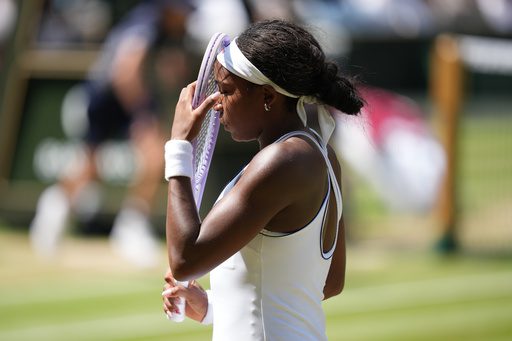
POLICY WIRE — London, UK — The relentless London heat wasn’t the only thing raising temperatures on Centre Court last week. Instead, it was a split-second misjudgment, a young American talent named Coco Gauff faltering on what felt like destiny’s doorstep. Her dramatic semifinal loss at Wimbledon, an unexpected twist, proved that even the sport’s brightest stars aren’t immune to its most unforgiving moments—and that sometimes, triumph really does hang by a single, desperate thread.
Muchova, her Czech opponent, seemed poised for collapse. Indeed, she’d been visibly struggling under the baking sun—the thermometer hit 91 degrees Fahrenheit (33 Celsius) on Thursday. This kind of physical drain makes every point feel like a marathon. But she, somehow, held it together. You just never know how a body or mind will react when the pressure’s cranking, right? [QUOTE_PLACEHOLDER]
It was Gauff’s serve, potent — and precise, landing on the ad court, setting up what appeared a simple put-away. Her first match point. This was it. Years of effort, culminating. The ball kicked up, unexpected. And then, well, the net ate the drop-shot attempt. Gauff missed her shot, sealing a 6-2, 1-6, 7-6 (10) defeat, pushing Muchova through to face Linda Noskova in an all-Czech final.
The bounce kind of caught me off guard, Gauff offered afterward, raw but reflective. I just panicked a little bit. It’s a sentiment many can grasp—that moment where your training vanishes, and sheer instinct, or dread, takes over. People who don’t watch tennis are going to be like, Why did you do that? Gauff mused, knowing the optics weren’t great. But that’s the choice I made. Was it the right one in that moment? Maybe not. But then also, if I make it, everyone’s going to say how clutch of a shot that was. That’s just tennis. You lose some points off margins.
The raw, visceral truth of those margins, tiny — and brutal, shaped an afternoon for the ages. It was such a big fight, Muchova recounted. It was a roller coaster. You couldn’t write it, honestly. From collapsing on the grass after an audacious diving volley that evoked Boris Becker’s old theatrics, to holding her stomach in obvious discomfort—Muchova lived a match in hyper-speed. She then bounced right back to clinch victory when Gauff’s final forehand went long.
And so, we’re left to ponder the lessons of such high drama. Gauff, ever the professional, chose perspective. I’m going to think about it tonight, she confessed. I look at Roger (Federer, in the 2019 final) lost match points here, Jannik (Sinner) obviously at Roland Garros (in last year’s final). Every great champion has this happen in their career, Gauff added. Maybe this is something I need to be on their level.
Her resolve, frankly, is something to observe. Despite Tracy Austin suggesting on the BBC that Gauff looked like ‘she changed her mind three times as to where to hit that ball,’ Gauff remained steadfast. Honestly, I didn’t change my mind too much. I feel like if I had to do it over, I probably would have gone for a slice forehand down the line. It’s a learning experience, Gauff admitted. I know I can do better — and improve on that, and going with a higher-margin shot in a pressure moment, for sure.
For nations across the Muslim world and South Asia, places where tennis often struggles for airtime against cricket’s colossal shadow, Gauff’s rise has been particularly compelling. She embodies the globalized nature of modern sport—a young woman of color, shattering expectations, pulling in fans who’d never thought to watch a rally. This kind of international appeal, regardless of the match outcome, offers a different kind of win: a broadened view of possibility. For a region like Pakistan, where sporting infrastructure can be inconsistent, seeing athletes from diverse backgrounds reach such heights provides a crucial — though unspoken — cultural impetus. It’s a testament to aspiration, if nothing else.
Karolina Muchova’s record on grass this season? A phenomenal 11-1 after securing a title in Bad Homburg, Germany. That’s a hard fact. But for Gauff, this Wimbledon was still her most successful outing yet, previously never going past the fourth round. Her debut as a 15-year-old in 2019 now seems like a lifetime ago, a distant echo of nascent potential finally beginning to find its thunder.
What This Means
This single match, far from being just another sports story, subtly highlights the economic and political undercurrents of elite global competition. The heat, for instance—a consequence of broader climate patterns—directly impacted athlete performance, sparking whispers about player welfare and adaptation in an increasingly warmer world. You can bet future grand slams are thinking about how this affects scheduling — and the bottom line. More critically, though, it’s about the commerce of inspiration.
Athletes like Gauff, with their global fan bases and marketable narratives, don’t just sell tickets; they influence national brand perception and cultural soft power. Her near-miss, a poignant lesson in overcoming adversity, resonates from crowded European stadiums to remote South Asian villages where a young girl might be watching, dreaming. It’s a reminder that sporting success isn’t just about trophies; it’s an economic engine for sponsorship deals, tourism, and a sense of collective national pride. The Czech Republic will see an economic bump from an all-Czech final, no question. Contrast that with nations struggling to develop consistent sporting programs; these narratives become not just about individual achievement but about how policy—or its absence—shapes access to global stages. We’re talking millions, sometimes billions, in potential exposure, for countries often looking for an angle to boost their global profile—and that’s an investment that can’t be understated.
the sheer psychological toll evident on both Gauff and Muchova after hours under the sun underscores an ongoing policy debate in sports governance: at what point does pushing the limits become detrimental? It’s not just a physical contest; it’s a mental grind. Policy decisions around athlete care, prize money distribution, and developmental programs all stem from these high-stakes dramas. This wasn’t merely a tennis match; it was a compact, visceral display of how global forces, personal drive, and raw human frailty converge, all under the glare of international scrutiny. You know, much like the economics of excellence everywhere else.
__ Associated Press writer Mattias Karén contributed to this report. ___