


Caracas’s Pragmatic Pivot: NGOs on Front Lines as Venezuela Faces Dual Crisis
POLICY WIRE — Catia La Mar, Venezuela — For years, non-governmental organizations in Venezuela lived under a cloud, targets of official suspicion and government repression. They were accused of...

POLICY WIRE — Catia La Mar, Venezuela — For years, non-governmental organizations in Venezuela lived under a cloud, targets of official suspicion and government repression. They were accused of everything from meddling to undermining stability, sometimes summarily expelled. But a powerful shift—a seismic one, perhaps—has altered this landscape. Now, after devastating earthquakes flattened homes and shattered infrastructure, these same organizations aren’t just tolerated; they’re the last line of defense against an escalating humanitarian catastrophe, filling a vacuum the state just can’t manage alone. It’s a striking turn, a pragmatic capitulation born of necessity, laying bare the deep systemic issues festering beneath the nation’s surface even before the earth moved.
Down in Catia La Mar, a hard-hit community, the scene speaks volumes. Forget just broken bones; relief services offered by these long-maligned groups are swamped with far more insidious problems. Doctors are reporting an uptick in nasty skin conditions and diarrheal diseases, things tied directly to crammed living spaces and iffy water supplies. People are turning up, desperate for medication they can’t get elsewhere for chronic ailments like diabetes and high blood pressure. They’re not showing up with just the fractures now, they’re turning up with those longer-term health needs. And it’s a grim indication of the widespread—and pre-existing—weaknesses that these recent disasters have mercilessly exposed.
Consider Irma Echarri, 67, clutching her usual eyedrops — and pain relievers. She wasn’t looking for rescue from a collapsed home—hers was fine, remarkably—but for basic medical care, hoping doctors at a mobile unit could replenish her essential meds. [QUOTE_PLACEHOLDER] Echarri, her nose throbbing since the quakes, captures a deeper agony. The superficial damage might bypass some, but the underlying systemic decay impacts everyone. Her story, though personal, mirrors the silent struggles of thousands. Because when a system’s already fragile, a disaster doesn’t just break it; it makes visible every stress fracture that was already there.
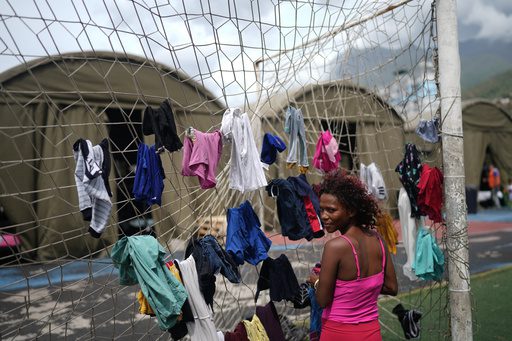
Venezuelan officials concede a staggering blow: the back-to-back earthquakes didn’t just injure. They claimed 3,889 lives. And they flattened 190 buildings while damaging 856 others. Acting President Delcy Rodríguez’s government figures suggest about 18,000 folks have no place to call home. They’re camping out—literally—in schools, on sidewalks, in parks, and plazas. The United Nations is pleading for roughly $300 million just to help 1.3 million people in urgent need. But how much of that truly reaches the ground, one might wonder, given the long shadows of past political maneuvering?
Yet, amidst this wreckage, a strange collaboration has bloomed. Mobile kitchens, pop-up clinics, even field hospitals now dot public spaces in La Guaira, the state hardest hit. Much of this on-the-ground assistance comes from local groups, many of them partnering with larger international organizations—like Paluz teaming up with the International Rescue Committee. These are the same groups that just a few years ago found themselves under fire. While Rodríguez served as vice president to former President Nicolás Maduro, organizations were repeatedly accused of anti-government activities and the U.N. local human rights office expelled. Tom Fletcher, the U.N. relief chief, observing this uneasy truce, noted, When you have a crisis of this magnitude, people put the politics to one side and are able to focus on saving as many lives as possible, and that’s what I’m seeing so far in this response. It’s an astute observation, but also a sober one: such unity often only surfaces when conditions are absolutely dire.
It’s not just the displaced citizens suffering; the professional classes are too. Armando Denegri, representing the Pan-American Health Organization in Venezuela, revealed that 50% of the health professionals in La Guaira were directly affected by the earthquakes. Some disappeared, some died, others were severely affected by the crisis, impacting their families. It’s a gut punch for an already strained healthcare system, a cascading failure affecting everyone. The United Nations Office for Disaster Risk Reduction (UNDRR) pegs the direct physical damage to housing and infrastructure at an eye-watering $37 billion. That’s an impossible sum for a nation already deep in economic quicksand.
📄 POLICY WIRE WHITEPAPER PUBLISHED: PAKISTAN'S NATIONAL SECURITY POLICY PRIORITIES
👉 READ BY CLICKING HEREWhat This Means
This Venezuelan crisis isn’t just about geology; it’s a stark lesson in political pragmatism and the limits of state control. The government’s sudden embrace of NGOs—itself a reversal of years of deliberate policy—demonstrates how thoroughly incapacitated Caracas is, and how utterly unprepared its infrastructure was. This isn’t generosity; it’s raw necessity. For countries like Pakistan, which routinely contend with natural disasters like earthquakes and floods, or even those across the broader Muslim world dealing with internal conflicts and refugee crises, Venezuela’s predicament offers a chilling echo. The sheer scale of destruction, the compromised public health, and the sheer number of homeless underscore the indispensable role of a resilient civil society and unfettered humanitarian access. Where governments fail, aid organizations become the de facto architects of recovery. But their effectiveness, here as elsewhere, remains tied to shifting political winds—a delicate balance, to say the least.
The immediate political implication is clear: Delcy Rodríguez’s acting administration, by allowing these groups unprecedented freedom, acknowledges its own severe capacity gaps. This tacit admission, though not an endorsement of prior actions, could lay groundwork for a recalibrated relationship with international bodies, perhaps even opening channels for broader economic engagement. It signals a desperation that could—could, mind you—force a rethink of past isolationist policies. Or perhaps not. But for now, Venezuelan relief efforts rely on those previously shunned. Their very presence offers a bleak commentary on the nation’s prior policies, — and its future struggles. They’re just trying to save lives, as Tom Fletcher observed, but the underlying political implications are difficult to ignore. Much like an ailing batter still swings, sometimes you just need to keep playing for hope itself. And the long shadow of past conflicts often extends into moments of deepest crisis.